From December 1–11, the Ministry of Science and Technology (MoST) through the Vietnam Agency for Radiation and Nuclear Safety is coordinating with relevant ministries and agencies to host an Integrated Nuclear Infrastructure Review (INIR) Mission in Hanoi. The delegation consists of seven IAEA experts, three international specialists invited by the agency from the U.K., Brazil and Bulgaria, and one observer from Egypt.
    |
 |
|
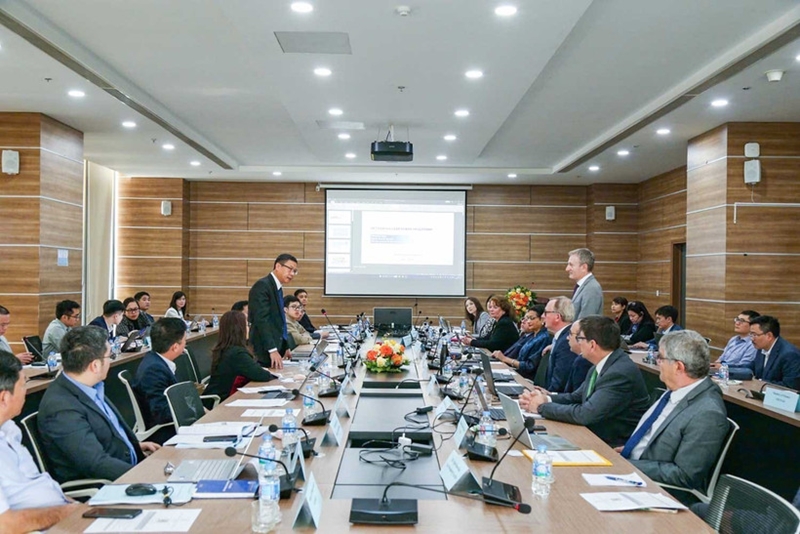
Deputy Minister of Science and Technology Le Xuan Dinh (standing, left) speaks at the working session with INIR Mission in Hanoi on December 1. |
The mission is meeting with representatives of the Ministry of Industry and Trade, Ministry of Finance, Ministry of Public Security, Ministry of National Defense, Ministry of Foreign Affairs, Ministry of Agriculture and Environment, Ministry of Education and Training, the Vietnam Electricity (EVN), the Vietnam National Industry - Energy Group (Petrovietnam), and the Khanh Hoa provincial People’s Committee.
Deputy Minister of Science and Technology Le Xuan Dinh said the timely support of the IAEA and the experience shared by international experts are of great significance as Vietnam works to develop its nuclear power infrastructure in line with international standards and IAEA guidelines.
As the coordinating agency for the program, the MoST will continue advancing nuclear infrastructure development in line with IAEA recommendations to meet the requirements of Vietnam’s first nuclear power project, he stressed. He added that the ministry will further support cooperation between Vietnam and the IAEA in promoting the peaceful uses of nuclear energy.
Eric Mathet, Head of the INIR Mission, said the review will mark an important milestone in Vietnam’s journey toward establishing a safe, secure and sustainable nuclear power program. The IAEA praised Vietnam’s efforts in preparing its self-evaluation report for the mission.
According to Mathet, the review team that is composed of highly experienced experts in all areas of nuclear infrastructure has thoroughly studied the report and maintained close contact with Vietnamese counterparts throughout the process to ensure accurate and objective assessment. The agency encourages open exchanges between the Vietnamese working groups and the INIR team to ensure the mission’s success.
Under IAEA guidelines, nuclear power infrastructure includes 19 key elements, ranging from physical infrastructure, site preparation and supporting facilities to legal frameworks, financial capacity and human resources. For newcomer countries like Vietnam, nuclear infrastructure development follows three phases - preparations for making a launch decision, for plant construction, and for plant operations.
This INIR Mission is assessing Vietnam’s readiness relative to Milestone 2. To prepare for the mission, Vietnam’s Nuclear Infrastructure Assessment Working Group completed and submitted its Self-Evaluation Report to the IAEA in October 2025.
Following the mission, the INIR team will submit a consolidated report to the Government of Vietnam, highlighting progress made, areas requiring further improvement, and key recommendations to help Vietnam develop a master plan for nuclear infrastructure.
The findings will support the effective, safe and secure implementation of the Ninh Thuan nuclear power project in line with IAEA and international standards.
Source: VNA