According to HSBC Global Investment Research, intra-Asian trade in AI-related goods, including semiconductors, electronic components and equipment supporting AI technologies, reached nearly 2 trillion USD in 2025, double the pre-COVID19-pandemic level. AI-related products now account for 35% of Asia’s total exports, up significantly from 19% a decade ago.
    |
 |
|
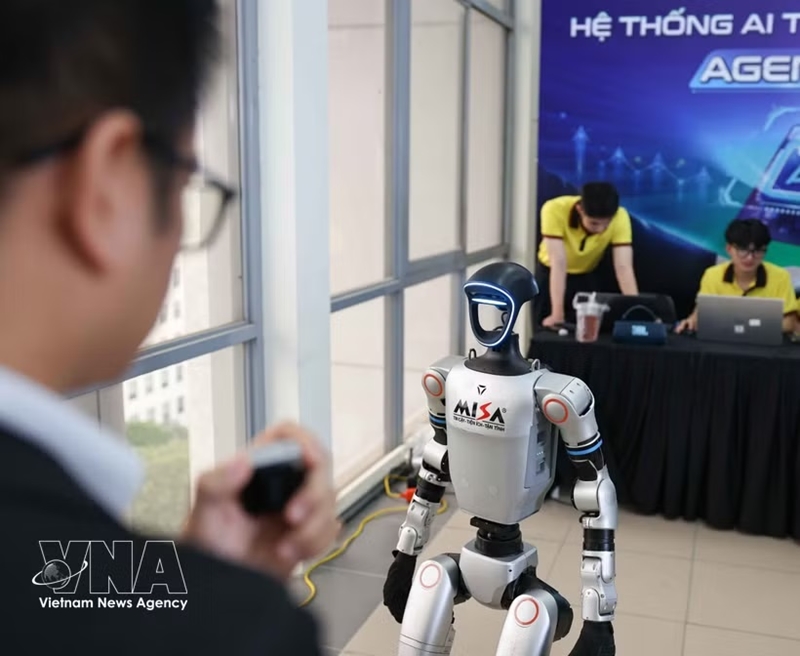
A product is showcased at the exhibition area during AI Day 2026. |
HSBC (Hongkong and Shanghai Banking Corporation Limited) identifies Vietnam as the economy that has recorded the fastest improvement in its position within the AI supply chain. The country’s share of global trade in AI-related equipment surged from 1.2% in 2015 to 12.4% in 2025, the strongest increase worldwide during the period.
Trade data from Vietnam’s key partners reflects this shift. In the first quarter of 2026, Taiwan (China) recorded its first quarterly trade deficit with Vietnam. During the three months ending in May, Taiwan’s imports from Vietnam jumped 173% year-on-year, driven largely by machinery, electrical equipment and household electrical appliances.
Meanwhile, exports of the Republic of Korea (RoK) to Vietnam posted the strongest growth among Southeast Asian markets, underscoring increasingly close production linkages between the two economies in electronics manufacturing and computer hardware, including equipment used for AI servers.
Tim Evans, CEO of HSBC Vietnam, said these developments demonstrate that Vietnam is gradually moving beyond its traditional role as a low-cost assembly base to become a more important node in regional supply chains.
He noted that Vietnam is importing more high-value components from the RoK and Taiwan (China), expanding domestic manufacturing capacity before exporting finished and semi-finished products to markets across Asia and other markets.
Speaking at the recent Vietnam–RoK Financial Cooperation Forum in Ho Chi Minh City, Lee Young Jick, head of the Korea-ASEAN Financial Cooperation Centre, described Vietnam as one of the region’s most promising growth performers, supported by stable macroeconomic fundamentals, including inflation, exports and the balance of payments.
According to Lee, global foreign direct investment (FDI) continues to shift toward ASEAN, particularly Vietnam, Indonesia, the Philippines and Malaysia. AI, semiconductors and digital platforms have become the most attractive investment sectors, contributing not only to economic growth and job creation but also to industrial upgrading and the development of new regional value chains.
Lee said Vietnam is increasingly being recognized as a new global manufacturing base, with strengths extending beyond traditional industries such as textiles and electronics to include precision engineering, smartphones, semiconductors and AI data centers. This transformation, he added, reflects the country's growing importance in international production networks and global value chains.
Experts attribute Vietnam’s progress to a combination of supportive government policies, including its semiconductor development strategy, and expanding investment by global technology companies in electronics manufacturing, semiconductor packaging and testing.
Vietnam is also investing heavily in human capital, aiming to train tens of thousands of semiconductor engineers by 2030 while identifying science, technology and digital transformation as new engines of economic growth.
Domestically, demand for AI applications is also expected to rise. Supported by its young population, strong digital adoption and expanding business ecosystem, Vietnam has the potential to become not only a leading AI hardware manufacturing hub but also a growing market for AI-enabled services.
Source: VNA