The program, running through August 1, is jointly organized by the Rencontres du Vietnam Association, ICISE and astronomers from the Vietnam Association for Cosmology and Astronomy. Participants come from Brazil, Croatia, France, Germany, India, Malaysia, the Philippines, Thailand and Vietnam.
    |
 |
|
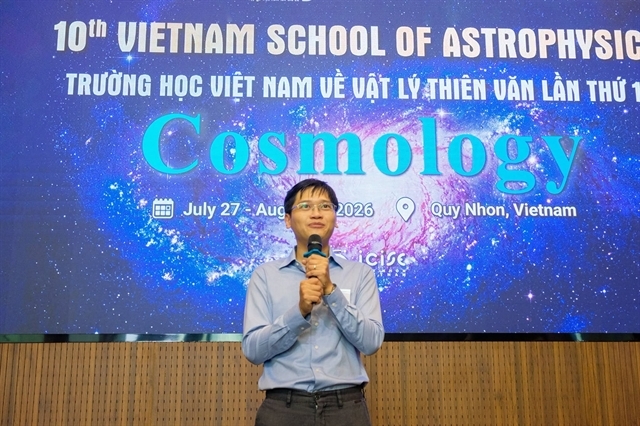
Dr. Nguyen Nhat Minh, the first Vietnamese recipient of the 2024 Buchalter Cosmology Prize, awarded by the American Astronomical Society, chairs VSOA 10. (Photo: vietnamnews.vn) |
According to the organizers, VSOA10 reinforces Vietnam’s growing role as a destination for international academic activities in fundamental science, providing an opportunity for early-career researchers to explore the latest advances in astrophysics and cosmology while expanding collaboration with the global scientific community.
This year’s lecturers include Professor Leander Thiele, Dr Otavio Alves, Dr Anamaria Hell and Dr Nguyen Nhat Minh, all affiliated with the Kavli Institute for the Physics and Mathematics of the Universe (Kavli IPMU) in Japan.
The event also marks the first time that Dr Nguyen Nhat Minh has served as the program’s lead organizer in his capacity as head of the Astrophysics and Cosmology Group at the Interdisciplinary Institute for Research in Science and Education (IFIRSE) under ICISE, a position he assumed in July 2026. He was previously the first Vietnamese scientist to receive the 2024 Buchalter Cosmology Prize from the American Astronomical Society, one of the field’s most prestigious awards for early-career researchers.
This year's program focuses on modern cosmology, examining the formation and evolution of the universe from the moments immediately following the Big Bang to the emergence of the large-scale structures observed today. The course also introduces advanced techniques for inferring cosmological parameters from increasingly precise observational datasets.
Organizers noted that cosmology has entered the era of big data, driven by rapid advances in measurements of the cosmic microwave background, galaxy clustering, weak gravitational lensing and other observations of the universe’s large-scale structure. These datasets are testing the standard cosmological model with unprecedented precision. At the same time, progress in numerical simulations, statistical inference, artificial intelligence and machine learning is opening new ways to connect theoretical models with observational evidence.
Held annually since 2013, the Vietnam School on Astrophysics was established by the Rencontres du Vietnam Association and ICISE to train, mentor and inspire young scientists pursuing astronomy and astrophysics. Over the past decade, it has developed into a respected academic forum, helping strengthen Vietnam’s scientific workforce, promote scholarly exchange and deepen collaboration between Vietnamese researchers and the international scientific community.
As astronomy becomes increasingly interdisciplinary, integrating particle physics, atomic physics, optics, plasma physics, chemistry and biology to explore the origin, structure and evolution of the universe, major questions such as the nature of dark matter, dark energy and the universe’s accelerating expansion continue to attract global scientific attention.
Advances in observational instruments and data-analysis techniques are creating new opportunities for discovery while enhancing Vietnam’s research capacity, international integration and the development of fundamental science.
Source: VNA