Reporting at the meeting on the approval of the total greenhouse gas emission quotas for the 2025–2026 period, Deputy Minister of Agriculture and Environment Le Cong Thanh said that the 2022–2024 period was heavily affected by the COVID-19 pandemic and post-COVID impacts, which disrupted production chains and resulted in very low production figures at many facilities. If data from this period were rigidly applied to set future quotas, enterprises could lack sufficient room for production and recovery.
    |
 |
|
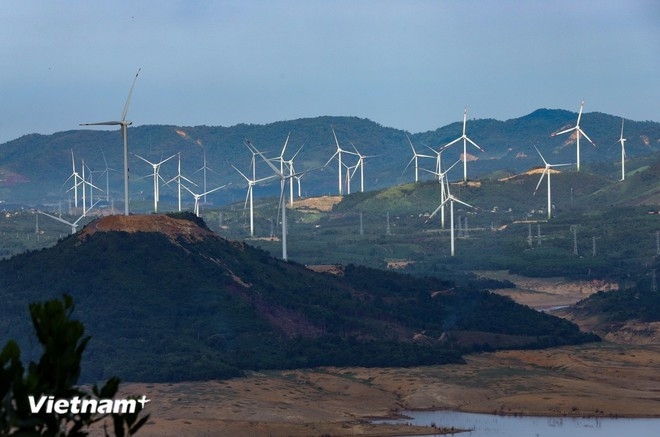
Enterprises express a desire for flexible internal quota coordination mechanisms, along with the early operation of a transparent carbon credit market. (Photo for illustration) |
Therefore, the ministry has worked with associations, corporations, and relevant ministries and sectors to develop a quota adjustment coefficient. This coefficient is based on three factors: growth targets, emission reduction targets, and the technological capacity of facilities.
Compared with the projected total emissions of plants in 2025–2026, the ministry proposed that the total quotas allocated to thermal power plants be 1.6–2% lower, to iron and steel (crude steel) production facilities 3.8–4.4% lower, and to cement (clinker) production facilities 4.0–4.5% lower.
Deputy Minister of Industry and Trade Nguyen Sinh Nhat Tan proposed the establishment of an independent measurement and verification mechanism to ensure the accuracy of emission data, noting that ministries can only appraise processes and cannot precisely verify figures self-reported by enterprises.
Representatives of energy, coal – mineral, cement, and building materials enterprises said that the implementation of emission quota allocation must strike a balance between emission reduction targets and the maintenance of growth momentum.
They proposed shifting the quota allocation method from an absolute approach to emission intensity per unit of product, in order to avoid constraining enterprises that are expanding production and to encourage investment in clean technologies. In addition, enterprises expressed a desire for flexible internal quota coordination mechanisms, along with the early operation of a transparent carbon credit market.
Concluding the meeting, Deputy PM Ha noted that this marks the first time Vietnam has implemented emission quota allocation. The determination of total quotas is based on data on the average output of each facility over the years 2022, 2023 and 2024.
Ha stressed the importance of piloting the allocation of greenhouse gas emission quotas as a crucial stepping stone for completing the management mechanism before nationwide mandatory application.
He said that the pilot phase is not limited to quota figures alone, but is a comprehensive process encompassing the refinement of methods for measurement, accounting, statistics, reporting, and verification, as well as legal and technical issues. These methods must be grounded in a solid scientific basis and aligned with international standards such as the United Nations Framework Convention on Climate Change (UNFCCC).
This is closely linked to Vietnam’s responsibilities and commitments under its Nationally Determined Contribution (NDC), affirmed the Deputy PM.
Regarding the mandatory implementation roadmap, the Deputy PM directed that the period from now until 2027 will focus on piloting in order to comprehensively finalize mechanisms and policies. From 2028, emission quota management will be officially and mandatorily implemented nationwide across all sectors and enterprises.
In particular, he called for the addition of sanctions against violations and data falsification, as well as economic instruments to encourage emission reduction.
Source: VNA