Cooperation between the Military Industry-Telecoms Group (Viettel) and Viet Nam Electricity (EVN) to ensure power supplies for mobile base stations has helped expand mobile coverage while enabling residents to access information and digital services, gradually narrowing development gaps between regions.
Under Politburo Resolution No.57-NQ/TW on breakthroughs in science and technology development, innovation, and national digital transformation, digital infrastructure serves as the foundation for national digital transformation, with people at its center.
    |
 |
|
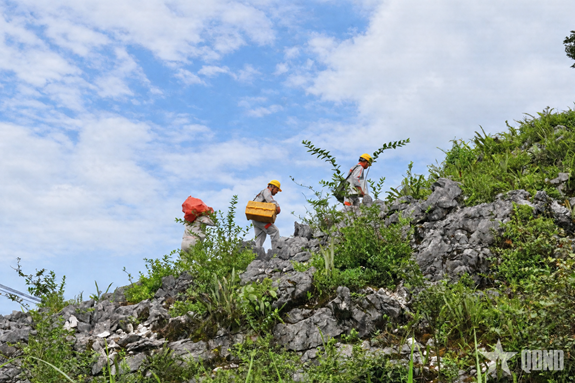
Viettel employees carry equipment across rugged rocky terrain to install a mobile base station in Cao Bang Province. |
To implement this policy, in March 2026, the Prime Minister assigned the Central Military Commission and the Ministry of National Defense to direct Viettel to eliminate mobile coverage gaps in remote and border areas within the year. This was one of the remaining major challenges after more than three decades of mobile network development in Viet Nam, as coverage gaps were scattered across mountainous and border areas with rugged terrain inaccessible to motor vehicles.
Viettel launched the program in March 2026. After more than seven months of implementation, 1,337 mobile base transceiver stations had brought high-speed connectivity to approximately 130,000 people in 788 villages and hamlets and 1,068 residential clusters, each with more than 50 residents.
Ensuring electricity supplies for mobile base transceiver stations (BTS) was one of the most urgent infrastructure requirements for the program. EVN worked closely with the General Department of Logistics and Technical Affairs and Viettel to survey existing conditions and develop power supply plans for 201 proposed BTS locations without access to the national power grid.
These locations were spread across 16 provinces and cities within the management areas of Northern Power Corporation (EVNNPC), Central Power Corporation (EVNCPC), and Southern Power Corporation (EVNSPC). Most were situated in mountainous, remote, and border areas, where rugged terrain and long distances from residential areas and existing power grids posed significant challenges. Some sites were deep inside protection forests or in isolated locations, making surveys, investment, and power supply arrangements particularly difficult.
EVN promptly instructed its power corporations and affiliated power companies to coordinate with local Viettel units to conduct field surveys. At each location, the teams assessed the existing power grid, the distance to available power sources, terrain conditions, and the feasibility of extending electricity supplies.
Taking a pro-active and responsible approach, the units also considered both immediate power requirements and the potential for long-term grid expansion, linking electricity provision for BTSs with plans to develop rural, mountainous, and island power networks.
Based on the survey results, EVN instructed its units to classify the 201 locations according to existing grid conditions, investment plans, and power supply feasibility. This provided a basis for agreeing with Viettel on implementation plans for each group of sites.
For locations near existing power grids, power companies helped identify connection points, arrange connection agreements, and provide technical guidance so Viettel could invest in transmission lines extending from those points to the stations.
At locations covered by local government-funded power supply projects, power companies coordinated to update implementation progress and support the completion of power supply plans once construction was finished.
For sites far from the grid, difficult to access, or awaiting investment projects, EVN worked with Viettel to select on-site power solutions to help maintain the mobile coverage rollout schedule.
Developing separate plans for each group of locations ensured feasibility and suitability for actual conditions while balancing the need to supply electricity for telecommunications operations with the efficiency of power grid investment.
|
|
 |
|
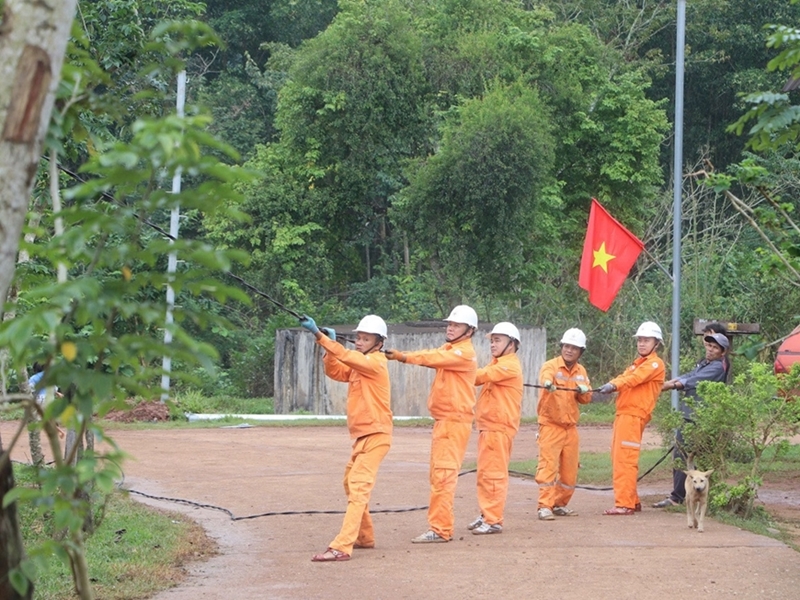
Power sector workers ensure electricity supplies for BTS stations. |
Through close coordination between EVN and Viettel, all 201 BTSs in remote and border areas were provided with power. Of these, 129 stations were connected to the national power grid, while 72 used generators and solar power systems.
At the November 20 conference reviewing the mobile coverage program for villages, hamlets, and residential clusters in remote and border areas, Lieutenant General Tao Duc Thang, Chairman and General Director of Viettel, said that the Government's, the Central Military Commission's and the Ministry of National Defense's decisive and close leadership and direction had been crucial to the program's success.
Viettel's leadership also expressed appreciation to ministries, agencies, EVN, and local authorities for their active cooperation in resolving difficulties related to mechanisms, procedures, power infrastructure, and other necessary conditions, helping ensure the program was completed on schedule.
The cooperation between EVN and Viettel reflects a shared commitment to implementing major Government tasks. It has helped residents in remote, isolated, and border areas gain better access to electricity, connectivity, information, and digital services in their daily lives. This represents a practical contribution to developing digital infrastructure and bringing the benefits of digital transformation to the people in line with Politburo Resolution No.57-NQ/TW.
Translated by Tran Hoai