He emphasized that this approach calls for a clear transition from expanding ties to improving their quality and depth, from participation to proactive leadership and agenda-setting, while bolstering national self-reliance and resilience and maintaining flexible, effective responses to an increasingly complex global landscape.
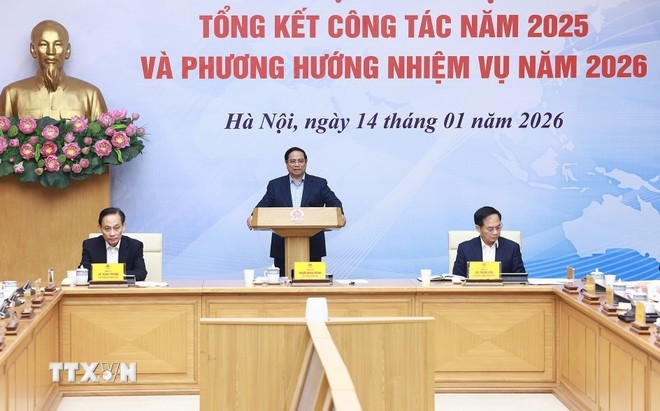
Addressing a national conference reviewing the National Steering Committee for International Integration's international integration work in 2025 and outlining tasks for 2026 on January 14, PM Pham Minh Chinh, who is also head of the committee, emphasized integration serves three key goals: enhancing Vietnam’s stature, capacity, position and credibility on the global stage; strengthening strategic proactiveness in international relations; and improving the material and spiritual well-being of the people.
    |
 |
|
Prime Minister Pham Minh Chinh chairs meeting of National Steering Committee for International Integration. |
He noted that mounting global and regional challenges in 2025 prompted the Politburo to issue Resolution No.59-NQ/TW on international integration in the new context, identifying integration as a central pillar among the country’s strategic development policies for the new era.
Reviewing the past year’s implementation of the resolution, the PM said international economic integration has helped elevate Vietnam’s role and standing, with economic diplomacy enabling the country to adapt swiftly to external shocks, overcome challenges, seize opportunities and translate strategic goals into tangible outcomes.
He called on ministries, sectors, agencies and localities to take a more proactive and effective approach to integration, guided by the principles of deepening substance, expanding scope and improving efficiency. He also urged renewed thinking and action, further refinement of the Party’s theoretical framework on foreign affairs and international integration, and the early development of a resolution outlining major foreign policy orientations of the 14th National Party Congress.
The PM stressed the need to enhance the quality of economic integration in support of strategic sectors, while advancing deeper, more substantive and effective political integration. He also highlighted the importance of closer coordination among foreign affairs, defense and security to form a “comprehensive forward defense line.”
Furthermore, Vietnam will accelerate integration in science and technology, innovation and digital transformation, while synchronously promoting cooperation in culture, society, tourism, environment, healthcare and education. Greater efforts will be made to conclude and effectively implement international commitments and agreements, and to strengthen the coordinating role of the committee in addressing institutional, policy and inter-sectoral challenges.
The conference heard that timely and sound leadership by the Party has helped shape a renewed mindset on international integration, contributing to record trade turnover of over 920 billion USD, a trade surplus exceeding 21 billion USD, and record disbursement of foreign direct investment estimated at 28–29 billion USD.
Vietnam’s integration in political, defense and security fields has been carried out in a coordinated and comprehensive manner, with the country playing an increasingly proactive and leading role at major international and regional forums such as the U.N., ASEAN, APEC, the WEF, BRICS expansion and the G20, earning broad support and positive recognition from partners.
Vietnam has also successfully initiated and hosted major international events, including the ASEAN Future Forum, the P4G Summit, the U.N. Vesak Day celebrations, the 2025 Autumn Economic Forum, and the opening ceremony for the signing of the U.N. Convention against Cybercrime in Hanoi.
Bilateral exchanges, participation in U.N. peacekeeping operations, engagement in multilateral defense forums and cooperation through mechanisms such as INTERPOL and ASEANPOL have further strengthened Vietnam’s international standing and helped mobilize resources for national safeguarding.
Integration in science and technology has played a pivotal role in tapping external knowledge and resources for growth and economic restructuring, while cooperation in culture, education, healthcare and other fields has expanded networks of shared interests with key partners, contributing to sustainable development, social welfare and human security.
Ministries, sectors and localities have become more proactive and innovative in advancing international integration, signing numerous international commitments and agreements that deliver tangible benefits. Border localities neighboring China, Laos and Cambodia have actively promoted border economies, logistics connectivity and cross-border trade, reinforcing peaceful and friendly borders while expanding strategic space for local socio-economic development.
The country’s capacity to negotiate and implement international commitments has continued to improve, providing momentum for domestic institutional, policy and legal reforms, with high-level foreign activities yielding a growing number of diverse agreements aligned with Vietnam’s strategic priorities, particularly in science, technology, innovation and sustainable development.
Source: VNA