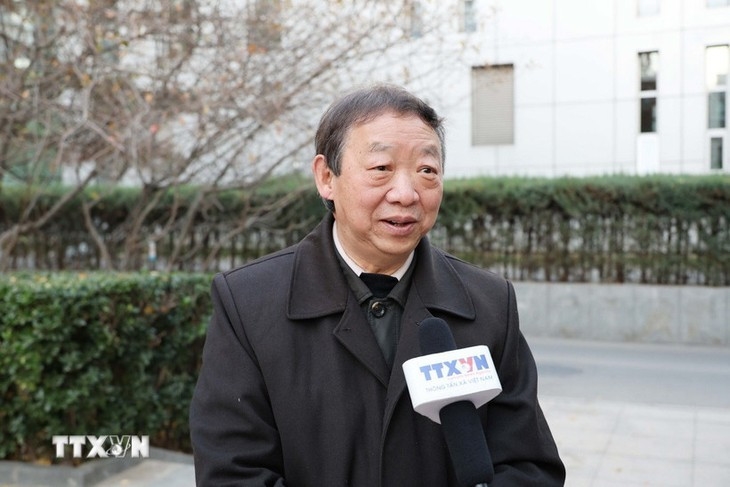
In an interview with Vietnam News Agency correspondents in Beijing ahead of the 14th National Party Congress, the Chinese scholar stated that in recent years, Vietnam’s external relations have become increasingly dynamic, with both the frequency and depth of exchanges and contacts with countries and international organisations continuously growing. Since 2015, and particularly in the more recent period, it has vigorously promoted high-level visits and engagements, while expanding bilateral and multilateral cooperation frameworks, clearly demonstrating the proactiveness of its senior leadership in consolidating and broadening foreign relations.
    |
 |
|
Zhu Chenming, Honorary Director of the institute of South and Southeast Asian studies under China’s Yunnan Academy of Social Sciences |
From a regional perspective, the expert held that Vietnam has clearly identified its foreign policy priorities with neighboring countries, maintaining and steadily developing relations with Laos, Cambodia and China. At the same time, the nation has demonstrated a flexible and balanced approach in its relations with major powers. At present, both China and the U.S. are comprehensive strategic partners of Vietnam.
Zhu assessed that this approach not only brings tangible economic, political and security benefits, but also enhances Vietnam’s position and role within a rapidly changing regional architecture.
Within the framework of the Association of Southeast Asian Nations (ASEAN), Vietnam’s standing has become increasingly evident. It not only takes an active part in the bloc’s cooperation mechanisms, but also pro-actively puts forward proposals and initiatives on regional issues. Vietnam's views and recommendations at ASEAN meetings have gained growing consensus and positive recognition from member states, reflecting the country’s increasingly prominent role within the Southeast Asian community.
At the global level, Vietnam’s relations with countries and international organizations continue to expand. It has been elected to participate in a number of important United Nations (U.N.) mechanisms, including the U.N. Human Rights Council.
The assumption of these roles demonstrates international recognition of Vietnam’s efforts and achievements in socio-economic development, as well as in the protection and promotion of human rights, Zhu said.
In particular, Vietnam’s continued receipt of broad support at the U.N. Human Rights Council is regarded as a significant achievement, helping to counter criticisms that the country lacks democracy or fails to safeguard human rights. The support of the majority of countries reflects an increasingly realistic, objective and balanced international assessment of the human rights situation in Vietnam, the expert noted.
The Chinese scholar affirmed that Vietnam’s foreign activities in recent years have produced many positive and noteworthy results. The country has consistently pursued a foreign policy of independence, self-reliance, multilateralization and diversification of international relations, while pro-actively advancing comprehensive and in-depth international integration. This is in line with the spirit of the Communist Party of Vietnam’s successive national congresses and contributes to creating a favorable international environment for the country’s development along a socialist-oriented path.
Source: VNA