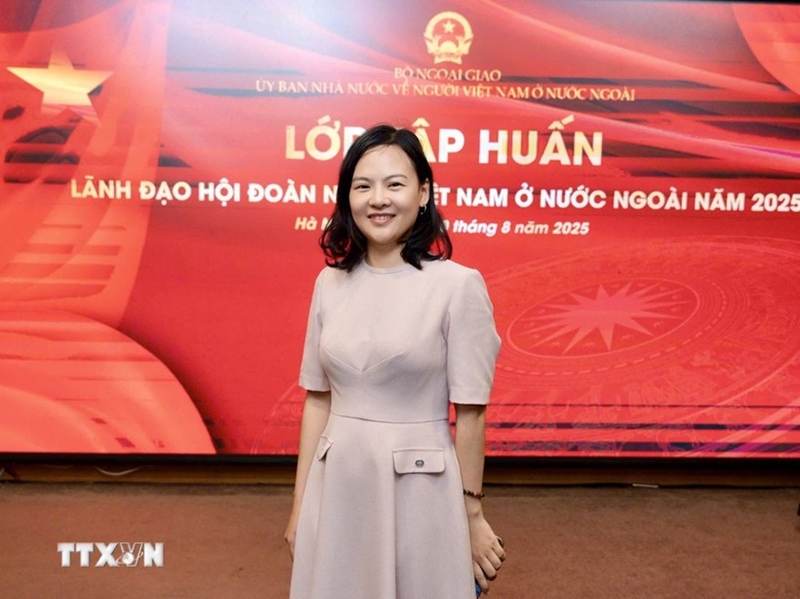
The remark was made by Tran Ha My, Director of the Vietnam Innovation Network in France (VINEU France) and President of the Vietnam Young Entrepreneurs Association in Europe (VYBE).
    |
 |
|
Tran Ha My, Director of VINEU France and President of VYBE |
She said that from global experience, countries and companies that stay competitive over the long term often focus heavily on science, technology, innovation, and high-value industries. Innovation hubs like Paris-Saclay in France have become new growth drivers through strong connections between the government, businesses, research centers, and universities. This approach shows that with a steady development strategy centered on knowledge, technology, and innovation, Vietnam could build new growth pillars and steadily lessen its reliance on labor-intensive sectors.
She also noted interest from French and European partners in Vietnam is clearly shifting to areas such as digital technologies, semiconductors, renewable energy, smart logistics and aerospace. This trend indicates that the orientations set out by the 14th National Party Congress are not only strategically sound but also aligned with global investment movements.
From the perspective of young entrepreneurs who are starting up, expanding their businesses, and making cross-border investments in France and Europe, My emphasized that the core issue lies not merely in incentives, but in institutional trust and the State’s capacity for long-term partnership and support.
First, the overseas Vietnamese young entrepreneur community is in great need of a stable, transparent, and long-term predictable policy environment. Unlike previous generations, many young entrepreneurs today operate in fields such as technology, innovation, digital finance, and the green economy - sectors that require long investment cycles, involve high risks, and depend heavily on the legal framework.
In practice, many Vietnamese start-ups and overseas Vietnamese technology enterprises in France in particular and Europe in general wish to relocate their research and development (R&D) centers or product testing activities to Vietnam, but remain concerned about frequent regulatory changes, especially in emerging areas such as data governance, artificial intelligence (AI), and financial technology (fintech).
Second, there is a need for truly effective one-stop mechanisms specifically designed for overseas Vietnamese businesses and investors, particularly the younger generation. In France, startup support models such as Station F and Bpifrance clearly demonstrate the State’s role in accompanying, advising, and reducing market entry costs for young enterprises. If Vietnam were to establish similar focal points that directly connect with the OV young entrepreneur community, flows of capital, knowledge, and innovative projects would be activated far more strongly.
Third, there is a need for a more open approach toward the private sector and the entrepreneurial spirit. The younger generation of entrepreneurs not only wishes to invest in Vietnam, but also aspires to participate in the policy-making process, experiment with new models, and contribute to addressing the nation’s major challenges. Recognizing the private sector and granting room for experimentation, especially for young enterprises, would create strong and sustainable momentum for innovation.
According to My, establishing preferential mechanisms specifically for overseas Vietnamese young entrepreneurs such as startup support programs, innovation-driven entrepreneurship initiatives, or co-investment funds accompanying the overseas Vietnamese community would help fully harness the entrepreneurial spirit and intellectual capital of the younger generation. Policies such as cross-border investment advisory focal points, regulatory “sandboxes” for technology enterprises (state-designed controlled testing mechanisms), or streamlined one-stop administrative procedures could help strengthen confidence and reduce market entry costs for young entrepreneurs seeking to invest in Vietnam.
She also noted that the Vietnamese community in France and Europe today enjoys a very unique advantage: a deep understanding of international business environments, research ecosystems, and global standards, coupled with a strong attachment to and desire to contribute to their homeland. Through their activities, VINEU France and VYBE frequently witness experts and entrepreneurs who are willing to share knowledge, connect partners, and even invest capital back in Vietnam, provided that appropriate mechanisms are in place.
To effectively mobilize these resources, she stressed that the 14th National Party Congress should provide clearer orientations for the development of concrete, long-term cooperation programs, in which overseas Vietnamese entrepreneurs and experts are involved from the very early stages of policy and project design. For example, in areas such as high-tech human resource training, innovation ecosystem development, or green transition, the OV community could play a bridging role between Vietnam and leading knowledge hubs in France and Europe.
Source: VNA