ICOS 2026 was held from January 5-7 in the central city of Da Nang, hosted by the Vietnam-Korea University of Information and Communication Technology (VKU) under the University of Da Nang, in coordination with the Republic of Korea’s Institute of Semiconductor Engineers (ISE). The conference brought together around 300 scientists, experts, lecturers, researchers and industry representatives in semiconductors, electronics and smart systems.
    |
 |
|
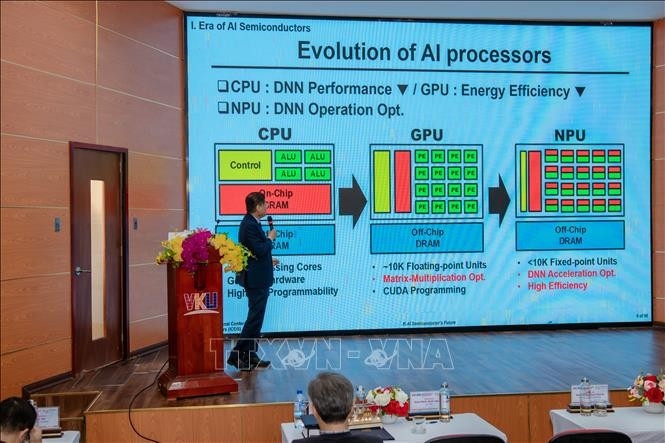
An expert speaks at the International Conference on Semiconductors (ICOS) 2026. |
This was the first international, specialized semiconductor conference held in central Vietnam and the first time the country hosted a large-scale academic forum dedicated exclusively to this sector. Organized in line with international standards, it featured plenary sessions, technical presentations and industry forums, reflecting major research trends shaping the semiconductor sector.
Professor Hanho Lee, Vice President for Technology at ISE, said ICOS is envisioned as an annual platform connecting academia and industry worldwide, enabling participants to share research breakthroughs and discuss technologies that will define the future of semiconductor systems. Hosting ICOS 2026 signals growing international recognition of Vietnam as a potential partner in the regional semiconductor ecosystem, rather than merely a market for technology adoption.
A notable focus of the conference was the convergence of semiconductors and AI, which is driving demand for specialized chips, heterogeneous integration and advanced packaging. ICOS 2026 featured 72 scientific reports by nearly 300 authors, covering topics from semiconductor materials and devices to AI hardware design, testing and interdisciplinary systems.
Associate Professor, Dr. Huynh Cong Phap, Rector of VKU and Co-Chair of the organizing board, noted that as semiconductor chips are increasingly viewed as a new form of infrastructure, the sector’s development directly affects innovation capacity, economic competitiveness and digital transformation. He added that human resources remain a key bottleneck, not only for Vietnam but globally, underscoring the need to place education and training at the center of semiconductor strategy.
The conference took place as Da Nang accelerates its strategy on science and technology development, innovation and digital transformation. A 2025 review of the city’s science and technology sector shows the coordinated implementation of the Politburo’s Resolution No. 57-NQ/TW on breakthroughs in science and technology, innovation and national digital transformation. Da Nang has also rolled out a range of strategic programs, including a dedicated scheme for the development of semiconductors and AI.
Source: VNA