Laying foundation for long-term development of petroleum sector
Commenting on the draft revised Petroleum Law, deputy Phan Thi Thuy Linh of Thanh Hoa province said the revision should go beyond addressing existing bottlenecks and instead deliver a breakthrough by shifting petroleum policy from offering investment incentives to an approach centred on global competitiveness.
She noted that the draft introduces a number of strong policy measures, including lower corporate income tax rates, reduced crude oil export taxes, and a higher cost recovery ceiling, describing these as significant steps forward.
    |
 |
|
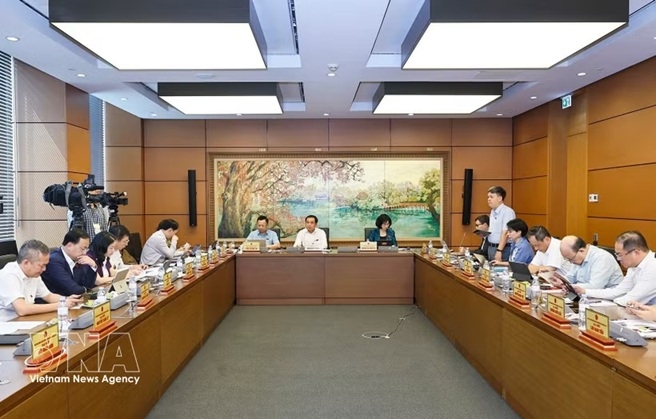
Hanoi's delegation of National Assembly deputies holds group discussions as part of 16th National Assembly's first extraordinary session on August 4. |
Linh proposed establishing a flexible and transparent investment framework, clearly defining the respective functions of the Vietnam National Industry–Energy Group (Petrovietnam), while identifying highly skilled human resources and indigenous technological capability as the long-term foundations of the oil and gas industry's development.
Deputy Vu Thi Lan Anh of Nghe An province called for a further review to ensure consistency between the draft revised Petroleum Law and related legislation, including the Law of the Sea of Vietnam, the Law on Marine and Island Natural Resources and Environment, the Electricity Law, the Law on Environmental Protection, tax laws, and the Law on State Budget.
Regarding decentralisation and the role of Petrovietnam, she noted that the draft grants the group greater authority in certain technical, approval and petroleum contract management functions, enabling the state-owned enterprise to operate more proactively in its leading role within the sector.
On investment incentives, Lan Anh supported maintaining preferential policies for small fields, marginal fields, fields with challenging geographical conditions, high costs or high risks, as well as enhanced recovery projects, in order to maximise resource utilisation and minimise waste.
Strengthening protection for those combating corruption, wastefulness, misconduct
Discussing the draft law amending and supplementing a number of articles of the Law on State Compensation Liability, lawmakers called for further refinement of provisions governing the assessment of damage and the expansion of state compensation liability to include cases where public authorities unlawfully delay or fail to perform their duties. They also stressed the need to ensure consistency across the legal system and strengthen the accountability of public authorities.
Deputy Do Duc Hong Ha of Hanoi described the shift from listing four categories of wrongful acts to adopting a broader provision with cross-references to the Law on Tax Administration as a major improvement.
He also praised the draft for promptly institutionalising the Party’s recent directives and conclusions on strengthening protection for individuals who dare to fight corruption, wastefulness and misconduct. However, he urged a thorough review to ensure consistency with the revised Law on Corruption Prevention and Control.
Sharing similar views, deputy Duong Khac Mai from Lam Dong province supported the proposal to establish state compensation liability where competent authorities fail to apply, delay the application of, or improperly apply protective measures, resulting in damage to whistleblowers or their relatives.
Mai recommended that the draft clearly define the legal scope of the term misconduct, identify who is entitled to protection, specify which authorities bear responsibility for providing protection, clarify when that responsibility arises, determine the protective measures to be applied, and establish the basis for determining causation. Without such clarity, he warned, the right to protection would exist in principle but prove difficult to enforce.
Source: VNA