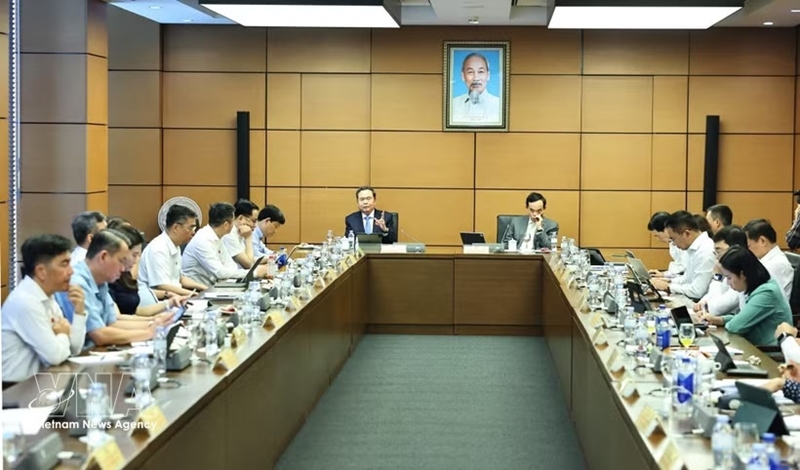
Speaking at a group discussion, N.A. President Tran Thanh Man praised the socio-economic development achievements recorded in the first nine months of 2026, with GDP growth reaching 9.01%, the highest level in 15 years.
    |
 |
|
National Assembly President Tran Thanh Man speaks at the discussion. |
Positive results have also been achieved in economy, culture, society, national defense and security, political system building and external relations.
Alongside these achievements, he called for an honest assessment of existing difficulties and shortcomings, urging deputies to contribute practical solutions to help fulfil the socio-economic development targets for 2026 and create a breakthrough in 2027.
Regarding key measures for the coming period, the top legislator stressed that macroeconomic stability is a prerequisite for growth.
Breakthroughs are also needed in mobilizing and efficiently using resources, particularly investment capital, alongside improved disbursement performance. The intensive growth model should be reformed, with priority given to strategic infrastructure, energy security, and strong advances in science and technology, innovation and digital transformation in 2027.
He stressed the need for continued institutional improvement and more effective implementation, with a focus on removing bottlenecks in land-related issues, accelerating administrative reform, improving the business environment and strengthening the capacity to implement policies and laws. Other priorities include human development and social welfare, improving education quality, addressing shortages of schools and textbooks, developing healthcare and social housing, implementing poverty reduction policies effectively, protecting the environment and proactively adapting to climate change.
On priorities for 2027, the N.A. leader highlighted the need to reform public investment management by linking funding to outputs and flexibly reallocating capital, prioritizing agencies and localities with strong implementation records.
He also called for decisive efforts to ensure that the Viet Nam International Financial Centre campuses in Ho Chi Minh City and Da Nang become fully operational, delivering tangible progress in implementing policies approved by the N.A.
To improve implementation effectiveness, he pointed to the need to tighten administrative discipline and order. From 2027, assessments of officials’ performance should be based on actual work results measured through key performance indicators, he added.
In science and technology, innovation and digital transformation, the top legislator called for a decisive shift towards tangible products and results, with clearly defined outputs for each agency and unit. He also highlighted the need to develop domestic industrial ecosystems and the marine economy.
Regarding economic management, he urged policymakers to assess the lagged effects of economic fluctuations in 2026 to develop more proactive and flexible management scenarios for 2027.
During the group discussion, deputies raised various issues concerning growth quality, science-technology development and digital transformation, and official assessment.
Deputy Nguyen Ngoc Son from Hai Phong city called for clarification of the reasons behind disparities in public investment disbursement among ministries, central agencies and localities so that appropriate remedial measures could be introduced.
Disbursement performance should be assessed against completed workloads, with stronger controls over construction quality, particularly when disbursement is accelerated towards the end of the year, he noted.
Regarding data connectivity and sharing, deputy Nguyen Thi Mai Thoa, also from Hai Phong, said stricter requirements to ensure consistency, synchronization and interoperability across the entire system from the design stage, particularly in macro-level management and the delegation of data governance to local authorities.
Existing shortcomings should also be addressed promptly to improve management and oversight effectiveness while saving manpower, time and costs in support of socio-economic development, she said.
Source: VNA