High economic growth alongside macroeconomic stability and inflation control
Reporting to the National Assembly on the major results of socio-economic development in 2026 and the proposed plan for 2027, Prime Minister Le Minh Hung said that ministries, sectors and localities had taken drastic measures, creating clear changes and achieving important and relatively comprehensive results. Fourteen of the 15 key socio-economic targets are expected to be met or exceeded.
    |
 |
|
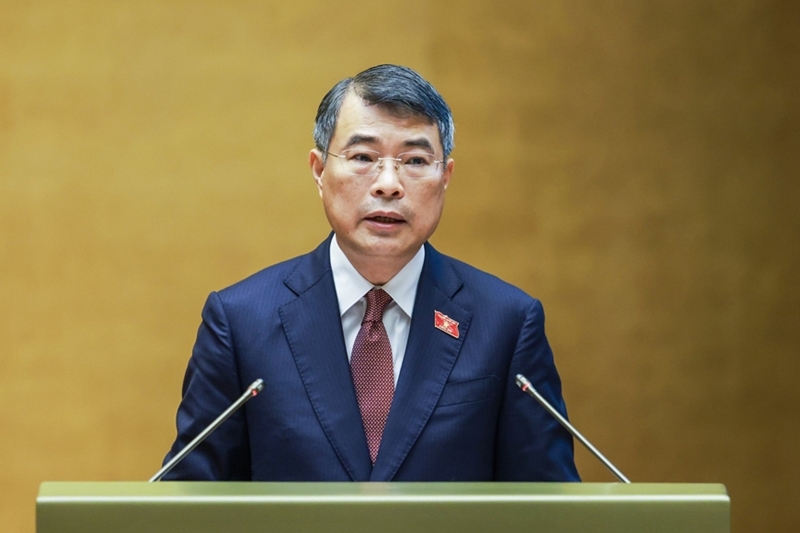
Prime Minister Le Minh Hung addresses the event. |
Economic growth remained high while macroeconomic stability was maintained, inflation was controlled and major balances were ensured. Growth in each quarter was higher than in the previous quarter, with GDP growing 9.95 percent in the third quarter and 9.01 percent in the first nine months, among the highest rates in the region and the world. Fiscal, monetary and other macroeconomic policies were managed proactively and flexibly. Average CPI growth in the first nine months was kept at 4.52 percent.
State budget revenue for the full year is estimated at VND 3.06 quadrillion, up 14 percent, while about VND 360 trillion in taxes and fees has been exempted, reduced or extended. By the end of 2026, public debt is estimated at 33-34 percent of GDP, government debt at 32-33 percent, national external debt at 28-29 percent, and the budget deficit at about 4.1 percent of GDP, all within safe limits. The exchange rate has remained stable, while liquidity in the credit system has improved. Through its policy measures, the State Bank of Viet Nam has directed credit institutions to uniformly reduce lending rates by 1.5-2 percent for production and business activities and priority sectors.
The legal system has continued to be improved, with a focus on removing bottlenecks, unlocking resources and creating a development-oriented institutional framework, while bringing about substantive changes in implementation in the spirit of Resolution No.66-NQ/TW. The restructuring and streamlining of the organizational apparatus have been carried out synchronously and effectively, with the two-tier local administration model gradually operating smoothly.
At the same time, Viet Nam has focused on developing a synchronous and modern strategic infrastructure network, promoting regional connectivity and opening up new development space. Efforts have also been intensified to address long-standing projects and unlock resources for development. By the end of September 2026, 4,688 projects had been resolved or had solutions identified, covering a total area of nearly 196,000 hectares and involving total investment of more than VND 3.2 quadrillion.
Cultural and social sectors have received greater attention, social welfare has been ensured and people's living standards have improved. The “500-day-and-night campaign to step up the search, collection and identification of martyrs’ remains” has been implemented resolutely and achieved significant results. The development of social and rental housing has also been accelerated, while workers' incomes have increased.
Striving to provide free textbooks from the 2028-2029 school year
According to the Prime Minister, education and training reform, human resources development, and the protection, care and improvement of people's health have been actively implemented in the spirit of Politburo Resolutions No.71-NQ/TW and No.72-NQ/TW.
Measures have been taken to reform and improve the quality of general education; reorganize the network of educational and training institutions at all levels while ensuring teaching and learning quality; gradually address localized teacher shortages; and review and improve textbook content.
The quality of education at all levels has gradually improved, while high-quality human resources training programs have been developed in priority fields. A single set of textbooks will be used nationwide from the 2026-2027 school year. Textbook content will continue to be reviewed and improved, with efforts made to provide free textbooks from the 2028-2029 school year. The Government is also working decisively to build, complete and put into use 108 multi-level boarding schools, while continuing to provide tuition exemptions and reductions.
In healthcare, the focus has begun shifting from treatment toward proactive disease prevention. In 2026, about 97 percent of the population is expected to receive regular health checkups and free screening, while 88.2 percent are expected to have electronic health records. Health insurance coverage is estimated to reach 95.5 percent.
National defense and security have been strengthened, firmly safeguarding independence, sovereignty, unity and territorial integrity while maintaining a peaceful and stable environment for development. Foreign affairs and international integration have also been comprehensively promoted.
Alongside these achievements, the Government's report pointed out that difficulties and challenges remain. Macroeconomic management and inflation control continue to face significant pressure, while the monetary market and exchange rate are under considerable external pressure. Given high demand for investment capital and inflationary pressures, deposit and lending rates remain elevated. The mobilization of social resources remains limited, while small and medium-sized enterprises continue to face difficulties in accessing land and credit. The structure of exports and imports is not yet sustainable. Greater efforts are also needed to promote science and technology, innovation and digital transformation to improve productivity, management capacity and the development model.
For the remaining months of 2026, the Government will strive to achieve the highest possible results for the targets set, particularly the goal of double-digit economic growth while maintaining macroeconomic stability and controlling inflation.
2027: Accelerating and creating new momentum
Regarding the 2027 socio-economic development plan, the Prime Minister emphasized that 2027 will be a year of acceleration, breakthroughs and creating momentum, positioning and resources to successfully implement the Resolution of the 14th National Party Congress.
The Government will strive for economic growth of at least 10 percent while maintaining macroeconomic stability, controlling inflation and ensuring major balances. It will lay the foundations for a new development model in which science and technology, innovation and digital transformation serve as key drivers; build and complete development institutions in a synchronous manner; effectively mobilize and use all resources; and create a favorable environment for the strong development of all economic sectors.
At the same time, Viet Nam will seek balanced development across the economic, cultural, social and environmental spheres, ensure social welfare, improve people's living standards, strengthen national defense and security, and enhance the effectiveness of foreign affairs and international integration.
Among the 45 socio-economic development targets set for 2027 are GDP growth of at least 10 percent, average CPI growth of around 4.5 percent, GDP per capita of USD 6,100, average social labor productivity growth of 8.6 percent, and a 1-1.5 percentage-point reduction in the multidimensional poverty rate.
Translated by Chung Anh