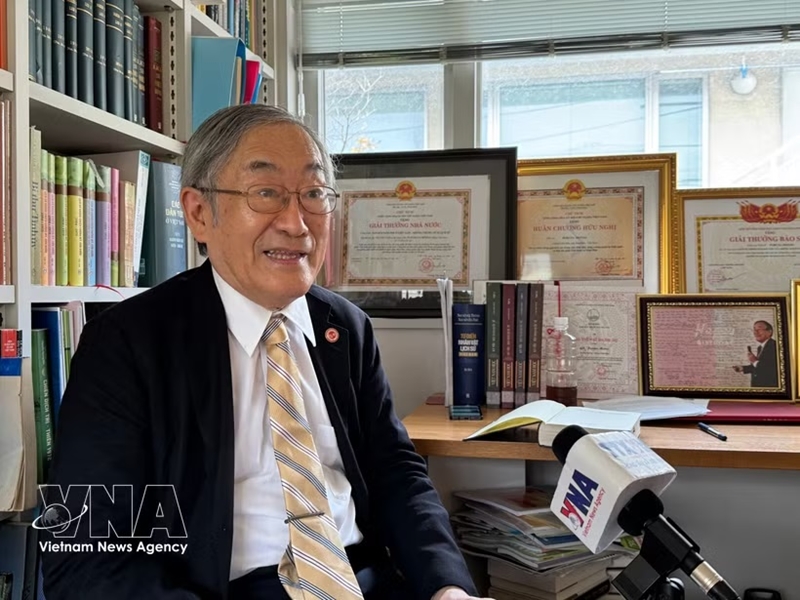
In an interview with Viet Nam News Agency correspondents in Japan, Furuta said this approach was evident during the leader’s visit to France in 1946.
As President of the Democratic Republic of Viet Nam (now the Socialist Republic of Viet Nam), Ho Chi Minh pursued efforts to ease tensions through both official and informal channels. In addition to official diplomatic negotiations with French government leaders, he met leaders of political parties and forces across the political spectrum, held press conferences, gave interviews, and engaged with the French public.
    |
 |
|
Prof. Furuta Motoo, former Rector of the Viet Nam–Japan University |
These activities helped French people better understand the Vietnamese people's aspirations for national independence and reunification, as well as the potential for cooperation between the two countries. Ho Chi Minh sought every possible avenue for peace while ensuring that no concessions undermined the core interest of national independence, Furuta noted.
Assessing the President's decision to continue negotiations and sign the September 14, 1946 modus vivendi after the Fontainebleau Conference failed to reach the expected outcome, Furuta said the move demonstrated his continued efforts to seek an agreement amid escalating provocations and acts of aggression by reactionary French colonial forces in Indochina against the Government of the Democratic Republic of Viet Nam.
According to the professor, the signing of the modus vivendi was a flexible political solution that helped prolong the valuable period of peace, allowing Viet Nam to continue building and consolidating its forces ahead of the nationwide resistance war. Although it failed to restrain hawkish colonial forces, the agreement helped deepen divisions within France over the Viet Nam issue, thereby serving the policy of making more friends and fewer enemies.
He noted that President Ho Chi Minh’s continued pursuit of peace until December 19, 1946 helped convince the Vietnamese people that every opportunity for a peaceful settlement had been exhausted. As a result, the decision to resist was not only driven by patriotism but also by the understanding that the country had no choice but to fight to defend its right to exist.
The spirit of “Quyet tu cho To quoc quyet sinh” (Determined to brave death for the survival of the Fatherland) was a continuation of those efforts to seek peace. When the possibility of a peaceful settlement was exhausted, the determination to defend independence became the driving force behind the people's decision to embark on the resistance war.
Looking back on the 1946–1954 resistance war, Furuta said President Ho Chi Minh’s diplomatic efforts, especially his visit to France, helped divide opposing forces, buy Viet Nam time to prepare for resistance and demonstrate its commitment to peace at home and abroad, despite failing to avert war.
These contributions formed part of the broader process leading to the Dien Bien Phu Victory and the 1954 Geneva Accords. The significance of the 1946 diplomacy therefore extended beyond the immediate negotiating results to the political and social foundations it helped build for the prolonged resistance war, he said.
According to Furuta, the consistent principle guiding the Vietnamese leader’s diplomacy was an unwavering commitment to national independence and reunification. Diplomacy was used to create favourable conditions for national defence and, when necessary, combined with military strength and the collective strength of the people.
This combination of steadfast principles and flexible tactics contributed to Viet Nam’s victory in the resistance war against French colonialism, he opined.
Source: VNA