The package of draft legislation under review features the draft Law on Cultural Industry Development, along with proposed revisions and supplements to several legal frameworks: the Law on Physical Training and Sports, the Law on Tourism, the Law on Libraries, the Law on Cinema, the Law on Cultural Heritage, and the Law on Advertising. Legislators additionally evaluated the Press Law, the Law on Legal Documents, and implementation outcomes tied to the N.A.’s Resolution 206/2025/QH15, designed to untangle institutional gridlock through special regulatory mechanisms.
    |
 |
|
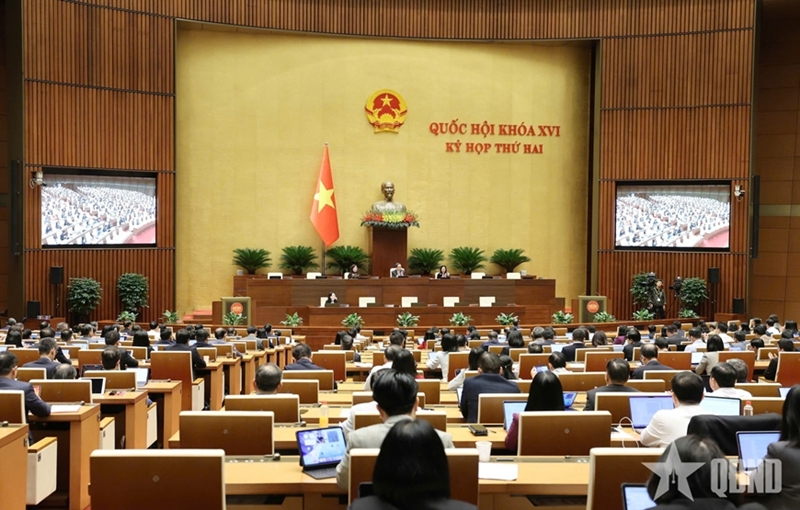
A view of the second session |
Alongside legislative matters, deputies assessed a comprehensive Government report examining the ramifications of administrative restructuring, expanded decentralization, delegation of power, and lingering statutory hurdles. The submission specifically focused on the investment policy for three critical expressway ventures: the Bao Ha - Tan Phong segment of the Bao Ha - Lai Chau expressway, the Quang Ngai - Kon Tum expressway, and the section of the Moc Chau - Son La - Dien Bien expressway traversing Son La province.
As outlined in the report, these infrastructure projects are vital to translating overarching Party guidelines on strategic transport links into reality while accommodating surging travel and logistics demand. At present, national highways connecting Son La, Lai Chau, and Quang Ngai with major economic hubs remain substandard, narrow, and highly susceptible to recurring seasonal landslides, which frequently disrupt supply chains and general transport. Developing modern expressways is projected to slash transit times by roughly 50 to 60 percent, effectively stimulating outside investment and capitalizing on local competitive advantages.
Beyond addressing transport bottlenecks, the planned routes are expected to complete the national expressway grid, close regional growth divides, and drive poverty reduction across disadvantaged mountainous communities. Son La currently records a 9.37 percent poverty rate (ranking fifth highest across Viet Nam), while Lai Chau stands at 17.24 percent (the second highest nationwide). Furthermore, the corridors fulfill a crucial role in safeguarding national defense, reinforcing border security, and enhancing disaster management and emergency relief operations.
Spanning a combined length of roughly 430.5 kilometers, the proposed works comprise 179.5 kilometers along Moc Chau - Son La - Dien Bien, 119 kilometers along Bao Ha - Lai Chau, and 132 kilometers along Quang Ngai - Kon Tum. Each route is engineered as a four-lane highway with design operating speeds ranging from 80 to 120 km/h. Construction will incorporate state-of-the-art engineering technology, comprehensive grade-separated interchanges, intelligent transportation systems (ITS), centralized traffic management centers, and designated highway rest stops.
The Government proposed financing all three initiatives via public capital, with aggregate preliminary outlays estimated at around 162.39 trillion VND (equivalent to 6.24 billion USD). Under the proposed roadmap, preparatory steps will run through 2026 and 2027, followed by the rollout of site clearance, compensation, resettlement, and physical works in 2027. The expressways are scheduled for basic completion by 2030, with full commercial commissioning expected from 2031 onward.
To expedite rollout schedules, the Government requested the application of exceptional policy mechanisms comparable to those previously approved by the NA for key national undertakings. These mechanisms encompass five core areas: authorization for investment policy adjustments, expedited compensation and resettlement frameworks, direct contractor appointment, procedural flexibility in spatial planning amendments, and the designated operation of dumping sites for solid construction waste.
Translated by Song Anh