PANO – Not only Vietnamese leaders, managers, experts but also all people can easily acknowledge the great achievements of the 30 years of reform (Doi Moi) as these achievements are reflected in the daily life, the images of cities and provinces and the development of the country. Unfortunately, a few people have not acknowledged, or pretended not to see, the national achievements over the past 30 years; as a result, they have made subjective and incorrect assessments on and blackened the overall picture of the Doi Moi process, which was initiated in 1986 and has been led ever since by the Party. In doing so, they have denied the truth that most Vietnamese people and international friends have recognized.
Doi Moi is an important phase of national history, which has marked the comprehensive growth of the Party, State and nation. Although the Party, in its leading the nation, and the State, in its ruling the country, have made a number of mistakes during the Doi Moi process, the Vietnamese people and other countries in the world have recognized the sound leadership of the Party, who has led the nation to successfully carry out Doi Moi and obtained historically significant achievements in country building and Fatherland defense over the past 30 years.
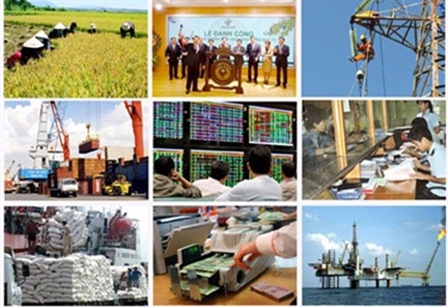 |
| (Photo for illustration) |
It is evident that Doi Moi has brought about enormous socio-economic development. Under the Party’s leadership, the Vietnamese economy has successfully overcome the financial and economic crises; from an underdeveloped nation, Vietnam has become a middle-income country and is accelerating industrialization, modernization and international integration; the socialist-oriented market economy has taken shape and is operating effectively; and lives of people have continuously been improved.
The abovementioned facts are only several examples of the socio-economic achievements that the Doi Moi process under the Party’s leadership has generated over the past 30 years. Yet some hostile people have still ignored these facts, predicting that the Vietnamese economy is “gloomy” and “at the peril of collapse,” and that Vietnam “sooner or later has to give up its economic development road of socialist-oriented market economy.”
It must be said that such prediction is not new. Five years ago, they gave a similar prediction. Facts have demonstrated that they have been completely wrong in the past. Official reports from the General Office of Statistics show that Vietnam’s GDP in 2015 grew at 6.68 percent from 2014, surpassing the planned target of 6.3 percent. This means the economy has strongly recovered.
Other official figures are also good references to the discussion. Vietnam’s average GDP growth between 1996 and 2015 was 7 percent per year, the highest GDP growth level second to only China. Furthermore, Vietnam’s average per capita income in 1990 was only US$ 98 or one fourth of that of a low-income country. The figure increased to US$ 400 in 2000, then to US$ 1,200 in 2010 or exceeding the level of a low-income country, and reached US$ 2,200 in 2015.
Reports from international organizations and the press have also highly valued the results of Doi Moi over the past three decades. The UK-based newspaper Financial Times reports that although the “darkness” is surrounding emerging economies, Vietnam is still an exception when it continues to grow relatively fast. According to figures released by the Capital Economics, since 2010 Vietnam has been one of the emerging economies that has successfully maintained a high economic growth pace in comparison to the average economic growth rate of the world. Meanwhile, results of a number of international research projects show that only Vietnam and 4 other European countries, namely Romania, Czech, Hungary and Poland, have benefited from the reduced oil prices. But when the GDP of Romania, Czech Republic and Hungary saw a modest growth rate during 2008-2014, the Vietnamese economy grew 40 percent in the period, the studies say.
Bloomberg also reports that Vietnam was one of a few emerging economies that obtained a good growth rate in 2015. This was more significant when the global economy in general still stumbled. According to the agency, the fall in prices of goods led many leading emerging economies into difficulty, while Vietnam and India surprisingly achieved positive growth rates. Its statistics show that Vietnam’s GDP growth rate was among the six emerging economies with the highest growth rate.
Citing a report of Moody’s Investors Service, CNBC highlights Vietnam as a success story and the best destination for international investors. With the same view, Alex Wolf with Standard Life recommends international businesses to invest and do business in Vietnam due to two reasons: the Vietnamese economy has really recovered, and Vietnam’s export market share is on the rise.
Meanwhile, figures of the FDI Markets of the Financial Times show that FDI in Vietnam continues to go up while other emerging markets are seeing a big fall. What is more, HSBC has recently released the report “Vietnam’s Economic Prospects 2016” saying that fast growth and low inflation have helped Vietnam attract large foreign capital sources.
In its report “The Global Economic Prospects”, WB notes that Vietnam as a future TPP member will have a big opportunity for its socio-economic development.
In a report on the application of mobile devices in the region, the US Progressive Policy Institute has ranked Vietnam the first in Southeast Asia. It points out that Vietnam has had nearly 29,000 high-quality workers who could contribute significantly to the knowledge economy.
Despite the optimistic views on the Vietnamese economy of international institutions, some hostile forces still exaggerate the shortcomings of the Vietnamese economy. In so doing, they post articles on the internet, criticizing Vietnam’s public debt and governmental overspending in an unconstructive manner. It must be said that their arguments are weak and their information is either distorted, fake or false. They irrationally claim, “Vietnam’s public debt is the highest in the world,” “Vietnam is about to go bankrupt” and so on.
Obviously, they are not telling the truth. In a recent National Assembly hearing, Prime Minister Nguyen Tan Dung stated, “The State Budget failed to have covered all national expenses as the demand for public spending has continuously increased, so the Government’s budget deficit has been high over the past few years [4.4% in 2011; 5.4% in 2012; 6.6% in 2013; 5.3% in 2014; and 5% in 2015]. As of December 31st, 2015, Vietnam’s total public debt accounted for 61.3% of the GDP, the Government’s debt was 48.9% of the GDP and foreign debt represented 41.5%. The debt was generally under the control of the economy, according to international financial rating institutions.”
Although Vietnam’s public debt has been at a safe level, the National Assembly has still asked the Government to reduce public spending in the coming years. For its part, the Government has planned to keep the budget deficit under 5% of the GDP, and control the public debt under 65% of the GDP, Government’s debt under 55% of the GDP and foreign debt under 50% of GDP, in the 2016-2020 period. To meet this end, the Government asks all branches and localities to carry out groups of comprehensive measures, particularly untying the knots for production and business activities and gearing up the economy in order to increase the revenue of the State Budget and reduce the pressure on the Government’s spending on social welfare. What is more, the Government will restructure all public debts and public spending; improve the effectiveness of the use of foreign loans and the management of projects involving foreign loans; review all State Budget and projects with foreign loans across the country and rule out the ineffective ones; and scrutinize sectors’ and localities’ borrowing foreign loans.
To conclude, those who experienced life in Vietnam before Doi Moi can easily recognize the miraculous change. The country has now become a major food exporter in the world from its constant lack of food before Doi Moi. In fact, Doi Moi has changed the face of all Vietnamese cities and rural areas. Modern infrastructural projects and tall buildings have sprouted in cities while public facilities, concrete roads and residential homes have continuously been built in the countryside. The overall picture of the country has been brightened up in the past 30 years, but the entire country still keeps moving forward.
With these proud achievements, the Vietnamese people are happily welcoming the 12th National Party Congress, and hoping that the Party will keep successfully steering the ship of Vietnam to new and greater achievements. In this spirit, few care about woven stories and hostile views on Vietnam of some political dissidents and opportunists.
Written by Do Phu Tho
Translated by Thu Nguyen