Tran Thi Chang, President of the Malaysia – Vietnam Friendship Association, said the orientations adopted by the Congress carry significance for Vietnam and provide a solid cornerstone for deepening the country's international cooperation and integration.
    |
 |
|
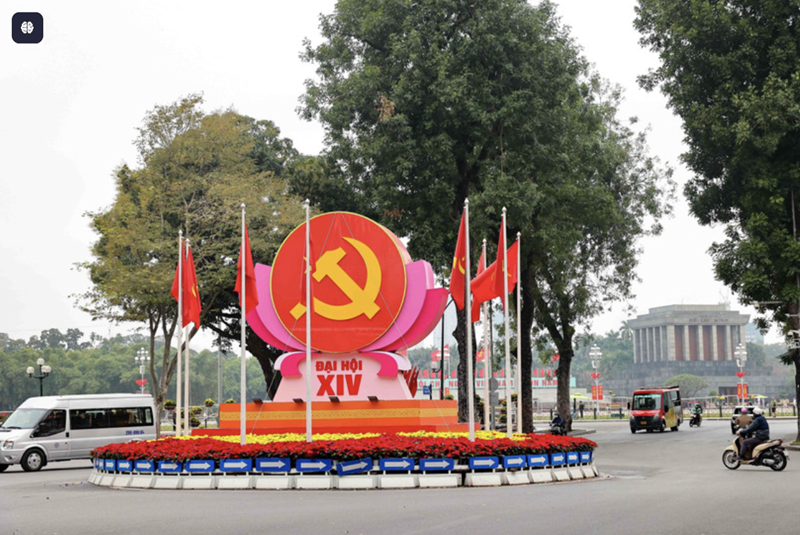
The emblem, Party flag and national flag are prominently displayed at the Dien Bien Phu – Doc Lap – Chu Van An intersection in Hanoi to welcome the 14th National Congress of the Communist Party of Vietnam. |
She expressed confidence that the CPV, under the leadership of General Secretary To Lam, will continue to steer the nation towards strong and sustainable development, realizing the 2045 goals and further promoting Vietnam’s position on the global stage.
Pham Tran Tieu My, a master’s student at Northern University of Malaysia, said the Congress clearly identified the major issues of the new era through a comprehensive, objective and forward-looking approach.
She noted that the strong focus on human resources development, educational reform and international integration opens up opportunities for the younger generation, including Vietnamese students abroad, to contribute their knowledge and experience to national development. The widespread attention and expectations surrounding the Congress, both at home and overseas, have further reinforced confidence in Vietnam’s political stability and sustainable development.
Le Thuong, Chairwoman of the Vietnamese People Association in Japan's Kansai region, said the Congress reaffirmed a strategic vision for sustainable and self-reliant national development that ensures harmony between economic growth and cultural and human development. She highlighted the emphasis placed on culture as the spiritual foundation of society, as well as the call to promote Vietnam’s cultural soft power amid intensive integration into the world.
For OVs, she noted, these orientations have met expectations, particularly the focus on preserving and popularizing the Vietnamese language as a core element in safeguarding national identity and maintaining long-term ties with the homeland.
Speaking to the Vietnam News Agency after the Congress concluded, Xu Liping, Director of the Centre for Southeast Asian Studies at the Chinese Academy of Social Sciences, said the newly elected leadership demonstrates continuity, renewal and determination, with sufficient capacity to lead Vietnam towards achieving its two centenary goals.
He noted that the Congress documents effectively combine theory and practice in building socialism in Vietnam, while outlining a unified yet flexible action plan linking immediate tasks with long-term vision.
The Congress’s earlier-than-expected conclusion, he added, reflected a high level of consensus and substantive deliberation.
Emeritus Professor Carl Thayer of the Australian Defense Force Academy at the University of New South Wales said the Congress outcomes clearly signal the beginning of a new era for Vietnam, marked by a shift from management to implementation and concrete results, including higher national stature and incomes.
Despite rapid and unpredictable global changes, he observed that Vietnam’s overall development direction has remained consistent over the past years.
With Vietnam’s commitments to global issues and the foreign policy and international integration orientations outlined at the Congress, the scholar expressed strong expectations for the country’s role in regional and international architectures in the years ahead. He noted that Vietnam is widely regarded as a representative voice of developing countries, or the Global South, owing to its independent, self-reliant, non-aligned foreign policy and active engagement in multilateral forums—factors that continue to earn the country international respect.
Meanwhile, Prof. George Toloraya, Director of the Asian Strategy Centre at the Institute of Economics of the Russian Academy of Sciences, emphasized that the 14th National Party Congress marks the beginning of a “new era—that of the Vietnamese nation’s rise”, one that will elevate Vietnam to a new qualitative level of development.
Source: VNA