More than half a century later, as the last surviving witnesses enter the advanced age, every story they tell may become a crucial clue in the search to bring home the soldiers who still lie beneath the soil of Mai Xa.
Memories of those who buried their comrades
In the memory of Senior Colonel Tran Van Tha, former head of Battalion 47 under Regiment 270, Mai Xa village was where he and his comrades welcomed the Lunar New Year's Eve amidst the flames of war. On that final night of the year, they still had “Banh tet” (cylindrical sticky rice cake), a little meat, and hot tea, but instead of festive firecrackers, the sounds of artillery shells and bombs rained down without pause.
He still remembers Mother Nay, a woman from Mai Xa who insisted the soldiers dismantle her house to build an underground kitchen. She not only sheltered revolutionary troops, but also showed them concealed positions along the ferry landing where they could move close to the river and use B41 and DKZ rocket launchers to strike enemy vessels at close range. From those positions, numerous enemy supply boats were destroyed.
    |
 |
|
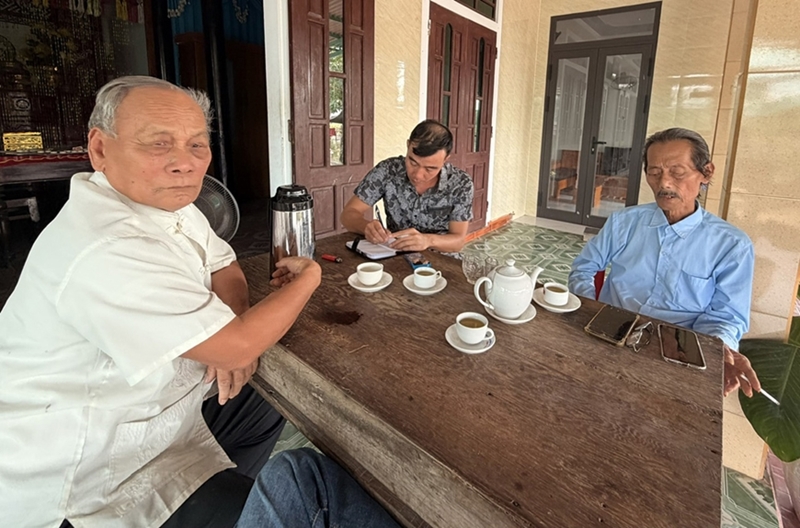
Truong Quang Chuong (left) and Bui Van Thanh, witnesses from Mai Xa hamlet |
Mai Xa and nearby Lam Xuan were also where Col. Tha and his comrades buried two correspondents from the People's Army Newspaper, Le Dinh Du and Nguyen Ngoc Nhu, who had been killed in action. After retiring, Sr. Col. Tran Van Tha returned to the former battlefield many times and recovered the remains of numerous fallen comrades, including those of the two military journalists.
One of Mai Xa's veterans, Truong Quang Chuong, joined the revolution at the age of 21. Now in his eighties, he enjoys life with his children and grandchildren while remaining remarkably sharp. Every morning, Chuong and Bui Van Thanh, widely regarded as the village's living historian, sit together over green tea, looking across fields that were once fierce battlefields.
Chuong served in Quang Tri's local armed forces before becoming head of the Hai Truong commune militia in the former Hai Lang district. He later worked for the district military command until retirement.
Reflecting on his years of service, Chuong recalled witnessing countless comrades wounded, captured, or killed. The battlefields of Hai Lam, Hai Truong, and Dien Sanh, once known as "meat grinders," remain etched in his memory. In 1971 alone, three comrades from the former Vinh Phu province, Hai Phong, and Hanoi were killed there. More than 50 years later, their remains have yet been found.
After many battles, surviving troops were forced to withdraw, leaving no opportunity to bury the fallen or mark their graves. Chuong particularly remembered two comrades known as Ry from Hanoi and Sau from Hai Phong. Local villagers buried them without knowing their names or hometowns. Today, the search for them depends almost entirely on the memories preserved by local residents.
What has haunted Chuong for decades is not only the brutality of war, but also the heartbreaking memories of brothers having to bury one another on the battlefield. He recalled the case of brothers Nien and Canh from Cua in Cam Chinh commune (former Cam Lo district), where the younger brother buried his elder sibling after he was killed in combat. He also remembered cousins Chon and Hoc from the Trung Hai commune (former Gio Linh district), whose fate was equally tragic. The younger man quietly buried his fallen relative before continuing the fight.
Repeated bombardment erased nearly every trace of those graves. Today, the fallen remain missing, remembered only by those who survived.
Martyr's grave in village cemetery
Although Bui Van Thanh never fought in the war, one childhood memory has stayed with him for nearly six decades. On December 20, 1967, when he was 12 years old, he witnessed a fierce battle at his uncle's house.
A military unit fought a much larger enemy force from morning until afternoon while enemy helicopters poured in heavy fire and troops surrounded the village. Several soldiers took shelter beneath Thanh's uncle's house along with about 20 civilians.
Two soldiers were hidden beneath rice stored inside a large grain bin. Unable to find them, enemy troops opened fire indiscriminately, killing several civilians. As enemy soldiers approached the shelter, Thanh and his friend Truong Quang Bong burst into tears, unintentionally warning those in hiding. A hand emerged from the grain bin, signaling them to remain silent. Moments later, a grenade flew from the bin into the enemy ranks, killing six or seven.
|
|
 |
|
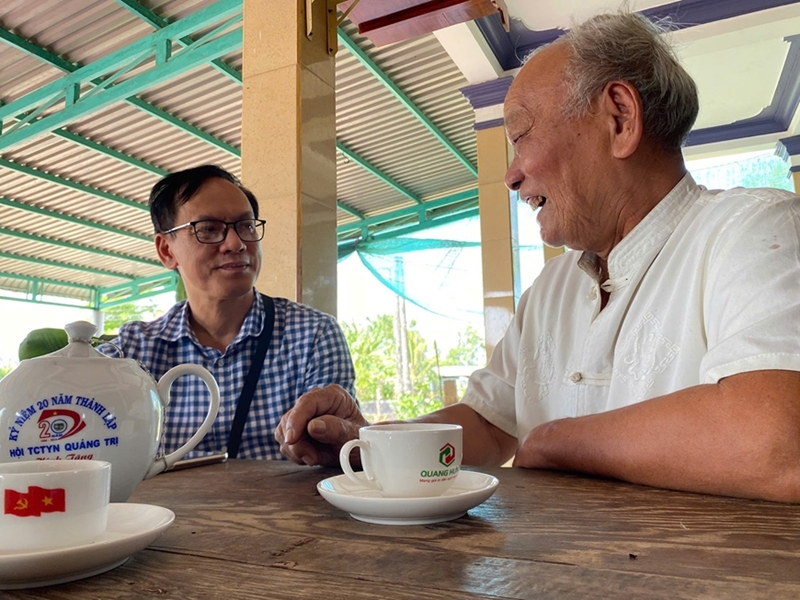
Truong Quang Chuong (right) provides information to the reporter. |
One soldier escaped through the rear exit. Furious, enemy troops surrounded the house and forced Thanh's uncle to serve as a human shield before ordering him to set fire to his own house. As flames and smoke engulfed the shelter, the remaining soldier was forced out through the back, where he was captured.
He was taken to a bamboo grove about 200 meters away. Thanh remembered hearing him shout, "Long live Ho Chi Minh!" before bursts of AR-15 gunfire ended his life.
After the enemy withdrew, villagers recovered the bodies of 10 soldiers, all believed to be from the North. They carefully collected the soldiers' belongings and identification before burying them on the edge of the village. Some identification notes had been sealed inside empty penicillin bottles. Between 1990 and 1995, the remains were exhumed and reinterred at the former Gio Mai Commune War Cemetery, now in Cua Viet commune, although some identifying information was lost.
Thanh also recalled another soldier whose identity has never been established. During the war against the French colonialists, after Quang Tri Front collapsed, a wounded soldier from Nam Dinh province (now Ninh Binh province) was hidden beneath a villager's house. When enemy forces discovered the shelter, he crawled away but was shot and killed beside a bamboo grove in the garden of Bui Thi Chau (in Mai Dong hamlet, former Gio Mai commune), now 90 years old.
Villagers secretly buried him and cared for his grave for decades. Nguyen Viet Vu, who has passed away, faithfully maintained the grave as if it belonged to a family member. Because the soldier's identity was never confirmed, his grave has not been officially recognized as that of an unidentified martyr and remains in the village cemetery.
Today, Bui Thi Chau, a former local guerrilla and the last surviving eyewitness, still remembers fragments of the soldier's story. If compared with military records and archival documents, her memories could provide an important lead in identifying him and finally returning him to his family after more than 70 years.
According to Sr. Col. Tran Van Tha, Battalion 47 of Regiment 270 held the Mai Xa - Cua Viet front for more than 100 consecutive days, from late January to early May 1968, repeatedly blocking the U.S. and its puppet regime’s sweep operations and supply routes.
During the opening days of the Tet Mau Than Offensive and Uprising in 1968 alone, the battalion destroyed numerous transport vessels, escort ships, tanks, armored vehicles, and aircraft, while suffering heavy casualties, with dozens killed and more than 70 wounded.
After a meeting, the battalion’s head Tran Van Tha called for comrades to remain in battle. More than 100 officers and soldiers chose to stay and defend positions along the Cua Viet River. Over the following months, the battalion continued ambushing enemy infantry, attacking river traffic, raiding the Cua Viet logistics depot, and repelling repeated large-scale offensives before completing its mission in early May 1968. Many, however, remained forever beneath the soil of Mai Xa and the surrounding region.
(to be continued)
By Tran Khac Tra
Translated by Tran Hoai