Compassion and responsibility
In Thien Nhan commune, Nghe An province, Tran Dinh Quy, severely-disabled by Agent Orange/dioxin, and his mother Nguyen Thi Cuc have finally moved into a newly-built house.
Quy’s body is covered with tumors, while his thin, contracted legs make walking extremely difficult. Persistent pain and unbearable itching often keep him awake throughout the night.
    |
 |
|
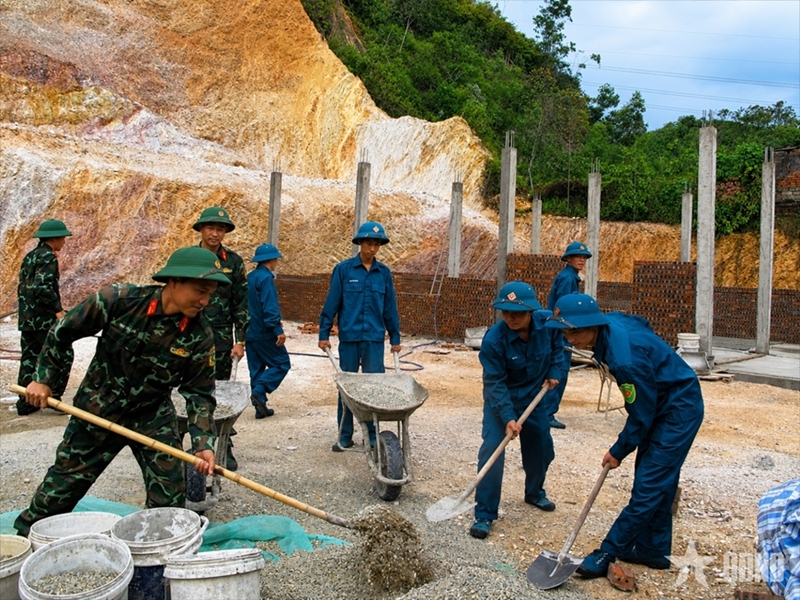
Personnel from the Military Command of Thien Nhan commune help Nguyen Thi Xoan build her new house. |
Since the death of her husband, war veteran Tran Ngoc Ty who fought on the Quang Tri battlefield, the lives of Mrs. Cuc and her son have relied solely on a few acres of farmland and Quy's Agent Orange/dioxin disability allowance. Therefore, building a new house was something Quy and his mother hardly ever dared to even think about.
Government funding, combined with contribution from relatives, neighbors, soldiers, and local militia force, made the new house possible. Tears welled in the mother's eyes as she watched her son quietly sitting in a bright, dry room. For her, it means security and peace of mind after years of hardship.
Nearby, the construction of a house for Nguyen Thi Xoan is underway. Xoan is a daughter of war veteran Nguyen Xuan Tam, who fought on the Quang Tri battlefield, served on international missions in Laos, and later took part in defending Vietnam's Northern border. Tam said his greatest concern has always been the future of his daughter who has been unable to hear or speak since childhood. The new house will give her a safe and stable place to live after her parents are gone.
Long-term commitment
|
|
 |
|
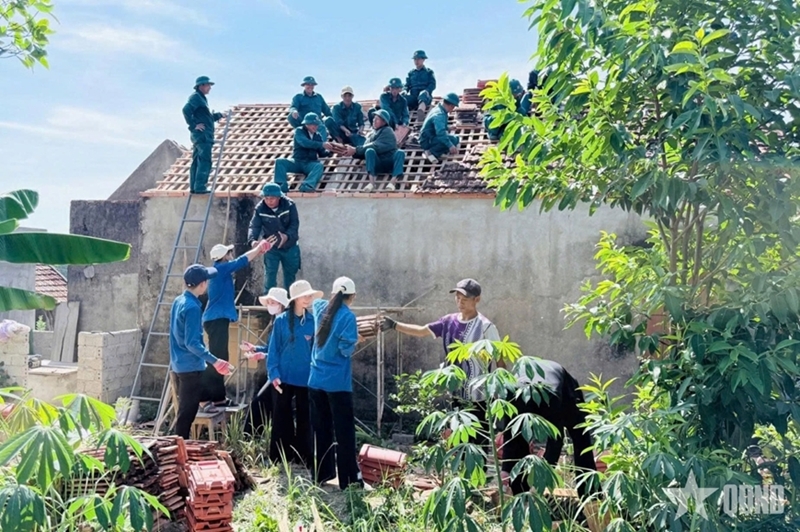
Soldiers, militia members, and Youth Union members assist Agent Orange/dioxin victims in housing construction. |
Military Region 4 is home to 54,542 Agent Orange/dioxin victims, including 32,524 veterans directly exposed to the chemical during the war and 22,018 of their children living with inherited health effects. Therefore, the housing support program carries profound humanitarian significance, reflecting the nation's gratitude and compassion toward families that continue to bear the hidden scars of war.
Under the program, every house must meet the “three-solid” construction standard (solid foundation, frame and walls, and roof). Financial support amounts to VND 60 million for each new house and VND 30 million for each repaired one. To ensure effective implementation of the program, local military units assist with site surveys, construction planning, and labor to ensure the durability and practicality of the houses.
Across Military Region 4, 769 houses are scheduled for construction or renovation, of which 361 are in Quang Tri province, 214 in Nghe An province, 82 in Hue city, 67 in Thanh Hoa province, and 45 in Ha Tinh province.
As of July 22, 231 houses, including 65 newly-built, have been completed. The local armed forces mobilized 4,171 personnel and contributed 12,651 workdays. The program aims to complete 50% to 70% of all projects by the end of 2026, finish the construction by June 2027, and conclude the program in July 2027 ahead of the 80th anniversary of Wounded Soldiers and Martyrs’ Day (July 27).
According to Major General Le Van Trung, Deputy Political Commissar of Military Region 4, housing support for national contributors and their family members, particularly the children of those exposed to Agent Orange/dioxin, is a long-term commitment, not just a task performed during a commemorative drive. Military Region 4 will continue working with local authorities and mobilizing social resources to provide more houses and help ease the enduring legacy of Agent Orange/dioxin.
Translated by Mai Huong