Historical records show that in May 1964, the Party Central Committee assigned the Party Committee of Phu Yen province (now Dak Lak province) to identify coastal sites for receiving weapons shipped from Northern Viet Nam. After surveys, Vung Ro Bay, now in Hoa Xuan commune, Dak Lak province, was selected in July 1964 for its deep, sheltered waters, rocky caves and secret routes linking it to revolutionary bases.
    |
 |
|
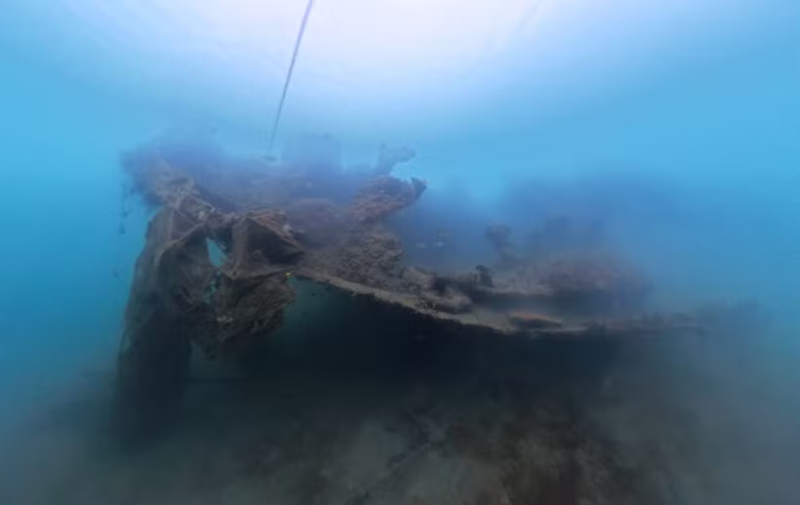
The unnumbered ship C143 lies on the seabed after more than six decades. |
From late 1964 to early 1965, Vung Ro received four unnumbered ship arrivals. Hero of the People’s Armed Forces and Lieutenant Colonel Ho Dac Thanh commanded Ship 41 on its first three successful voyages, transporting more than 200 tons of weapons to Southern battlefields.
Thanh recalled that the forces of the U.S.-puppet regime in the South established three coastal patrol lines to prevent weapons shipments. Every ship carrying supplies had to pass through all three.
Nguyen Van Chin, former head of the Inspection Board of the former Phu Yen provincial Party Committee, recently revisited the Vung Ro historical site, recalling his role in protecting revolutionary leaders, ships and porters who transported weapons ashore during 1964–1965. Small fishing boats carried the weapons to shore before local porters moved them into mountain shelters for onward delivery to the battlefield. These efforts reflected the close coordination, courage and resourcefulness of military personnel and civilians.
Recently, the management board of historical sites under the Dak Lak provincial Department of Culture, Sports and Tourism filmed and photographed the remains of unnumbered Ship C143 lying off Bai Chua in Vung Ro Bay. After more than six decades underwater, the vessel has suffered oxidation and mineral deposits and is covered with coral and marine organisms.
Historical records show that Ship C143, commanded by Captain Le Van Them, arrived at Vung Ro on the night of February 15, 1965, carrying around 60 tons of weapons. A winch failure delayed unloading, leaving the vessel unable to depart before daylight. Enemy aircraft spotted it the following morning, prompting an attack on the landing site. Facing encirclement, Vietnamese forces fought back and deliberately sank the ship to protect military secrets and its weapons cargo before withdrawing.
After the incident, Thanh commanded Ship 41 on another mission, carrying more than 60 tons of weapons to An Tho wharf, in present-day Quang Ngai. The voyage tested a new method of delivering supplies to open beaches in Military Region 5: weapons would be dropped into the sea near the shore for forces on land to retrieve.
However, waves damaged the ship’s propeller, leaving it unable to move, while two enemy warships waited nearby. Thanh recalled ordering the crew to swim ashore while he and the chief engineer remained behind to prepare explosives to scuttle the vessel. He set a 30-minute delay before the charges detonated and eventually reached shore safely. Only two-thirds of the weapons could be dropped into the sea, and two crew members sacrificed their lives. Under no circumstances could the ships be allowed to fall into enemy hands, along with their weapons and personnel.
Nguyen Le Vu, Deputy Director of the Dak Lak Department of Culture, Sports and Tourism, said the newly documented images of Ship C143 will support future exhibitions at the Vung Ro historical site, helping younger generations better understand the heroic battles and sacrifices associated with the Ho Chi Minh Trail at Sea.
More than six decades later, the stories and surviving evidence of these unnumbered ships continue to preserve the memory of a remarkable chapter in Viet Nam’s history, reminding generations today to cherish the values of independence and freedom.
Source: VNA