Affirming capabilities amidst challenging times
From successful emergency care and surgeries in Bentiu, South Sudan, to infrastructure projects that have transformed the landscape in Abyei, the contributions of Viet Nam’s peacekeeping force to the common mission are reflected in the effectiveness of their work and the trust and sentiment they have earned from local people.
    |
 |
|
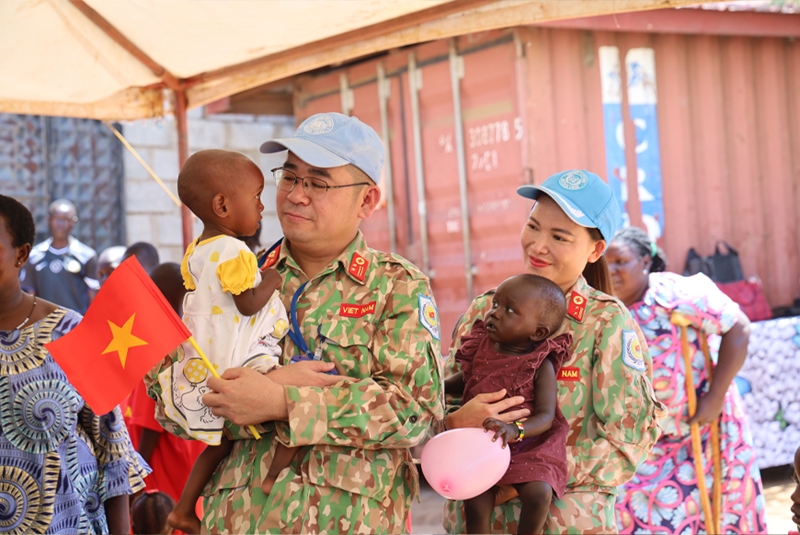
Members of the L2FH Rotation 7 with children in South Sudan (Photos provided by the Viet Nam Department of Peacekeeping Operations) |
U.N. peacekeeping operations are currently facing unprecedented challenges. Disagreements among major countries have affected political consensus, while funding shortfalls have forced missions to reduce personnel and scale back operations. Meanwhile, ethnic conflicts, disease outbreaks and the threat of drone attacks have made mission environments increasingly complex. These obstacles require U.N. blue-beret peacekeepers to strengthen their rapid deployment capabilities, technological proficiency and coordination under resource constraints.
Such challenges are also evident in areas where Vietnamese units are deployed, including South Sudan, the Central African Republic and Abyei. The Engineering Company Rotation 4, which has recently completed its mission and returned home, took over its duties at a time when the UNISFA was facing budgetary difficulties, with reductions in civilian personnel and contractors across various positions. As a result, the unit’s workload increased. Meanwhile, in Bentiu, the L2FH Rotation 7 and its predecessors have maintained medical examination, emergency care and treatment capabilities amidst harsh weather conditions, limited infrastructure and disease risks.
Major General Junhui Wu, Force Commander of the UNMISS, evaluated that since Viet Nam deployed its first L2FH to Bentiu in 2018, the country had become a valued contributor to the mission. Over seven rotations, Vietnamese military personnel serving in the hospital had consistently demonstrated professionalism, capability and a strong commitment to supporting peacekeeping forces and local communities.
In Abyei, the Engineering Company Rotation 4 completed 104 task orders involving the construction and repair of roads, bridges, airfields, helicopter landing sites and essential infrastructure. A notable achievement was the upgrading of the approximately 37-kilometer Abyei–Agok vital road in just 85 days, 35 days ahead of schedule. The project improved mobility for peacekeeping forces while facilitating travel and trade for local residents.
The Vietnamese engineering unit also demonstrated its response capabilities when armed conflict broke out in South Sudan in early March 2026, forcing thousands of people to flee to Abyei. Vietnamese engineers worked through the night to erect tents and transport heavy equipment to support the mission’s emergency response. They also arranged for clean water to be supplied at accommodation sites for displaced people.
|
|
 |
|
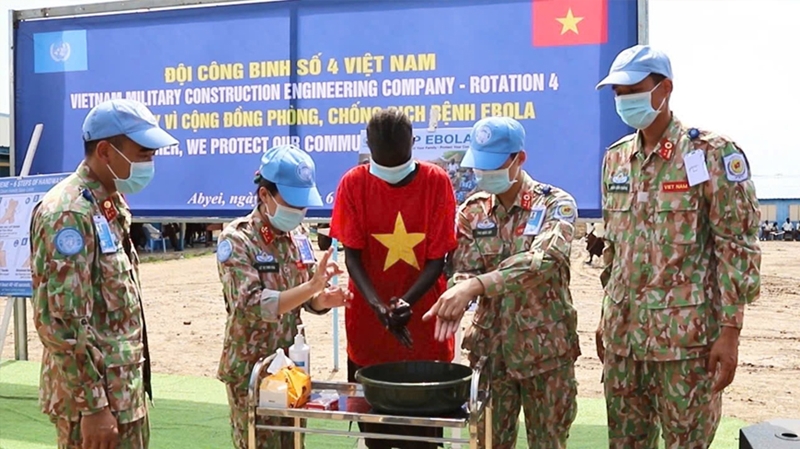
Medical personnel from the L1FH attached to the Engineering Company Rotation 4 provide guidance to local residents in Abyei on hygiene and disease prevention. (Photos provided by the Viet Nam Department of Peacekeeping Operations) |
Working together to build trust
Beyond their professional duties, Vietnamese units have devoted considerable effort to helping improve the living standards of local communities. The L2FH Rotation 7 conducted civil-military coordination activities involving humanitarian assistance and charitable support for local people. Amidst the threat of a cholera outbreak, the hospital provided hygiene and disease prevention guidance to 600 students at Sunshine Primary School and donated medical equipment and supplies for disease prevention and control.
Vice Principal of Sunshine Primary School Gabriel Galuak said the school had previously lacked even basic first-aid equipment. The hospital’s donation of a school medical cabinet, therefore, meant a great deal to the students, helping provide them with a safer learning environment.
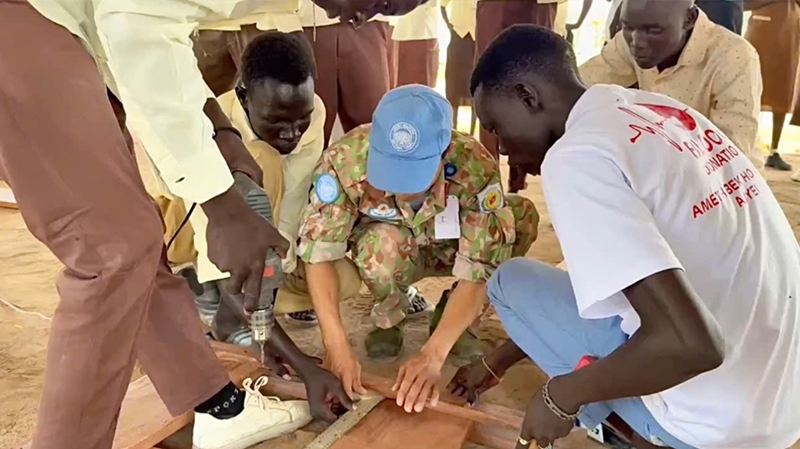
In Abyei, the Engineering Company Rotation 4 repaired school facilities, renovated schoolyards, built 60 sets of desks and chairs, and taught students with basic carpentry and mechanical skills. The unit also provided 10 hospital beds, supplied clean water and improved access roads to schools and hospitals, among other activities.
Abyei Administrative Area Minister of Education Karbimo Dut acknowledged that these efforts demonstrated the sense of responsibility and humanitarian values promoted by the U.N.
In less than eight months of deployment, the Engineering Company Rotation 4 received three letters of commendation from local authorities. UNISFA also nominated the unit for U.N. recognition for its outstanding achievements.
Beyond earning the trust and affection of local communities, the Vietnamese units’ people-centered activities have helped strengthen public confidence in UN blue-helmeted peacekeepers as a whole. According to Brigadier General K.C. Indu, Chief of the UNISFA Force Medical Branch, Vietnamese peacekeeping force has consistently inspired confidence in the mission through their professionalism and humanitarian spirit. They are building “bridges of trust,” helping enhance the U.N.’s credibility.
|
|
 |
|
Personnel of the Engineering Company Rotation 4 teach carpentry skills to students in Abyei. (Photos provided by the Viet Nam Department of Peacekeeping Operations) |
From the first two officers deployed in 2014 to the present, Viet Nam has sent nearly 1,400 personnel on deployments to U.N. peacekeeping operations, gradually affirming its capabilities, professional standards and sense of responsibility in this field.
In response to the evolving demands of U.N. peacekeeping, Viet Nam continues to prepare to expand the types of forces it contributes. In April 2026, the Ministry of National Defense successfully registered seven types of units in the U.N. Peacekeeping Capability Readiness System, with all seven recognized at Level 1. The Law on Participation in U.N. Peacekeeping Forces, which took effect on January 1, 2026, provides a legal foundation for the next stage of development.
Senior Lieutenant General Nguyen Truong Thang, Deputy Defense Minister, head of the Intersectoral Working Group and the MND’s Steering Committee on Viet Nam’s participation in U.N. peacekeeping operations, emphasized that expanding and preparing seven new types of peacekeeping units had strongly reaffirmed Viet Nam’s commitment to the international community to maintaining global peace, stability and sustainable development.
He called on relevant agencies and units to proactively prepare highly qualified personnel to enable Viet Nam to participate more extensively and effectively in U.N. peacekeeping operations in the coming years.
As resources for U.N. peacekeeping operations become increasingly constrained, improving the quality and readiness of Vietnamese peacekeeping force while actively preparing to expand the range of contributions has taken on greater practical significance. Viet Nam’s increasingly active and effective participation in U.N. peacekeeping operations demonstrates its enduring commitment to standing by the U.N. through concrete actions. With their professional capabilities, dedication, devotion and compassion, Vietnamese blue berets are helping sustain mission operations amid mounting challenges, protect local communities and build trust in regions still plagued by instability.
Translated by Quynh Oanh