In an interview with the Viet Nam News Agency ahead of the trip, Tam said that this is the second official visit to Viet Nam by a Vanuatu Prime Minister, following that of PM Joe Natuman in 2014.
He noted that although Viet Nam and Vanuatu are thousands of kilometers apart, the two countries share historical connections, close people-to-people ties and common interests.
    |
 |
|
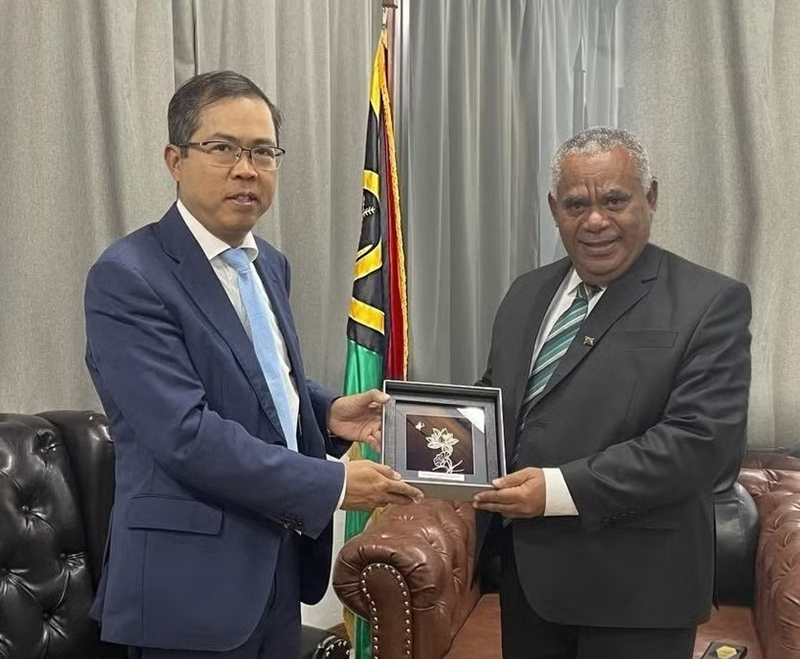
Vanuatu Prime Minister Jotham Napat (right) poses for a photo with Vietnamese Ambassador to Australia and Vanuatu Pham Hung Tam. |
Over more than four decades, bilateral friendship and cooperation have been nurtured on the basis of political trust, respect for independence, sovereignty and territorial integrity, peaceful settlement of differences and adherence to international law. Despite their different historical experiences, both peoples understand the value of independence and self-reliance and share aspirations for development.
A special bond between the two countries stemmed from the history of the Vietnamese community in Vanuatu. The first Vietnamese people arrived in the then New Hebrides, now Vanuatu, in the 1920s to work on plantations. According to some historical records, the community once accounted for nearly 10% of the country’s population.
Although most Vietnamese later returned home amid historical changes, the Vietnamese-origin community in Vanuatu today remains well integrated into local society, contributing to the country’s development while maintaining close ties with their homeland.
In political and diplomatic affairs, the two countries have maintained exchanges of delegations and contacts at various levels, and coordinated and supported each other at multilateral forums, including the United Nations, the Non-Aligned Movement and the International Organization of La Francophonie. They share many views on peace, security, international law and sustainable development.
During a personal visit to Viet Nam in January, PM Jotham Napat met and encouraged Vanuatu students studying at universities in Ho Chi Minh City, Khanh Hoa and Hanoi, and learned about agricultural production models in the Mekong Delta. This reflected the Vanuatu leadership’s interest in human resources development and learning from Viet Nam’s development experience.
Education and training have been a bright spot in bilateral cooperation, with around 160 Vanuatu students currently learning in Viet Nam in fields such as biomedical science, business administration, information technology, environment, maritime studies and fisheries.
Economic, trade and investment cooperation, however, remains modest compared with its potential. Geographic distance, the lack of direct transport links, limited market information and insufficient business contacts remain key obstacles. Most Vietnamese goods exported to Vanuatu still pass through third countries, increasing costs and reducing competitiveness, Tam stated.
Nevertheless, the diplomat stressed that the two economies are highly complementary. Viet Nam has strengths in agricultural production, aquatic product processing, food, consumer goods, technology and training, while Vanuatu offers potential in specialty agricultural products, seafood, ecotourism and marine resources.
This visit will help Vanuatu implement its foreign policy of being friends with all countries, diversify economic partners, seek mutually beneficial cooperation and learn from Viet Nam’s development experience. For Viet Nam, it will provide an opportunity to deepen friendship with Vanuatu, elevate bilateral cooperation to a more practical and effective level, and expand engagement with the South Pacific region.
He noted that the visit comes amid shared challenges, including strategic competition, climate change, energy and food security, and digital transformation. In this context, small- and medium-sized countries need to strengthen cooperation, coordinate their positions and contribute to a rules-based international order.
The visit will also help reaffirm Viet Nam’s consistent foreign policy of independence, self-reliance, peace, cooperation and development, and diversification and multilateralization of external relations, as well as its commitment to being a friend, reliable partner and responsible member of the international community.
It will further demonstrate Viet Nam’s attention to relations with South Pacific island nations, whose voices are increasingly important in addressing global issues, particularly climate change and ocean protection.
During the visit, PM Jotham Napat is expected to hold talks and meetings with Vietnamese leaders, visit localities and economic and educational establishments in Ha Noi and Ho Chi Minh City, and meet business representatives and Vanuatu students.
The ambassador showed his expectations that the visit will help the two sides agree on long-term cooperation orientations, consolidate political trust and translate friendship into substantive programs in areas of mutual interest.
Another important outcome will be the establishment of a more favorable legal framework for cooperation. The two sides are expected to sign an agreement on visa exemption for diplomatic and official passport holders, facilitating exchanges of delegations and contacts between relevant agencies. They will also discuss promoting negotiations on sectoral agreements in education, fisheries, economy, trade, investment and tourism, Tam said.
Agriculture and fisheries are promising areas, he stated, noting that Viet Nam can share experience and transfer technology in rice cultivation, aquaculture, seafood processing and agricultural value chains to help ensure food security and improve livelihoods in Vanuatu. Both sides should also step up trade promotion, business connectivity, tourism cooperation and people-to-people exchanges.
At multilateral forums, Viet Nam and Vanuatu are expected to continue consultations, coordinate positions and support each other at the U.N. and other institutions, contributing more effectively to peace, stability and sustainable development in the Asia-Pacific region.
The ambassador expressed confidence that, with traditional friendship, leadership attention and support from their peoples, Viet Nam-Vanuatu relations will enter a new phase of more substantive, effective and sustainable development.
Source: VNA