Addressing a technical symposium jointly held by the three organizations in Geneva on November 25, the ambassador stressed that the COVID-19 pandemic highlighted the need to diversify production capacity, reduce dependence on a limited number of supply centers and build a sustainable pharmaceutical manufacturing ecosystem.
Developing the pharmaceutical industry is not merely an economic objective but also a strategic priority for protecting public health, strengthening self-reliance and enhancing the capacity to respond to public health emergencies, he said.
Sharing Viet Nam's experience, Dung said the domestic pharmaceutical market is currently worth approximately USD 7 billion. Locally manufactured medicines account for around 60% of the volume of medicines used but only about 46% of market value.
    |
 |
|
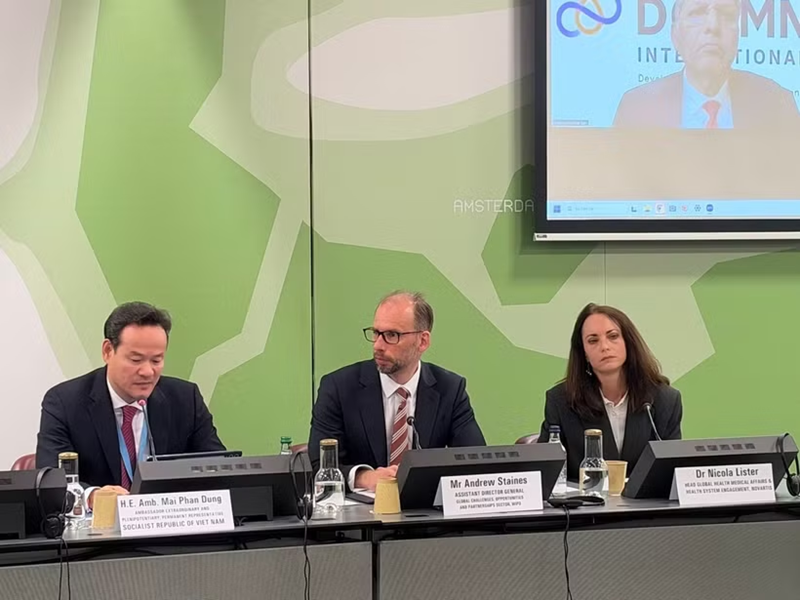
Ambassador Mai Phan Dung, Permanent Representative of Viet Nam to the United Nations and other international organizations in Geneva (third, left), at the symposium on November 25 in Geneva |
Under the National Strategy for the Development of the Pharmaceutical Industry to 2030, with a vision to 2045, Viet Nam aims to ensure that domestically produced medicines meet around 80% of demand and account for 70% of market value by 2030. The country also aims to develop domestic pharmaceutical material production capacity to meet 20% of the demand for raw materials used in local drug manufacturing.
To achieve these targets, it is prioritizing the development of research and production capacity for medicines, vaccines and medical technologies; encouraging investment, innovation and cooperation between domestic enterprises and international corporations and research institutes; and ensuring that advances in the pharmaceutical industry help improve the quality, safety and affordability of medicines.
The ambassador affirmed that strengthening domestic production capacity and deepening international integration and cooperation are mutually reinforcing priorities.
On intellectual property, he emphasized that it is not merely a tool for protecting rights but also a driver of innovation, investment, technology transfer and the commercialization of research outcomes.
He highlighted the Politburo's Resolution No.57-NQ/TW, issued in December 2024, and Conclusion No.51-KL/TW, issued in June 2026, along with the Intellectual Property Strategy to 2030, updated in August 2026, on the exploitation and commercialization of intellectual property assets.
Viet Nam seeks to strike a balance between the legitimate interests of innovators and the need to protect public health, in line with Articles 7 and 8 of the Agreement on Trade-Related Aspects of Intellectual Property Rights (TRIPS) and the Doha Declaration on the TRIPS Agreement and Public Health, he said.
Regarding emerging technologies, Dung noted that AI and digital transformation are creating opportunities to accelerate drug research and development, optimize production processes and improve quality control. However, developing countries continue to face challenges related to digital infrastructure, data, human resources and finance.
International cooperation should therefore help narrow, rather than widen, technological gaps among countries, he stressed.
In terms of international cooperation, Viet Nam proposed promoting practical forms of technology cooperation, including voluntary licensing, joint research and joint ventures; prioritizing workforce training and strengthening the capacity to absorb and master technologies; and developing pharmaceutical production networks and regional value chains, particularly within ASEAN.
The ambassador also called on WHO, WIPO and WTO to enhance coordination in providing technical assistance tailored to the specific needs of each country. WHO can support regulatory management, quality assurance and health policies; WIPO can assist with intellectual property systems, the use of patent information and technology transfer links; while WTO can provide support in trade policies, intellectual property rules and trade facilitation.
During the discussion, answering a question on frugal innovation and shortening the time needed to bring research results to market, Dung proposed strengthening links among research institutes, manufacturing enterprises and technology owners; making greater use of intellectual property in licensing and technology transfer; and improving access to finance, technical assistance and management support.
He also shared Viet Nam's successful cooperation with WIPO in establishing dedicated intellectual property units within Vietnamese enterprises, suggesting that the model could be expanded to the manufacturing sector.
In response to a question about the relationship between voluntary licensing and the flexibilities under the TRIPS Agreement, the ambassador affirmed that these are complementary tools that could be applied according to each country's public health needs and specific circumstances.
He noted that removing patent barriers does not necessarily mean gaining access to manufacturing know-how, particularly advanced vaccines and biological products. Viet Nam therefore attaches importance to developing research capacity, training human resources, strengthening technology absorption and cooperating with international manufacturers.
At the end of the session, WIPO Assistant Director General Andrew Staines praised Viet Nam's insights into its pharmaceutical development strategy and its approach to building an efficient and balanced intellectual property system. He expressed interest in continuing discussions with Viet Nam on expanding the model of intellectual property cooperation within enterprises and sharing the experience with other countries.
WIPO will continue coordinating with WHO, WTO and partners to strengthen the role of intellectual property across the entire innovation ecosystem, he affirmed.
Source: VNA