Devoid of podium or textbooks, for these local students June has been filled with laughter and sweat-drenched hammer strikes - a setting where labor skills and drive to overcome adversity were sown.
    |
 |
|
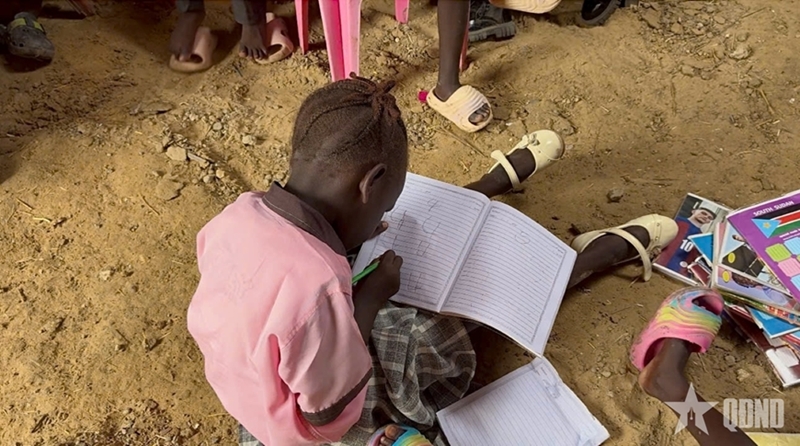
Bare dirt floors instead of desks and chairs - a heartbreaking reality at schools in Abyei |
The Abyei Special Administrative Region struggles not only with food and medical shortages but also with an alarming lack of educational infrastructure, as students in many areas are forced to sit on bare dirt floors. Faced with this reality, instead of providing conventional one-way assistance, the Vietnamese troops decided to turn their workshop into an open space, guiding students to construct sturdy desks and chairs with their own hands.
The sound of change
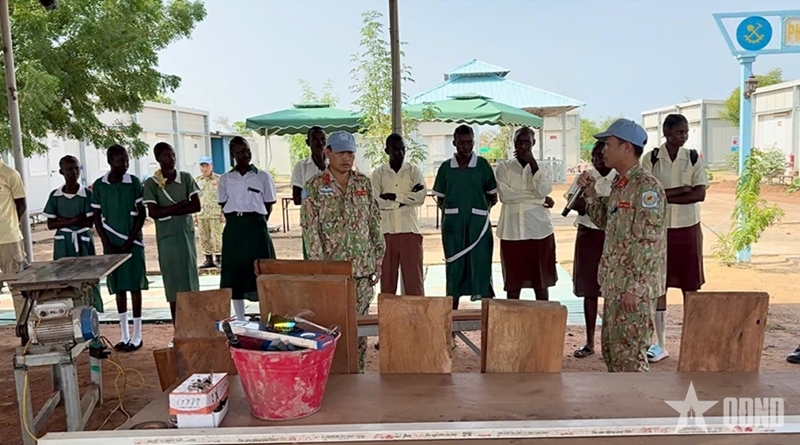
In stark contrast to the quietness of patrol hours, the workshop was permeated with the raw scent of sawdust and the rhythmic mechanical hum of equipment. Stepping through the security gate of the peacekeeping force for the first time, Abyei high school students exhibited a mix of timidity and curiosity. However, their apprehension was quickly dispelled by the gentle smiles and friendly waves of Vietnamese soldiers.
|
|
 |
|
The carpentry workshop at Highway Base welcomes special guests. |
|
|
 |
|
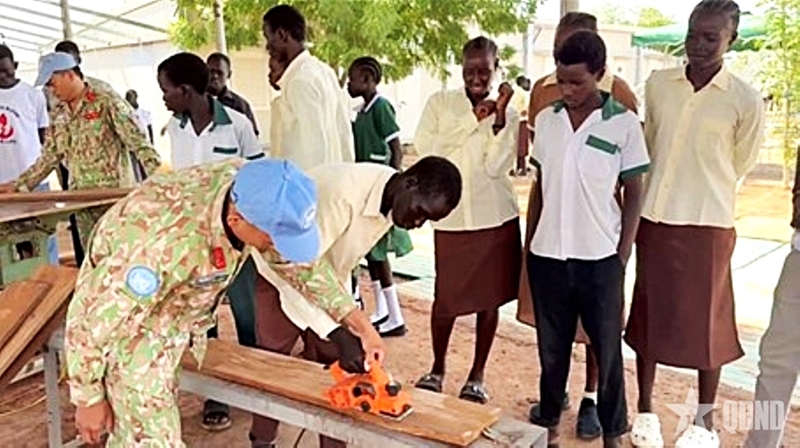
Meticulous hands-on guidance: The magic of transforming rough planks into smooth tabletops. |
Here, military engineers accustomed to operating massive excavators and road rollers became diligent guides. The first lesson began not on paper, but with raw wooden planks and basic carpentry tools. Students were introduced to the crafting process, learning how rough boards could be sanded smooth and how fragmented pieces could be assembled into solid desks.
Podium-less experience and language of dedication
In the stifling heat of the African summer, sweat soaked the backs of both the engineering troops and the students. Amidst the scattered sawdust and wooden planks of the workshop, mechanical skills were imparted not through academic lectures, but through the calloused hands and extensive experience of Vietnamese engineers.
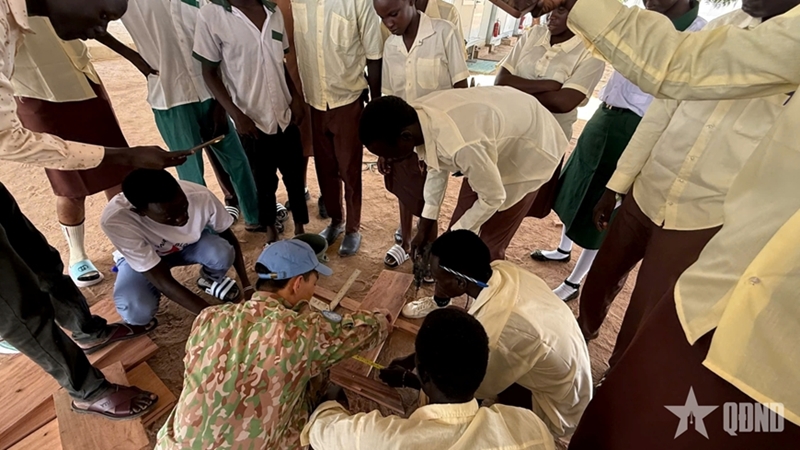
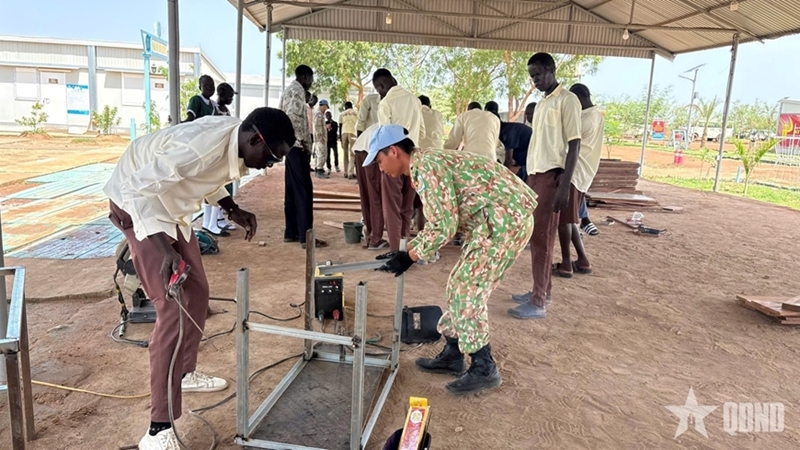
Although interpreters provided crucial support, technical terminology still posed a slight barrier. To overcome this, Vietnamese soldiers adopted a hands-on approach, directly guiding the students through specific practical actions: from taking measurements and grinding edges to feeling the tension of tightening a bolt. This visual interaction and language of action dismantled all barriers, making complex crafting skills vivid, relatable, and easy to absorb. Caressing a smooth tabletop he had just bolted together, a male high school student shared that he had never touched such equipment before. Despite his initial fear of the noisy machinery, the meticulous guidance from the soldiers enabled him to assemble a sturdy desk, leaving him immensely proud of his handiwork.
|
|
 |
|
Visual interaction and the language of action erase all barriers. |
Reminiscences of hometown
Observing the patient and gentle eyes of the blue berets as they leaned in to correct a saw line or a hammer strike for the children, one could see the reflection of fathers tenderly instructing their own kids. Guiding the young apprentices hands-on, Non-commissioned Major Tran Quoc Cong expressed deep emotion, noting that watching students awkwardly handle tools reminded him of his young child back home. He explained that the unit had collectively agreed not to do the work for the children, but rather to guide them to actively participate. This approach aimed to help students understand the value of labor and cherish every desk and chair they made.
The soldiers’ longing for their children and families thousands of miles away seemed to be channeled into every weld and screw. This heartfelt dedication transformed a potentially dry mechanical practice into a warm transmission of patience, meticulousness, and pride in hard work.
|
|
 |
|
Students enthusiastically explore basic mechanical skills. |
|
|
 |
|
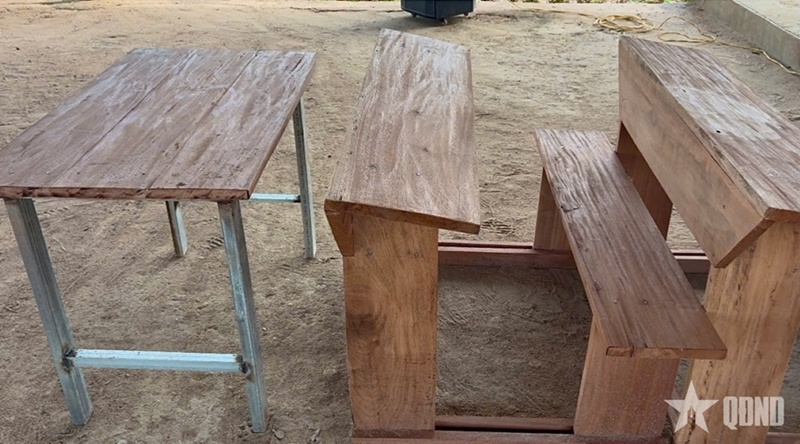
Brand-new desks completed by the students themselves |
Pride in labor
At the end of the experiential session, the sets of brand-new desks and chairs crafted jointly by students and Vietnamese soldier-mechanics were neatly arranged in the workshop courtyard. Far from passive charity, these items stood as a proud testament to the labor of the local youth, achieved with the silent companionship of Vietnamese troops.
Having accompanied his students throughout the extracurricular activity, Majok Chol Lual, a teacher at Abyei High School, described it as an invaluable practical experience. He emphasized that his students not only built their own desks but also acquired essential life skills and the determination to strive forward. The school representative also affirmed that the Vietnamese peacekeeping force had introduced a phenomenally practical method of community support.
The session concluded with the joy of labor, establishing a solid foundation for the students’ dreams of independence. Behind the camp fences, the Vietnamese blue berets quietly packed up their tools and resumed their shifts, carrying with them the simple happiness of those planting seeds in a barren land.
Translated by Minh Anh