The proposal was discussed at a meeting between a delegation from the Ho Chi Minh National Academy of Politics (HCMA) and the Central Council for Theoretical Studies, led by Prof., Dr. Nguyen Xuan Thang, chairman of the council, and NZAI leaders headed by Associate Professor Antje Fiedler, the institute's director, during a state visit to New Zealand by General Secretary of the Communist Party of Viet Nam Central Committee and President of Viet Nam To Lam.
NZAI is a research institute under the University of Auckland focusing on New Zealand's engagement with Asia, while serving as a bridge among researchers, businesses and policymakers.
    |
 |
|
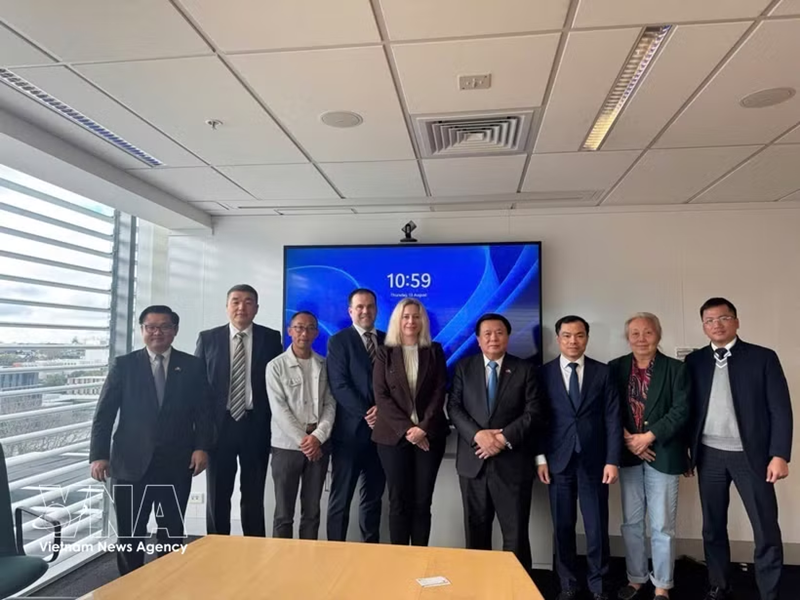
Participants at the working session between the delegation from the Ho Chi Minh National Academy of Politics (HCMA) and the Central Council for Theoretical Studies and NZAI leaders |
At the meeting, the two sides said the elevation of Viet Nam-New Zealand ties to a Comprehensive Strategic Partnership has created an important political foundation for deepening cooperation between their research and academic institutions.
NZAI leaders recognized Viet Nam's development achievements and growing role in the region and bilateral relations.
Exchanging views with New Zealand scholars, Thang affirmed that Viet Nam attaches importance to deepening its Comprehensive Strategic Partnership with New Zealand and strengthening cooperation with South Pacific countries.
He said strategic research institutions such as the Ho Chi Minh National Academy of Politics, the Central Council for Theoretical Studies and NZAI should take a more proactive role in research, analysis and policy advice, thereby enhancing mutual understanding among the two countries' governments, business communities and people.
The two sides agreed that future cooperation should go beyond individual academic exchanges towards more institutionalized, regular and sustainable mechanisms.
They discussed potential areas including international trade, digital transformation, artificial intelligence (AI), emerging technologies, green development, renewable energy, circular economy and energy transition.
Viet Nam paid particular attention to New Zealand's experience in green development and renewable energy. The sides discussed the possibility of sharing experience in wind power, as well as addressing environmental, ecosystem, planning and policy issues in a coordinated manner.
Another focus was the Vietnamese community in New Zealand. With around 15,000 people living, studying and working in the country, including many scientists, lecturers, experts and entrepreneurs, the Vietnamese community is regarded as an important resource capable of making greater contribution to the bilateral ties.
Under the proposal, the center could be based at the University of Auckland but would not be limited to the university, instead drawing on a wider network of experts from research institutes and universities across New Zealand, including those in Auckland and Wellington.
The model is expected to provide a broader platform connecting scholars, research institutions and expert communities of the two countries, while supporting research on Viet Nam, Viet Nam-New Zealand relations, and economic, technological and development issues of shared interest.
Source: VNA