The partnership was formalized through the “Ha Noi Joint Declaration :Viet Nam and Germany – Strategic Partnership for the Future,” signed by then Vietnamese Prime Minister Nguyen Tan Dung and German Chancellor Angela Merkel. It provided a framework for developing bilateral relations with a long-term vision.
    |
 |
|
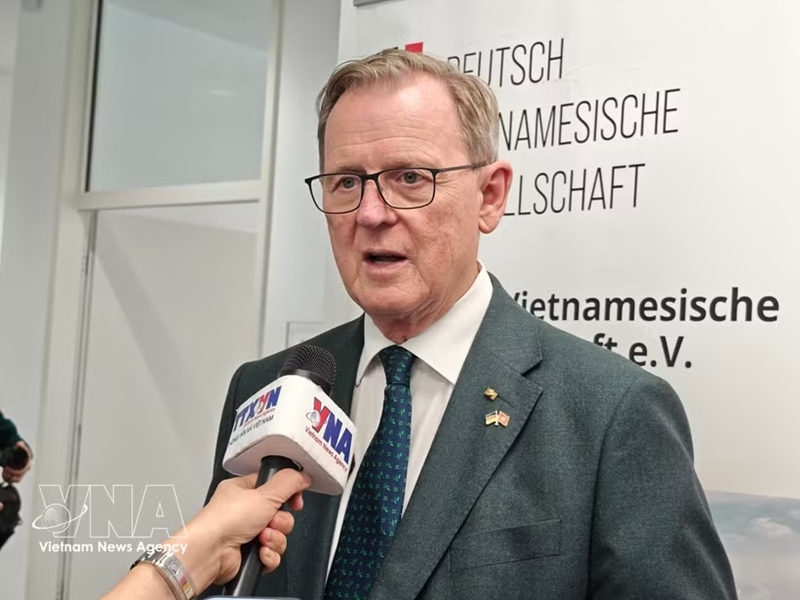
German Bundestag Vice President Bodo Ramelow |
In an interview with Viet Nam News Agency correspondents in Germany, German Bundestag Vice President Bodo Ramelow described the progress achieved by the two countries as a “miracle”, saying such developments would have been unimaginable 50 years ago, when Viet Nam was still at war and Germany remained divided.
Political dialogue has become more regular through high-level visits and bilateral consultation mechanisms. The eighth Viet Nam–Germany Strategic Dialogue, held in Ha Noi on June 11, 2026, focused on trade, investment, science-technology, energy transition, workforce training, and defense-security.
Parliamentary cooperation has also gained momentum. During his official visit to Viet Nam in June 2026, Ramelow met National Assembly (NA) President Tran Thanh Man. He said both sides agreed to further strengthen their partnership and improve mutual understanding despite differences in their parliamentary systems.
In September, Vietnamese NA Vice President Nguyen Thi Thanh visited Germany and held talks with German Bundestag Vice President Bodo Ramelow, affirming that Viet Nam attaches great importance to and seeks to further strengthen its Strategic Partnership with Germany. She noted that the 16th National Assembly of Viet Nam had established the Viet Nam–Germany Parliamentary Friendship Group.
Defense cooperation, initiated in 1998, has expanded since the Strategic Partnership was established. Activities include high-level exchanges, personnel training, military medicine and United Nations peacekeeping. A defense cooperation agreement signed in November 2022 provided a framework for deeper collaboration.
Education and vocational training are another important pillar. Established in 2008 with support of Germany and international partners, the Vietnamese-German University (VGU) has become a prominent symbol of bilateral educational cooperation. Training models aligned with German standards, scientific research, and business partnerships contribute to developing a highly skilled workforce for Viet Nam.
The German Academic Exchange Service (DAAD), Goethe-Institut and universities in both countries also support academic exchanges and joint research.
Ramelow said tens of thousands of Vietnamese students are pursuing vocational training in Germany, adding that it is a positive development. Cooperation also enables young Vietnamese people to obtain dual vocational qualifications recognized by both countries, helping improve their career prospects.
Science-technology and innovation have become increasingly important, with joint research covering biotechnology, environmental protection, climate change adaptation, disaster risk management and sustainable development.
Economic-trade ties have also become an increasingly important pillar of bilateral relations, reflecting the growing depth of Viet Nam-Germany cooperation. Germany is Viet Nam’s largest trading partner in the European Union, while Viet Nam is an important German trading partner in Southeast Asia. Bilateral trade exceeded 21 billion EUR (23.6 billion USD) in 2025, according to Germany’s Foreign Office.
The E.U.-Viet Nam Free Trade Agreement, which took effect in August 2020, has further improved market access and encouraged business links. Viet Nam exports electronics, garments, footwear, coffee and seafood to Germany, while German exports include machinery, precision engineering products, pharmaceuticals and industrial technologies.
According to the German Chamber of Commerce Abroad in Viet Nam (AHK Viet Nam), about 620 investment projects associated with German businesses had been identified in Viet Nam by August 2026, with estimated investment of 3.7 billion USD and at least 55,000 direct jobs.
Ramelow said more than 500 German companies are active in Viet Nam, describing the two countries as gateways to the Asian and European markets, respectively.
The Vietnamese community in Germany, numbering more than 200,000, also helps connect the two societies through cultural, educational and economic exchanges.
As the partnership enters its next phase, both countries have opportunities to deepen cooperation, expand investment and build stronger links between their people.
Source: VNA