The meeting took place during the top Vietnamese leader’s working trip to attend the high-level General Debate of the 81st session of the United Nations General Assembly and conduct bilateral activities in the U.S.
General Secretary and President To Lam spoke highly of Stanford University in general and Stanford Graduate School of Business in particularly as leading global educational institutions and hubs connecting knowledge, technology, businesses and talent worldwide.
    |
 |
|
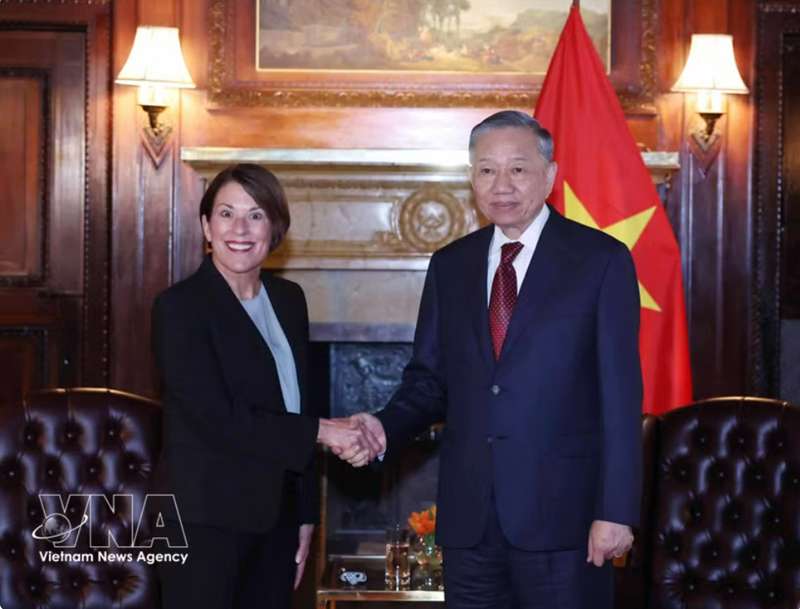
General Secretary of the Communist Party of Viet Nam Central Committee and President To Lam (right) meets with Professor Sarah Anne Soule, Dean of Stanford Graduate School of Business at Stanford University, in New York on September 21. |
He expressed interest in Stanford’s priorities in education, leadership capacity development and AI, stressing that as AI advances rapidly, core human capabilities such as creative thinking, judgment and decision-making are becoming increasingly important to the competitiveness and development of countries.
The leader said Viet Nam is entering a new development phase with the goals of achieving fast and sustainable growth and becoming a high-income developed country by 2045.
The country has identified science, technology, innovation, digital transformation and high-quality human resources as key drivers of growth, he said, adding that it needs not only additional resources but, more importantly, the capacity to generate, absorb and transform knowledge, technology and innovation into productivity and competitiveness.
General Secretary and President To Lam expressed his belief that combining Viet Nam’s strengths, dynamic economy, development ambitions and innovation opportunities with Stanford’s global knowledge, talent and networks will help establish an effective cooperation model between academia and practice, universities and businesses, and technology and people, generating new value and practical benefits for both sides and the region.
Proposing the two sides focus on three priority areas of cooperation, he elaborated that the first is leadership capacity development for management officials, business leaders and other relevant groups, with a focus on modern governance and international connectivity.
The second is strengthening innovation capacity and AI expertise. Stanford could share knowledge and experience in AI and the digital economy while connecting Viet Nam’s innovation ecosystem with its global network of experts, founders and investors.
The third is promoting research and innovation partnerships to enable Viet Nam to become a co-creator of knowledge and new value, he added.
On this occasion, General Secretary and President To Lam also informed Soule that Viet Nam will host APEC in 2027 and expressed his hope that Stanford will participate as a knowledge partner contributing to activities related to science, technology, innovation, digital transformation and human resources development.
He welcomed the signing of a memorandum of understanding (MoU) between Viet Nam’s Ministry of Foreign Affairs and Stanford Graduate School of Business, as well as the school’s planned visit to Viet Nam in early 2027 to implement priority cooperation programs. He considered this as a starting point for larger collaborative initiatives with clear objectives and outcomes that meet the needs and interests of both sides.
For her part, Soule spoke highly of Viet Nam’s dynamic economic growth and its increasingly important role in the global economy.
She agreed with the Vietnamese leader’s suggested cooperation priorities and affirmed Stanford’s commitment to developing partnerships based on mutual respect and a shared commitment to educational excellence.
She said such partnerships will help develop leadership and human resource capabilities, promote mutual understanding and train leaders capable of addressing complex global challenges.
Besides, she added, the signing and implementation of the MoU on cooperation between Viet Nam's Ministry of Foreign Affairs and Stanford Graduate School of Business will help create substantive, meaningful, and impactful cooperation opportunities that serve the interests of both sides, while also contributing to further strengthening the partnership between the U.S. and Viet Nam.
Soule invited General Secretary and President To Lam to visit Stanford Graduate School of Business at a convenient time, and he accepted with pleasure.
In the presence of the Vietnamese leader, Minister of Foreign Affairs Le Hoai Trung and Soule exchanged the MoU between the Ministry of Foreign Affairs and Stanford Graduate School of Business.
Source: VNA