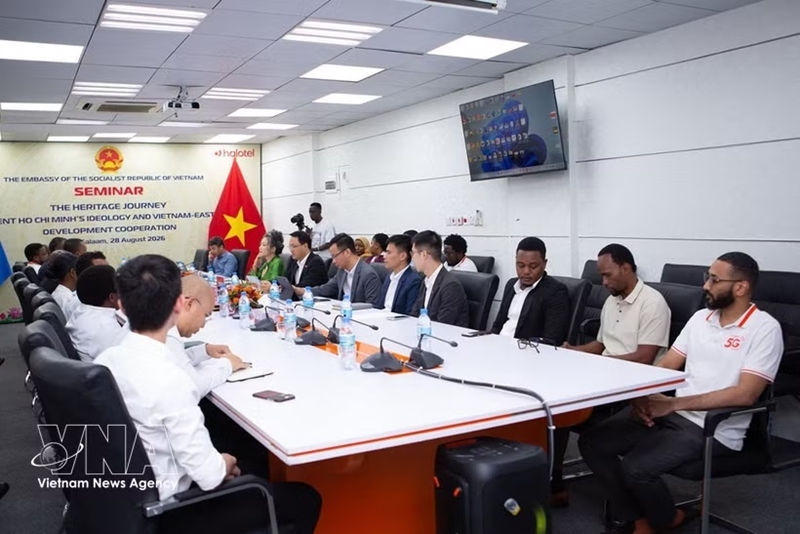
The event drew a large number of scholars, lecturers, students and business representatives from the three countries. Those from prominent businesses operating in the region, including Viettel Tanzania, Halotel, Viettel Burundi, Lumitel and Ethiopian Airlines also attended the seminar.
    |
 |
|
A view of the seminar held in Dar es Salaam as part of activities marking the 50th anniversary of Viet Nam–Ethiopia diplomatic ties |
The participation of diplomats, academics and business representatives created a multi-dimensional forum for discussions on the legacy of the founder of modern Viet Nam, the history of national liberation struggles, and prospects for cooperation. Economic and technological connectivity, together with people-to-people exchanges, were highlighted as key drivers for deepening Viet Nam–East Africa relations.
Addressing the seminar, Vietnamese Ambassador to Tanzania Vu Thanh Huyen, who is also in charge of Ethiopia, highlighted three enduring pillars of President Ho Chi Minh's thought, namely national independence, international solidarity and human progress.
The Ambassador noted that the late leader, from an early stage, had linked Viet Nam's struggle with the global anti-colonial movement, including in Africa, through activities such as his involvement in the Intercolonial Union and his contributions to Le Paria. Viet Nam and Africa share many historical similarities in their journeys to safeguard sovereignty, promote self-reliance, self-strengthening and pursue people-centered development, she said.
Huyen said the spirit of solidarity forged during the struggles for national liberation should be translated into practical cooperation programs in the new period, focusing on stronger air connectivity, expanded academic exchanges, high-tech agriculture to support food security and resilience to climate change, as well as digital trade and business, market and people-to-people linkages between Viet Nam and East Africa.
Ethiopian Ambassador to Tanzania Fekadu Beyene Ayana highlighted similarities between President Ho Chi Minh's thought on national liberation and that of early African leaders such as Kwame Nkrumah, Jomo Kenyatta, Julius Nyerere and Patrice Lumumba. Their common core was the aspiration for independence, linking political liberation with economic sovereignty and social justice.
Ayana affirmed that lessons in mass mobilization, self-reliance and international solidarity remain relevant to Viet Nam–Africa relations today.
David S. Muya, an expert from the international relations department at the University of Dar es Salaam (UDSM), emphasized the role of education and young people in carrying forward the legacy of friendship. The UDSM proposed a two-way approach to cooperation, linking education and research with specific development challenges facing the region, including food security, small- and medium-sized enterprise development, vocational training and digital transformation. Recommended initiatives included short-term exchange programs, visiting lecturers, applied research projects and the establishment of innovation networks among educational institutions.
General Director of Halotel Tanzania Bui Van Thang presented a paper on Halotel's model as an example of Global South cooperation for community development. The company pledged to continue serving as a bridge, translating diplomatic ties into concrete economic projects.
The seminar not only provided an opportunity to learn about and discuss the life, career and thought of President Ho Chi Minh, but also opened a dialogue on values relevant to international relations and development cooperation today.
The Vietnamese Embassy affirmed that it would continue to promote academic, business and youth connectivity, contributing to making Viet Nam–East Africa relations increasingly substantive, effective and sustainable.
Source: VNA