During the visit, Thanh held talks with Vice President of the German Bundestag Bodo Ramelow; had a working session with Armin Laschet, Chairman of the Committee on Foreign Affairs in the German Bundestag; attended a plenary session of the Bundestag; visited the Rahel Hirsch Center for Translational Medicine in Berlin; and met with the Vietnamese community in the European country.
    |
 |
|
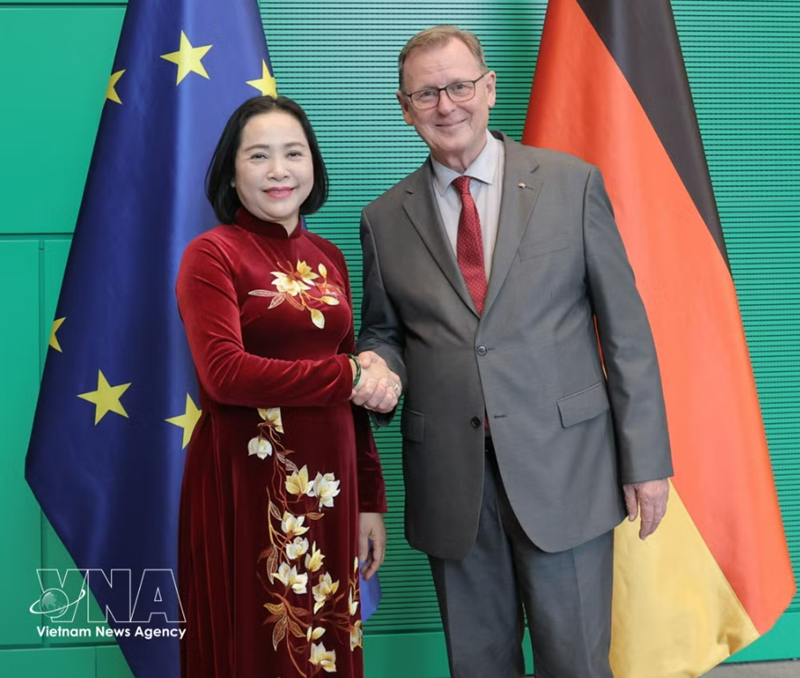
Vice President of the National Assembly (N.A.) Nguyen Thi Thanh (left) and Vice President of the German Bundestag Bodo Ramelow |
At the talks with Ramelow, Thanh affirmed that Viet Nam always attaches importance to relations with Germany, one of its most important partners in Europe, and wants to further deepen the bilateral Strategic Partnership in a substantive and effective manner.
She proposed the two sides strengthen political trust, maintain high-level exchanges, promote the role of the two legislative bodies in facilitating and supervising the implementation of agreements between the two countries; enhance cooperation between their specialized committees and legislators, and coordination at inter-parliamentary forums.
Regarding economic, trade and investment cooperation, Thanh called for more effective implementation of the E.U.-Viet Nam Free Trade Agreement (EVFTA) and existing cooperation frameworks; increased German investment in Viet Nam, particularly in high-tech, digital transformation, green transition, renewable energy and infrastructure; and Germany’s support for the European Commission’s early removal of its “yellow card” warning related to illegal, unreported and unregulated (IUU) fishing on Vietnamese seafood in recognition of Viet Nam’s efforts and progress.
Ramelow spoke highly of the positive development of Viet Nam-Germany relations, noting the two countries’ complementary advantages and huge room for cooperation, particularly in transport infrastructure, vocational training and healthcare. He expressed his wish to further promote political trust and parliamentary cooperation and strengthen connections among agencies, localities, vocational education institutions and businesses.
At the working session with Thanh, Laschet highly valued Viet Nam’s growing role in the region and the world, and expressed interest in the Southeast Asian country’s foreign policy of independence, self-reliance, diversification and multilateralization as well as its role in regional and international mechanisms.
|
|
 |
|
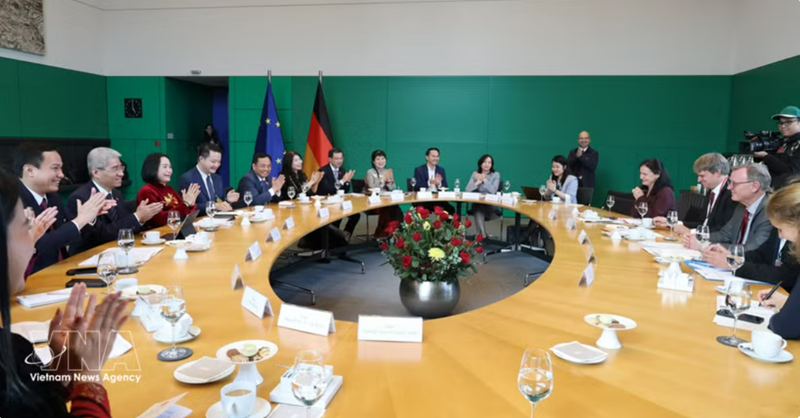
At the talks between Vice President of the National Assembly (N.A.) Nguyen Thi Thanh and Vice President of the German Bundestag Bodo Ramelow |
Discussing international and regional issues, the two sides stressed the need to promote dialogue, peacefully settle disputes; uphold the U.N. Charter, multilateralism and international law; and ensure peace, stability, security, safety, freedom of navigation and overflight, and uninterrupted international trade routes in accordance with international law.
Regarding the East Sea, Thanh reaffirmed Viet Nam’s consistent stance of settling disputes peacefully in accordance with international law, including the 1982 United Nations Convention on the Law of the Sea (UNCLOS 1982).
The two sides agreed to strengthen parliamentary exchanges, share legislative and supervision experience, and coordinate at multilateral forums to further deepen the Viet Nam-Germany Strategic Partnership.
The Vietnamese legislator also proposed the German side continue to create favorable conditions for the Vietnamese community in Germany in stabilizing their lives, successfully integrating into the host society and promoting its role as a bridge between the two countries, contributing to promoting people-to-people exchanges, and tourism and travel connections.
Thanh took this occasion to conveyed N.A. President Tran Thanh Man’s invitation to President of the German Bundestag Julia Klöckner to pay an official visit to Viet Nam at a convenient time.
On September 25, the Vietnamese delegation attended a plenary session of the German Bundestag, which offered the delegation an opportunity to learn about the Bundestag’s operations, legislative procedures and voting process.
Visiting the Rahel-Hirsch center, the Vietnamese delegation learned about its training model and met Vietnamese trainees. She proposed stronger links between the center and Vietnamese vocational education institutions, including exchanges of teachers and trainees, sharing training programs and methods, and expanding cooperation based on Germany's occupational standards.
Thanh said that cooperation in this field could make a practical contribution to Viet Nam’s goal of developing high-quality human resources while helping meet Germany’s demand for skilled workers, thereby creating an additional driver for long-term cooperation between the two countries.
Meeting with more than 200 representatives of Vietnamese associations, businesses, intellectuals, students and young people in Germany, Thanh affirmed that overseas Vietnamese are an integral part of the nation and an important resource for national development.
She emphasized that the Political Bureau’s Resolution No.23-NQ/TW on overseas Vietnamese affairs continues to affirm this consistent viewpoint, while setting out the requirement to more strongly harness the resources, intellect, experience, networks and bridging role of the Vietnamese community abroad in the country’s new development period.
Thanh encouraged the community to stay united, integrate successfully, preserve Vietnamese language and culture, and strengthen connections with the homeland.
Vietnamese Ambassador to Germany Nguyen Dac Thanh affirmed that the embassy would continue connecting agencies, localities, businesses and German partners to concretize cooperation priorities and further deepen the Viet Nam-Germany Strategic Partnership.
Source: VNA