Discussions covered India’s technology and innovation ecosystem; Viet Nam’s strategic priorities, potential and strengths; technology partnership models and specialized technologies; and cooperation in quality workforce training and technology transfer.
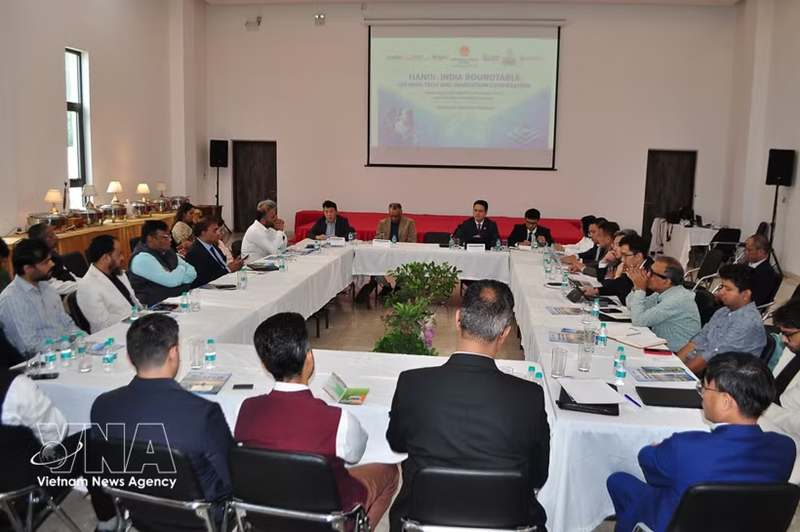
The event brought together more than 20 representatives from Indian firms, research institutes and universities, plus a delegation from the Ha Noi Hi-Tech and Industrial Park Management Board (HHTIP).
    |
 |
|
The Ha Noi-India hi-tech innovation cooperation roundtable in New Delhi on September 24 |
Vietnamese Ambassador to India Trinh Minh Manh stressed the particularly important role of science, technology, innovation and digital transformation in Viet Nam's development strategy for the new phase. He called on Indian partners to share knowledge, experience and expertise and create concrete cooperation opportunities with Viet Nam’s sci-tech community broadly and Hoa Lac Hi-Tech Park specifically.
The Vietnamese side laid out its hi-tech capabilities and cooperation needs, with a focus on R&D, application and commercialization of new and advanced technologies and tech products in the country.
Indian participants detailed their experience in developing hi-tech industries, especially AI, the startup ecosystem, semiconductors, RISC-V, AI/ML, UAVs, robotics and technology transfer. They also pointed to opportunities in quality workforce training and joint research and co-development schemes.
Sudhanshu Mittal, Director of the IoT & AI Center of Excellence under NASSCOM, held that information technology is one of the most potential sectors for the two countries to expand cooperation in the near future.
He pledged to help Viet Nam build centers of excellence based on India’s experience. That will let Viet Nam study and apply proven models whose feasibility has been demonstrated and which have delivered concrete results through 58 centers now operating across India.
Mittal, however, said the more important factor is helping Viet Nam build self-reliant capabilities. Cooperation should initially focus on India providing knowledge, experience and technology; Vietnamese companies and partners could then gradually take mastery and independently conduct related activities.
Dr. Dhruv Galgotia, representing Galgotias University, said he wants to facilitate opportunities for Indian and Vietnamese students to share academic and industrial ecosystems and access training, research and hands-on technology opportunities.
Source: VNA