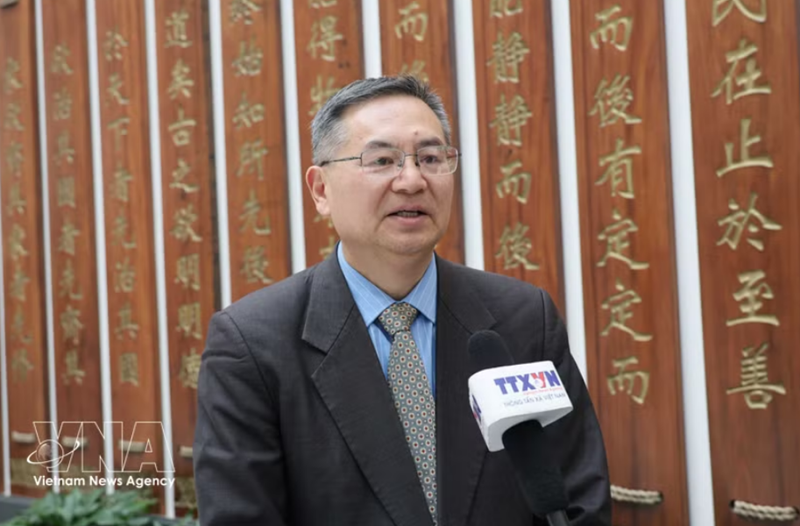
The assessment was made by Professor Dr Cheng Hanping, Executive Director of the Institute of Regional and Country Studies and Director of the Vietnam Research Center at Zhejiang University of Technology, in an interview with the Vietnam News Agency's correspondent in China on the four strategic shifts outlined by General Secretary and President To Lam at the third plenum of the CPV’s 14th Central Committee.
    |
 |
|
Professor Dr Cheng Hanping, Executive Director of the Institute of Regional and Country Studies and Director of the Vietnam Research Center at Zhejiang University of Technology. |
The scholar noted that the top leader’s focus on using national resources more effectively speaks directly to the country’s current realities and challenges. Building on the broad institutional reforms implemented by the Party Central Committee over the past year, the next step is to make the most of these resources and rally the positive forces in society, laying a strong foundation for Vietnam to achieve its two centenary goals and fulfil its vision for a new era of national growth.
He added that General Secretary and President To Lam’s call for a more proactive approach to risks reflects the CPV leadership's strong awareness of potential threats and its vigilance. Such an approach is essential in the face of a rapidly changing global landscape, the constant emergence of unforeseen events, and the continuing erosion of the international order.
The CPV leadership has recognized emerging risks and measures to address them, Cheng said, adding that this demonstrates such leadership not only has a long-term vision for the future but also possesses the strategic planning capacity needed to anticipate and mitigate risks at an early stage.
Regarding how these proposals could be implemented effectively, the scholar stressed that strong implementation capacity must be embedded at every level of the political system, noting that slogans from the top leadership alone would not be sufficient.
He also said Vietnam should mobilize society to contribute ideas and proposals on national planning and future implementation, ensuring that the public has a genuine voice and that democratic participation is fully promoted.
Finally, Cheng said the Party's strategic advisory bodies should attract outstanding talents from across all fields and, more importantly, bring together individuals with diverse expertise and professional backgrounds.
Source: VNA