Despite geopolitical uncertainties, disruptions to global supply chains, stricter import standards in many markets and rising shipping costs, exports and imports continued to expand at a robust pace.
In May, trade turnover exceeded USD 99 billion for the first time. As a result, the country’s total merchandise trade value in the January–May period climbed 25% from a year earlier to more than USD 445 billion.
    |
 |
|
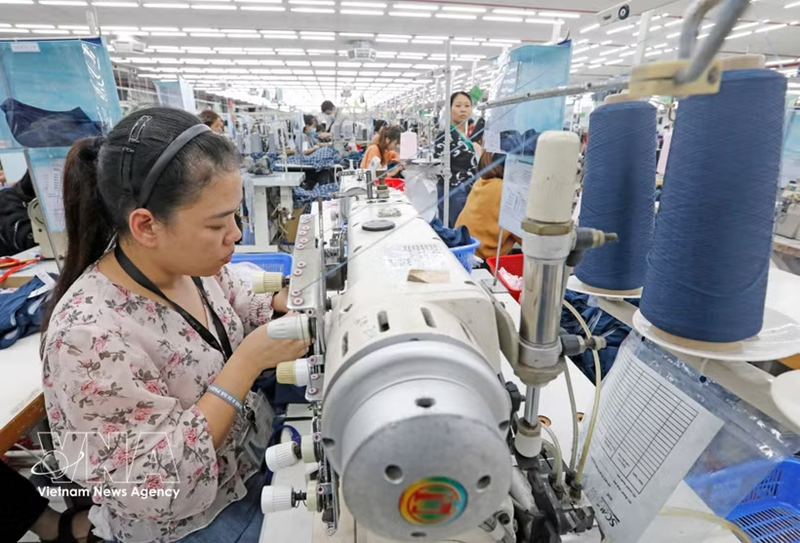
Apparel is a major contributor to Vietnam's exports. |
Specifically, exports generated USD 215.66 billion, up 19.5% and equivalent to an increase of USD 35.13 billion while imports surged 30.8%, or more than USD 54 billion, to USD 229.46 billion.
The faster rise in imports in recent months led to a trade deficit of nearly USD 14 billion, compared with a surplus of over USD 5 billion recorded in the same period last year.
A notable feature of the export panorama was the dominance of the foreign direct investment (FDI) sector. Domestic enterprises earned USD 43.5 billion from exports, rising only 2.5% and accounting for 20.2% of total export revenue. Meanwhile, the FDI sector, including crude oil exports, generated USD 172.16 billion, climbing 24.7% and contributing 79.8% of the country’s overseas shipments.
High-tech and industrial products remained the key growth drivers. Exports of electronics, computers and components went up 46.2% to USD 56.1 billion. Machinery, equipment, tools and spare parts increased 22.1% to nearly USD 27 billion, while shipments of phones and components reached USD 26.37 billion, up 17.7%. Transport vehicles and spare parts also recorded growth of 17.1%, approaching USD 8 billion.
Traditional labor-intensive sectors, including textiles, footwear, wood and wood products, continued to record trade surpluses but posted modest growth due to slow demand recovery and higher logistics and insurance costs. Their export values rose by just 0.4%, 0.2% and 2.9% from a year earlier, respectively.
Agricultural exports maintained positive momentum thanks to efforts to improve product quality and meet increasingly stringent import requirements. Fruit and vegetable exports increased 20.4% while pepper shipments expanded 14.4%.
Fishery exports also sustained their recovery. The sector earned USD 1.02 billion in May alone, bringing total export revenue in the first five months to USD 4.67 billion, up 11% year-on-year.
According to the Vietnam Association of Seafood Exporters and Producers (VASEP), the double-digit growth reflects continued recovery although exporters still face cautious purchasing patterns, increasingly segmented markets and stricter compliance requirements.
China and Hong Kong (China) emerged as major growth drivers, importing USD 1.2 billion worth of Vietnamese fishery products during the period, up 40.5%. Rising demand for shrimp, pangasius, crab, molluscs and other high-value seafood products helped enterprises secure additional orders.
Vietnam’s major export markets all recorded double-digit growth thanks to improved market analysis, flexible production planning and effective utilization of free trade agreements. Exports to the U.S., Vietnam’s largest market, reached USD 69.6 billion, up 21.6%. Shipments to the E.U. rose 13.2% to USD 26 billion while the value hit USD 30.1 billion in China, up 28.2%. Exports to the Republic of Korea, ASEAN and Japan climbed 14.7%, 16.9% and 14.2%, respectively.
The Agency of Foreign Trade under the Ministry of Industry and Trade attributed the strong performance to exporters’ effective use of major trade agreements like the EVFTA, CPTPP, and RCEP, which have helped expand market access and reduce tariff barriers.
However, looking ahead, challenges remain. Seafood exporters face uncertainty in the U.S. and E.U. markets, where exports declined by 10% and 2.2%, respectively. Manufacturers are also closely watching Vietnam – U.S. trade negotiations, particularly discussions on reciprocal tariff arrangements.
For 2026, the country targets export growth of 15–16%. Despite a sharp rise in overseas shipments in the first five months, imports of raw materials, machinery, and equipment have outpaced exports in recent months, widening the trade deficit. Nevertheless, experts believe this is not a cause for concern as the high import volume is to stockpile raw materials in preparation for the year-end production cycle.
Source: VNA