The robust performance reflects the manufacturing sector’s steady recovery and reaffirms its role as the economy’s main growth engine.
The NSO reported that the IIP in the second quarter rose an estimated 11.2% year-on-year, driven by manufacturing (up 11.3%), electricity production and distribution (12.4%), water supply and waste management (10.3%), and mining (7%).
    |
 |
|
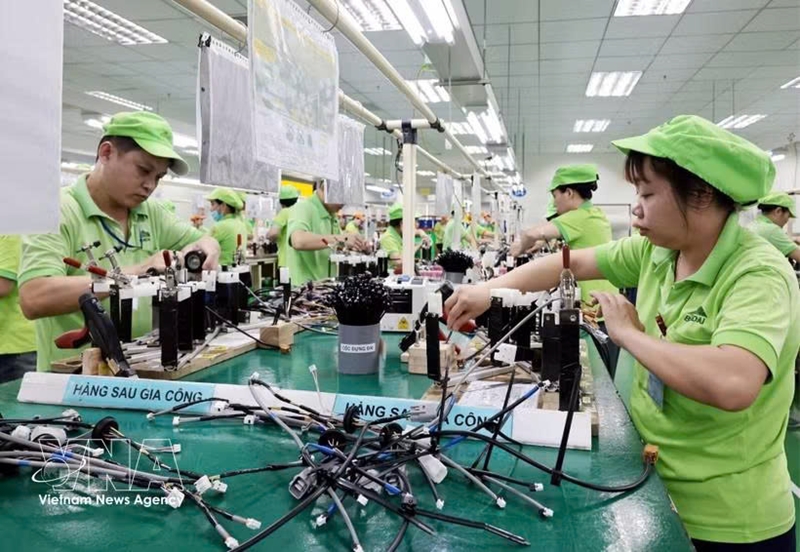
A production line for electrical wire harness assemblies at Bandai Company |
For the first six months, the index increased 10.8% from a year earlier, surpassing the 8.7% growth recorded in the same period of 2025 and marking the highest first-half expansion since 2019.
This indicates that industrial production is recovering broadly, supported by stronger domestic consumption, exports and investment, said NSO Director Nguyen Thi Huong.
Manufacturing remained the largest contributor, expanding 11.4% and contributing 8.9 percentage points to the overall industrial growth. Electricity production and distribution rose 9.6%, while mining increased 5.8%, reversing its decline in the same period last year.
Many manufacturing subsectors posted outstanding growth, including basic metals (21.5%), motor vehicles (17.7%), beverages (15.4%), other transport equipment (15%), non-metallic mineral products (14.9%), chemicals (14.8%), and fabricated metal products (13.9%).
Some others recorded weaker growth or contraction, however. Leather and related products rose only 4%, while hard coal and lignite mining fell 5.7%, highlighting uneven performance across industries despite the broader recovery.
Industrial production increased across all 34 provinces and cities, with strong growth in manufacturing and electricity generation driving local performance.
Manufacturing output surged in Quang Ninh (37.8%), Ha Tinh (30.7%), Ninh Binh (27.7%), Phu Tho (25.8%), and Nghe An (25%).
Electricity production recorded notable increases in Ha Tinh (48.3%), Phu Tho (18.3%), and Dien Bien (15.6%), reflecting the broadening momentum of industrial growth nationwide.
Output of major industrial products also recorded strong growth, including motorcycles (32.9%), automobiles (26.9%), rolled steel (23.3%), processed seafood (21.6%), refined sugar (16.8%), beer (14.4%), chemical paints (14%), and crude oil (13.1%). Production of NPK fertilizer, monosodium glutamate, clean coal and leather footwear declined.
Meanwhile, market demand also continued to improve. The manufacturing consumption index rose 10.8% in the first half, exceeding the growth recorded a year earlier, while the average inventory ratio fell to 82.2%, down from 85.7% in the same period last year, indicating stronger sales and faster production turnover.
The labor market also showed positive signs, with employment at industrial enterprises increasing 3.1% year-on-year, including a 3.2% rise in manufacturing, reflecting business confidence in further production expansion.
The strongest first-half industrial growth since 2019 not only underscores the sector's solid recovery but also provides a firm foundation for Vietnam to sustain robust economic growth throughout 2026. With manufacturing continuing to lead, supported by improving demand, employment and production capacity, industry is expected to remain a key pillar of economic expansion.
Source: VNA