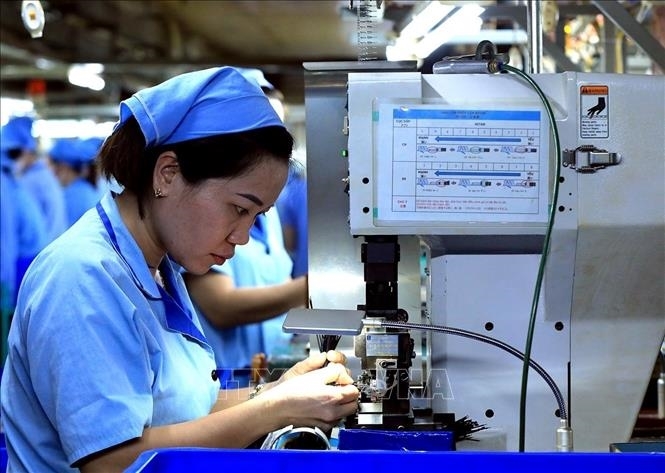
Citing the latest data released by Vietnam’s National Statistics Office, the article reported that the Southeast Asian nation’s GDP grew by 8.46% year-on-year in the fourth quarter of 2025, bringing full-year growth to 8.02%. Notably, the industrial sector recorded its highest growth rate since 2019.
    |
 |
|
According to an article by the Global Times, newly released data on Vietnam’s GDP are particularly impressive amidst global headwinds. |
It said with these results, the Vietnamese Government still has ample room to adjust monetary policy, unleash market vitality, and push ahead with institutional reforms. This, the paper noted, could enable Vietnam to achieve double-digit economic growth during the 2026-2030 period.
Huang Dongri, a researcher at the regional and national studies center of the Guangxi Normal University for Nationalities (China), said that several key factors underpin Vietnam’s strong economic performance. These include domestic political stability, administrative reforms implemented in 2025 that significantly optimized the business environment and accelerated market-oriented processes, and the ongoing transformation of the growth model.
In addition, Vietnam continued to capitalize on its population of more than 100 million with a young demographic structure, and its deep integration into the international community, further reinforcing its position as a key hub in the restructuring of Asian industrial supply chains.
Huang also underscored Vietnam’s unique position in the global manufacturing chain. The country benefits from both land and maritime connectivity, ensuring smooth supply chains and short transport cycles. Institutionally, it has effectively leveraged major free trade agreements such as the Regional Comprehensive Economic Partnership (RCEP) and the Comprehensive and Progressive Agreement for Trans-Pacific Partnership (CPTPP) to export products to a wide range of markets. From an industrial perspective, Vietnam has developed relatively complete industrial chains, spanning textiles and garments, electronics, and new energy.
Commenting on Vietnam’s recent economic growth, Ge Hongliang, Deputy Director of the ASEAN Institute at Guangxi Minzu University (China), said that its rapid growth has been largely driven by shifts in trade and investment amid the global restructuring of industrial chains. Since 2018, not only companies from Europe, the U.S., Japan, and the Republic of Korea, but also many Chinese enterprises have chosen Vietnam as an investment destination.
According to Ge, industrial cooperation between the two countries goes beyond simple capacity transfer to include higher-end industries. He expressed his confidence that this model of cooperation will continue to be strengthened, driven by deeper ASEAN - China regional integration.
Source: VNA