A “master blueprint” for double-digit growth through 2045
General Secretary Lam stressed that the resolution must serve as a “master blueprint” for Vietnam’s double-digit economic growth model through 2045. A new growth model, he said, must entail a fundamental shift in the underlying drivers of the economy, rather than incremental adjustments to existing policies.
    |
 |
|
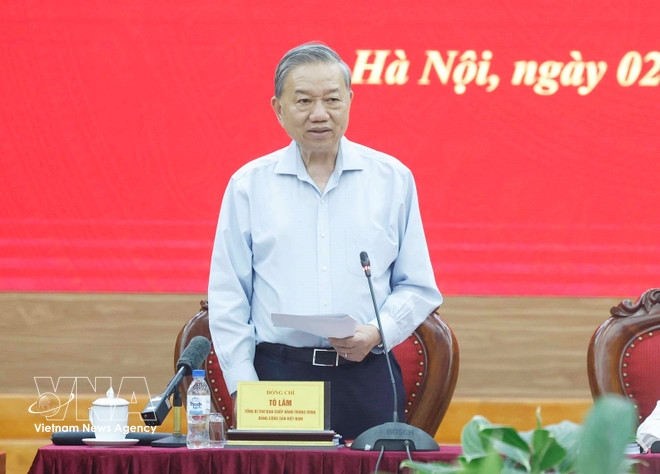
Party General Secretary To Lam speaks at the working session. |
Highlighting the importance of identifying feasible resources to achieve the target, he described it as challenging, yet grounded in concrete and well-founded calculations. Key elements include clarifying sources of capital mobilization, including domestic savings, foreign direct investment (FDI), and capital markets, alongside market-based resource allocation mechanisms and well-defined thresholds for macroeconomic stability.
“Above all, the principle of economic accounting and efficiency-based resource allocation must be strictly enforced. High growth can only prove sustainable when all resources, including state budget, land, natural resources, credit capital, and public assets, are fully and accurately inventoried, allocated efficiently, and held to strict accountability,” he said.
He also called for proactive risk governance to ensure that rapid growth remains safe and sustainable, with all growth decisions weighed carefully against potential risks and the economy’s overall resilience.
On discipline and organizational mechanisms, he urged the establishment of a governance and oversight system capable of pooling the entire society toward shared development goals.
No trade-off between growth and stability
To achieve the growth target, the Party chief underscored the need for a fundamental shift in development mindset across the entire political system and society at large. The goal should be treated not merely as an economic indicator but as a central, urgent and strategic political mission.
On such basis, sci-tech, innovation and digital transformation must become the core drivers of new growth model, supported by institutional framework that encourages research and development. Building a robust innovation ecosystem, including digital infrastructure, big data and artificial intelligence, while forging tighter collaboration among the State, enterprises, research institutes and universities will be crucial to commercializing research outcomes and integrating more deeply into global production and value chains.
Institutional reform must be substantive and comprehensive, turning it into a competitive advantage. He also called for building a contingent of capable and visionary officials, particularly leaders and heads of agencies who possess integrity and professionalism. A clean political system free from corruption and truly supportive of citizens and businesses is equally essential.
Maintaining macroeconomic stability, controlling inflation, safeguarding major economic balances, developing strategic infrastructure, nurturing quality workforce and enhancing national governance must go hand in hand with ensuring social equity, environmental protection and climate adaptation, he said.
The industrialization process, he noted, must be reshaped toward high technology, smart manufacturing and digital economy, with upgrades to the overall economic structure and mastery of advanced technologies.
Domestic market of more than 100 million people should become a sustainable pillar of growth. A harmonious economic structure among the state, private and FDI sectors must be established on the basis of fair competition and value chain linkages, generating synergy and enhancing the autonomy of each sector.
National development space should be reorganized toward substantive regional connectivity, concentrating resources on growth poles, economic corridors, financial centers and innovation hubs, while effectively tapping maritime, urban and digital economic potential.
Global integration must become more proactive and selective, focusing on building internal capacity, raising added value, and elevating the position of Vietnamese enterprises in global value chains.
Growth, he stressed, must be pursued in tandem with safeguarding national defense and security, ensuring social welfare and protecting the environment, without trading stability, equity or sovereignty for mere economic expansion. Such an approach would lay a solid and enduring foundation for sustainable national development.
The commission was requested to carefully study and incorporate feedback to finalize the draft resolution for submission to the Politburo.
Source: VNA