Over the past decade, the country’s durian cultivation area has expanded nearly sixfold to around 180,000 hectares, with output exceeding 1.5 million tons. The Central Highlands region is the largest growing region, accounting for more than 75,000 hectares.
    |
 |
|
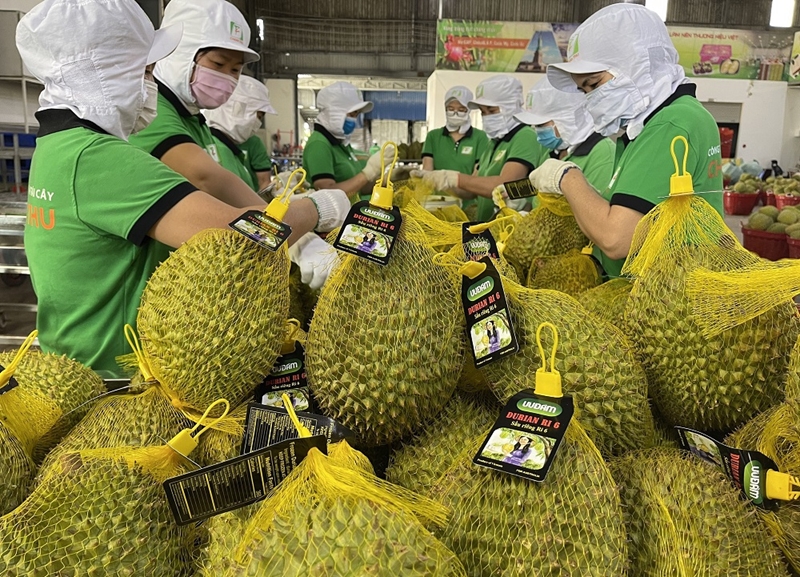
Vietnam’s durian industry posts a breakthrough in 2025, with export turnover reaching an estimated 4 billion USD. (Photo for illustration: vneconomy.vn) |
According to the Department of Agriculture and Environment of Dak Lak, the province currently has about 44,900 hectares of durian. Of this, 269 growing areas covering nearly 7,400 hectares and 40 packing facilities have been granted official codes. Notably, 16 frozen durian packing facilities in the province have been approved for export by China’s General Administration of Customs. In 2025, Dak Lak province’s fresh durian was exported to markets including China, Thailand, Japan and the U.S., generating about 1.1 billion USD in export revenue.
Dang Thi Thuy, Deputy Director of the provincial department, noted that despite its pivotal role in the local agricultural economy, the durian sector still faces many shortcomings. Production areas remain fragmented and small-scale, while farming practices and pest control are not strictly followed. Cases of excessive fertilizer and pesticide use, or the application of unapproved chemicals, have resulted in warnings over plant quarantine and food safety for several export shipments.
Weak linkages among farmers, cooperatives and enterprises have further hindered the formation of stable value chains, making consumption volatile and exposing exporters to higher risks. These issues are common across the national durian industry.
Data from the Ministry of Industry and Trade’s Agency of Foreign Trade show that China remains the dominant market, strongly influencing growth trends. In 2025, exports fluctuated, with a decline in the first half of the year due to China’s tighter control on pesticide residues and technical standards.
Exports rebounded from the third quarter as businesses strengthened compliance with growing area and packing facility codes, enhanced traceability, along with closer coordination among authorities to resolve technical bottlenecks. By the end of November, Vietnam exported nearly 885,000 tons of durian to China, worth 3.24 billion USD.
Experts agree that durian export growth can no longer rely solely on expanding acreage or market demand, but must be closely linked to compliance with standards and the sector’s organizational capacity.
Le Minh Tam, Director of Thien Tam Agricultural Products Trading Company Limited, said that the industry needs to diversify markets, boost processed products to increase added values and reduce risks.
Furthermore, the managerial role of state agencies needs to be more clearly defined by proactively providing early warnings of technical barriers to trade, standardizing the application of quality standards, and strengthening substantive supervision throughout the entire chain from production and processing to export.
Source: VNA