From the alluvial banks along the Tien River to brightly colorful flower routes, farmers are working around the clock to care for millions of potted flowers destined for markets at home and abroad. More than a seasonal cycle, the Tet flower crop reflects the stature of Sa Dec as a distinctive economic and tourism brand, and the vitality of a century-old craft village undergoing strong transformation.
“City of flowers” in Mekong Delta
Once a local supplier, Sa Dec has expanded to over 3,000 hectares, cultivating 2,000 varieties and supplying 12 million products annually. The industry has evolved from simple agriculture into a high-value sector integrated with tourism and culture.
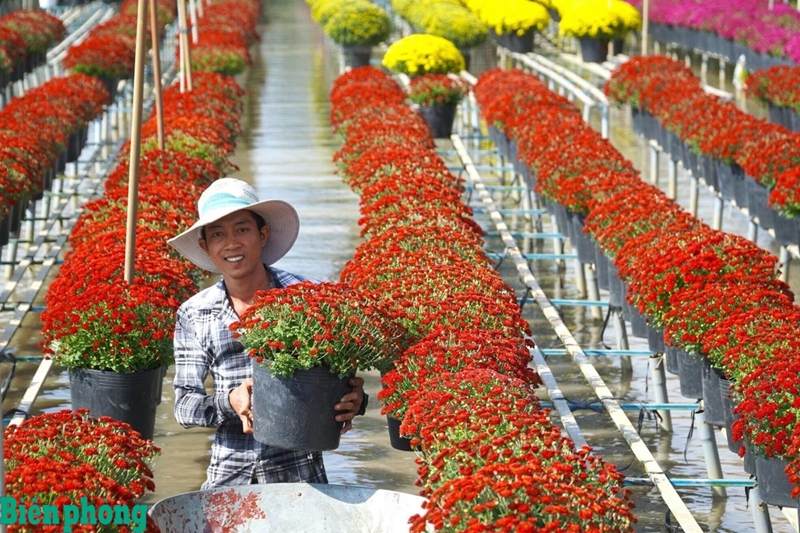
In Tan An hamlet, the pace is relentless. Farmers utilize precise lighting and fertilization schedules for key products like multicolored pompon chrysanthemums. To avoid oversupply, local authorities have encouraged quality improvement over indiscriminate expansion. Farmers like Nguyen Van Minh Sang are shifting toward market-oriented production, experimenting with new color varieties to meet specific consumer demands.
    |
 |
|
The flower-growing in Sa Dec has helped many households escape poverty. |
Nguyen Van Minh Sang said that this year his family is experimenting with 500 pots of four-color pompon chrysanthemums, red, yellow, purple and pink, to better meet market demand. His experience reflects a broader shift from spontaneous production toward market-oriented farming based on demand forecasting.
Science and technology applied to improve productivity and quality
The most significant shift in Sa Dec is the move toward professionalization. Traditional manual methods are being replaced by science and technology.
Tissue culture has emerged as a game-changer. Unlike traditional cuttings, tissue-cultured seedlings are disease-free, resilient, and offer stable coloration. At the Ut Hiep Seedling Facility, owner Le Thanh Tuyen notes that this technology allows for customized orders and uniform quality, significantly reducing losses caused by weather or pests. This technological foundation is crucial for Sa Dec to meet international export standards.
Creativity also drives value. Beyond traditional pots, many households now craft ornamental animal topiaries from ixora plants. These intricate figures can fetch between 5 and 20 million VND, showcasing the artisan skills of the village.
|
|
 |
|
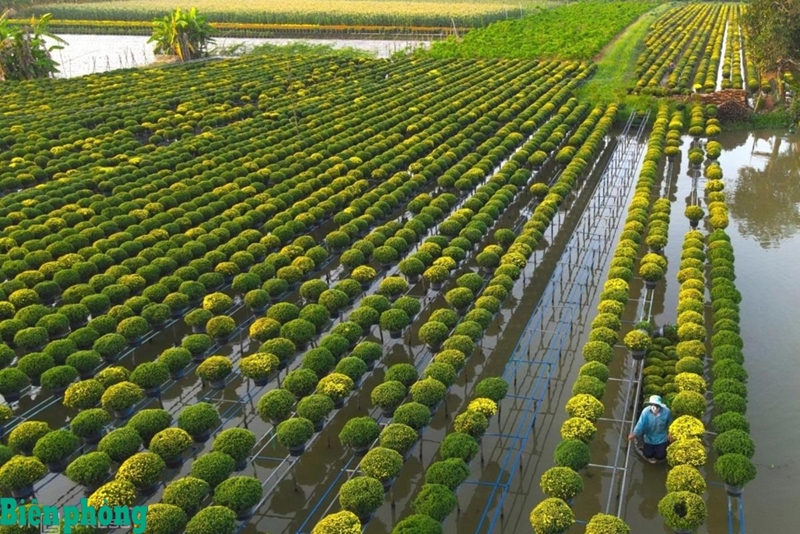
A distinctive feature of Sa Dec is its flower fields cultivated on water. |
Alongside technological upgrades, farmers are also diversifying their products. Beyond traditional flowers, many households have developed ornamental animal topiary made from ixora plants, catering to higher-end demand during the Tet season. These carefully shaped figures, such as deer, horses, buffaloes and cats, require high-level skills and long-term care. Depending on size and complexity, prices range from 5 to VND 20 million per product, providing a significant source of income and demonstrating the creative potential of the craft.
Added value through tourism
Located 150km from Ho Chi Minh City, Sa Dec has become a regional tourism hub. During the year-end season, the village transforms into a living festival. Visitors flock to the Cai Dao - Sa Nhien flower route to experience unique sights, such as flowers grown on water and boat rides through blooming beds.
By linking production with services like homestays and photography, Sa Dec has created a comprehensive value chain. Each basket of flowers blooming for Tet represents the enduring vitality of a century-old craft village successfully adapting to a modern, integrated economy.
Translated by Tran Hoai