Chairing a working session with representatives of several ministries, agencies and localities at Dong Dang railway station in Lang Son province on March 19, General Secretary Lam described enhanced rail ties as an important driver of bilateral trade ties into a new stage that is more substantive, effective and sustainable. The push follows the Party’s resolutions and is expected to inject new momentum and open up new space for national economic growth.
    |
 |
|
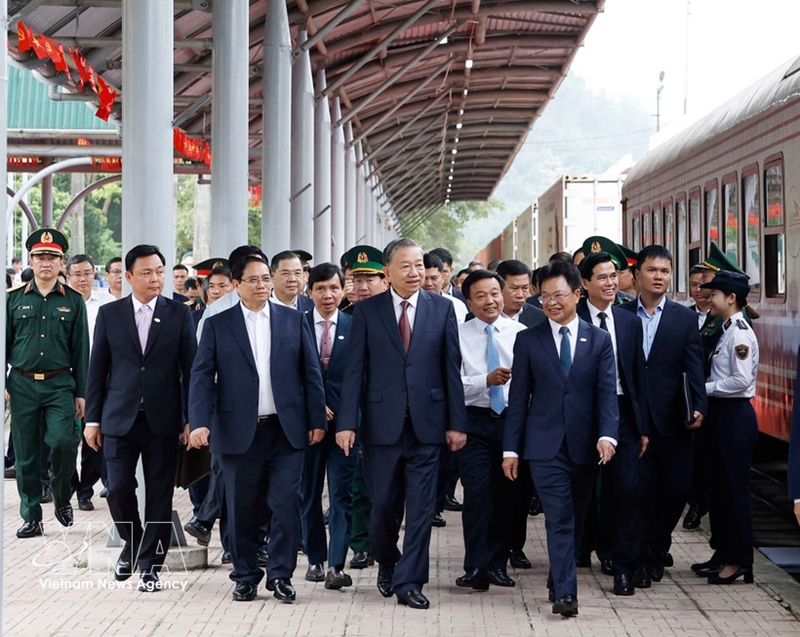
Party General Secretary To Lam, Prime Minister Pham Minh Chinh and other officials inspect the Dong Dang railway station on March 19. |
Following an on-site inspection at the station, which was also joined by Prime Minister Pham Minh Chinh, he listened to an overview report from the Ministry of Construction (MoC) regarding investment in three railway lines: Hanoi – Dong Dang, Lao Cai – Hanoi – Hai Phong, and Hai Phong – Ha Long – Mong Cai. He was also updated on the progress of relevant bilateral agreements, cross-border passenger services, and key issues raised during discussions.
Vietnam – China railway cooperation is both an imperative and a major opportunity, as well as one of the most practical and effective areas for collaboration in the coming years, he said, adding that it is a powerful lever for Vietnam to modernize infrastructure, cut logistics costs, expand global reach, and gradually build mastery of a new foundational industry.
He highlighted multiple economic payoffs from improved bilateral rail links: lower logistics costs, shorter transit times, sharper competitiveness, accelerated trade and border economic growth, enhanced customs efficiency, and relief from congestion at road border gates. Longer-term benefits include the emergence of logistics hubs, border gate economic zones and industrial clusters in frontier provinces, integration into the broader Asia – Europe rail network, thus diversifying transport options, reducing dependence on maritime shipping, creating economic corridors and regional production chains, enhancing regional economic integration, and elevating Vietnam’s standing within Asian supply chains.
On financing, he stressed the need for diversified and sustainable funding models that safeguard national financial safety. He called for the creation of a single, high-level national coordinating mechanism to oversee these flagship connectivity projects, which clearly delineates responsibilities across ministries, agencies and local authorities while providing a dedicated focal point to manage negotiations, preparation and execution from start to finish.
|
|
 |
|
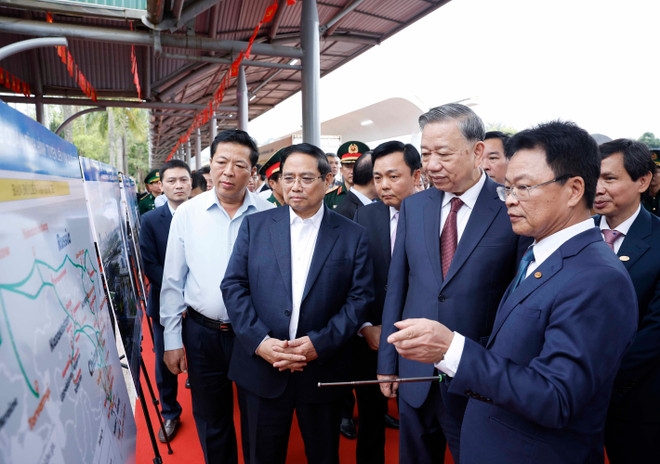
The Party and Government leaders listen to an introduction of the Dong Dang railway station. |
He added that stronger inter-sectoral coordination must ensure close alignment between transport infrastructure development and regional economic planning, logistics systems and industrial zones along economic corridors, rather than treating railway projects in isolation.
The leader ordered that strategic cooperation principles be upheld and projects must be consistent with Vietnam’s national development strategy and infrastructure planning. He also underscored the need to diversify funding sources and ensure economic efficiency, technological transparency and clear standards.
As the task is highly demanding, time sensitive and subject to high requirements, the General Secretary pushed for strong resolve and unity across the entire political system. He asked the Government Party Committee, and directly the MoC, to formulate a Vietnam–China railway development strategy as part of the broader Vietnam railway development strategy for 2026–2030, with visions toward 2045, 2100 and 2130.
Source: VNA