Nguyen Minh Phuong from the ministry’s Department of Foreign Market Development and Multilateral Trade said Israel is a key Middle East market, with a developed economy, high per-capita income and demand for a diversified import mix. It is a potential outlet for Vietnamese farm produce, food, seafood, apparel, footwear and consumer goods.
Trade ties have been growing. The Viet Nam – Israel Free Trade Agreement (VIFTA) has added cooperation room. Israel is now Viet Nam’s third largest Middle East trade partner. In 2021-2025. Bilateral trade kept rising, peaking at about 3.6 billion USD in 2025. During January-August, the figure hit 2.72 billion USD, up 9.3% year on year, with Vietnamese exports at 804.7 million USD and imports at 1.92 billion USD.
    |
 |
|
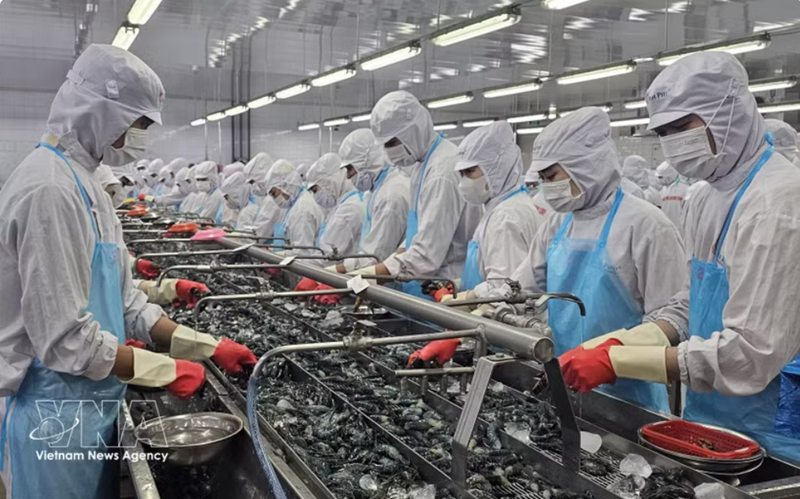
Processing shrimp for export |
As Israel is a tough market on product quality, food safety, technical standards and import rules, she urged exporters to know the conditions and meet product and regulatory requirements. Complex security and geopolitical developments in the region are also creating new challenges for trade, logistics, cargo transport and contract execution between the two countries’ businesses.
For Vietnamese companies, that means timely market intelligence, close tracking of export-import policy changes, a clear grasp of VIFTA preferences and active risk management.
The VIFTA, in force since November 17, 2024, is a new-generation FTA that gives trade and bilateral economic cooperation a more favorable framework. Tariff cuts or eliminations on many exports to Israel open opportunities in farm produce, seafood, processed food, apparel, footwear and electronics.
The deal also eases customs procedures, technical standards and certificates of origin, improving the competitiveness of Vietnamese goods. That gives companies a basis to expand market share, diversify exports and reach Israel at lower cost.
The VIFTA also facilitates investment cooperation, technology transfer and supply chain links. Using the commitments matters not only for exports but also for wider bilateral business cooperation. To capture the upside, however, companies must understand the commitments, tariff cut roadmap and eligibility conditions. Certificate-of-origin requirements and conditions for imported goods need attention when preparing documents, production and export contracts.
Phuong said the ministry will keep working with relevant agencies, the Viet Nam Trade Office in Israel and industry associations to provide market information, connect partners, push trade promotion and spread awareness of international economic integration commitments.
Le Thai Hoa, Vietnamese Trade Counsellor in Israel, said two-way trade is estimated at 4.4 billion USD this year, up 21%. Viet Nam now earns about 800 million USD a year from exports to Israel. In 2026, exports are expected at 1.3 billion USD, up 50.3%, mostly mobile phones, seafood, footwear, cashew nuts, apparel, coffee, foodstuff, processed food, spices, beverages, electronic equipment, household appliances and construction materials.
Viet Nam spends about 2.5 billion USD a year on imports from Israel, which is expected to exceed 2.6 billion USD this year, predominantly electronic components, machinery, equipment, spare parts and fertilizers.
According to him, Israel holds strengths in quality workforce, startups and innovation, and hosts R&D centers of many leading global technology corporations. Its standout fields include IT, software, automation integration, artificial intelligence, semiconductors, healthcare, biology, high-tech agriculture and new energy. Those open opportunities with Viet Nam, especially in high-tech agriculture, water management, science - technology, digital transformation, innovation, electronics, semiconductor components, technology equipment and technical workforce development.
Hoa said Israeli firms are actively seeking Vietnamese partners. Direct Israel-Viet Nam flights and the Vietnamese market’s appeal to Israeli companies are also favorable factors for trade and investment ties.
In his view, the ministry and relevant agencies should actively deliver on VIFTA and brief businesses on commitments, orient markets and encourage Vietnamese companies to visit Israel to explore opportunities. They should also uphold cooperation mechanisms such as the inter-governmental committee and joint committee under the VIFTA.
The Viet Nam Trade Office in Israel should focus on providing information, market orientation, business demand and potential products; and regularly update and disseminate Israel’s new import rules and policies. It should also promote the VIFTA to the Israeli business community and encourage Israeli companies to explore Viet Nam.
Trade promotion should also be stepped up through seminars to introduce Vietnamese goods, match Israeli buyers with Vietnamese partners, and push domestic firms to visit Israel, learn about new technologies and connect in hi-tech fields.
Beyond rules of origin, companies must meet other standards and rules, especially food certification or products fully compliant with strict Jewish dietary laws. They should also stay in contact with the Viet Nam Trade Office and embassy in Israel for support and advice when needed, he added.
Source: VNA