Presenting the Government’s report, Minister of Finance Ngo Van Tuan said that a decade on, the existing law has laid a legal foundation for enterprise support but many policies have missed their mark. Support mechanisms remain fragmented, spread too thin, and disconnected from actual business needs. Barriers to access persist, and post-support evaluation is ill-defined.
    |
 |
|
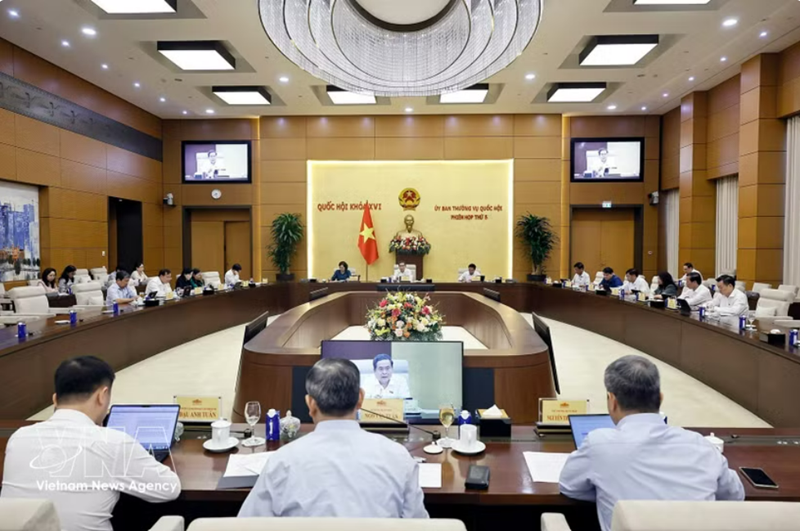
The N.A. Standing Committee's session on August 28 |
The law’s new name signals a policy pivot from “supporting businesses” to “creating conditions for development,” aligning with Party and State directives and international norms, Tuan said.
The five-chapter, 35-article draft introduces fundamental breakthrough policies. It replaces broad-based assistance with targeted, time-bound support tied to measurable outcomes along an upgrade path, from business households to micro, small, medium, and large enterprises. Success will be gauged not by beneficiary headcount but by capacity to absorb support and subsequent growth.
It moves toward data-driven administration, accelerating digitization and data sharing through the stages of securing, launching, monitoring and evaluating support. It also shifts from direct State aid to comprehensive ecosystem building, with the State pooling resources, sharing risk, and connecting universities, research institutes, funds, incubators, and large firms. Support will follow demand via vouchers, commissioned services, or assigned tasks.
The draft sets out two policy tracks, including general support clearing bottlenecks in capital, premises, technology, and markets; and targeted support for high-potential groups capable of creating breakthroughs, such as innovative startups, value chain stakeholders, sustainable enterprises, and business households transitioning to formal status.
Chairman of the N.A. Committee for Economic and Financial Affairs Phan Van Mai backed the bill in a preliminary appraisal.
On tax, accounting, technology, and digital policy, Mai urged that SME incentives be codified under specialized tax law to maximize preferential treatment. He called for feasibility review of production premises support to ensure alignment with land and public asset rules. For venture capital and startup support, the draft must define fund eligibility and, where State capital is involved, clarify authority, oversight, risk-sharing, and capital protection.
On public procurement, he flagged commissioning and direct contracting mechanisms for SMEs, demanding safeguards against bid-rigging, procurement delays, and breaches of international commitments. For business households formalizing, he supported lower market-entry costs but sought clarity on beneficiary criteria, support duration, and funding sources.
The appraisal agency stressed that the law must enshrine openness and transparency, avoiding new red tape or discretionary “ask-and-give” mechanisms. Responsibilities across ministries, agencies, and localities must be explicit, with data sharing mandatory to prevent firms from resubmitting information the State already holds.
Source: VNA