Speaking at the event, Acting Editor-in-Chief of Thoi bao Ngan hang (Banking Times) Nguyen Xuan Hai said cashless payments are becoming increasingly common in commerce, services, healthcare, education, public services and production and business activities.
    |
 |
|
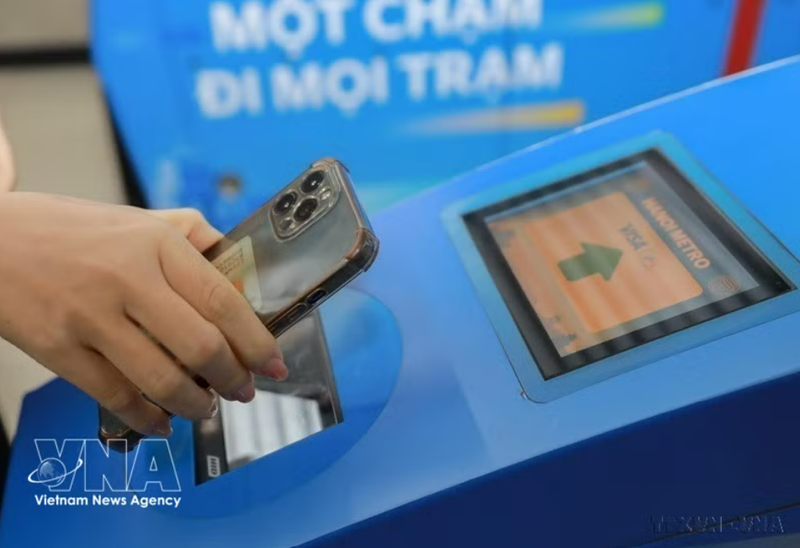
The automatic ticketing system that uses electronic identification, authentication, biometric recognition and cashless payment for passengers on the Cat Linh - Ha Dong railway line in Hanoi. |
The development of payment infrastructure and digital payment methods not only makes transactions more convenient but also expands access to formal financial services, he said.
Cashless payments are a key pillar of the National Financial Inclusion Strategy for 2026-2030, as they serves as a “bridge” enabling people and businesses to gain deeper access to the financial ecosystem, from payment accounts to savings, credit, insurance, and other suitable financial products, he noted.
Nguyen Thi Thu, Deputy Director of the Payment Department under the State Bank of Viet Nam (SBV), said digital transformation is changing how people and businesses access banking and financial services.
Digital payments are increasingly becoming the first point of entry for people to familiarize themselves with and gradually make greater use of other financial services, she said.
According to her, cashless payments can be viewed from four aspects: opening the gateway to financial services, removing geographical and cost barriers, generating financial data, and improving transparency and security.
As users become familiar with basic transactions, they can gradually access services such as savings, investment and insurance without relying heavily on physical transaction points.
Cashless payments continued to grow rapidly in the first eight months of 2026. The number and value of cashless transactions rose 34.56% and 13.26% year-on-year, respectively, while online transactions increased 46.57% in number and 21.77% in value.
Mobile payments rose 35.33% in number and 23.9% in value. Notably, QR payments at payment-accepting units increased 6.66% in number and 25.85% in value.
Account coverage has also expanded significantly. By the end of 2025, 88.96% of adults had payment accounts, while the total value of cashless payments was equivalent to about 28 times GDP. The figures are approaching the 2030 targets of 95% of people aged 15 and above having transaction accounts and cashless payment value reaching 30 times GDP.
However, Thu said the next phase should shift the focus from quantity to quality, with access accompanied by convenience, transparency, reasonable costs and regular use.
Nguyen Thanh Tung, Deputy General Director of the National Payment Corporation of Viet Nam (NAPAS), said financial inclusion can begin with everyday needs such as transferring money, paying for goods and services, electricity and water bills, tuition, medical fees and public services.
When such transactions can be carried out conveniently online, people gradually develop the habit of using accounts and formal financial services.
“The success of financial inclusion is not measured only by the number of accounts opened, but more importantly by whether they are used conveniently, regularly and meaningfully in daily life,” Tung said.
According to him, shared payment infrastructure plays an important role in this process as it helps connect people, banks, businesses and service providers, while also reducing the cost of individual connections and making it easier to expand services to rural areas, remote regions and underserved customer groups.
NAPAS currently connects 70 member institutions and processed about 12 billion transactions in 2025, serving 100 million customers through a network of more than 20,000 ATMs and over 930,000 POS/mPOS terminals, he said.
Source: VNA