By 2030, the seaport system of Ho Chi Minh City (after the administrative merger with Binh Duong and Ba Ria - Vung Tau) will need to handle between 440.8 million and 531.8 million tons of cargo, according to forecasts.
    |
 |
|
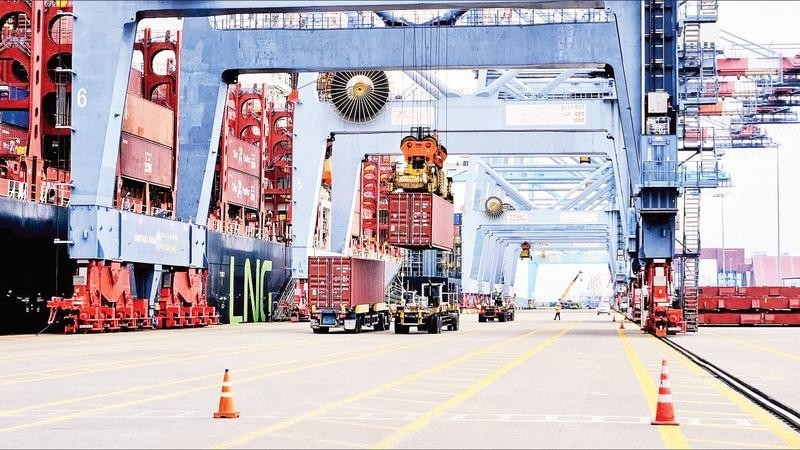
A view of Cai Mep - Thi Vai port |
As the Government is adjusting the national master plan for 2021–2030 with a vision to 2050, which sets a target of sustained double-digit economic growth (over 10%) during 2026–2030, cargo volumes passing through the city’s seaports are expected to rise even further.
Mai Trung Hung, Deputy Director of the municipal Department of Construction, said the Cai Mep - Thi Vai port area now mainly operates as a gateway port. Nearly 96% of container throughput is Vietnam’s import-export cargo, while just over 4% is international transshipment cargo, mostly destined for Cambodia via the Tien and Hau rivers.
The port complex has seen its navigation channel from Buoy No.0 to the Cai Mep container terminals upgraded to a depth of 15.5 meters, the deepest in the country, allowing vessels of 160,000–200,000 DWT to operate safely without dependence on tides.
In 2024, total cargo throughput at the port cluster reached 152 million tons, accounting for about 34% of the nation’s total container volume.
With these advantages, Ho Chi Minh City has been striving to raise the share of international transshipment cargo there. The target is to reach 10% by 2030, and 2025% during the 2030–2050 period.
In reality, most cargo handled at Cai Mep - Thi Vai originates from the city and the southern key economic region. Local industrial parks, export processing zones and distribution centers are the decisive “input” sources underpinning the vitality of the port cluster.
Given this, the city has outlined a series of major plans and orientations, including developing regional-level logistics centers, forming networks of warehouses and satellite inland container depots, accelerating supply-chain digitization, and reforming customs procedures.
At the same time, it is investing in transport infrastructure connecting to the port complex to maximize the efficiency of multimodal transport by sea, road and rail, thereby generating higher added value for the logistics system. Currently, the inter-port road and direct road connections from Cai Mep - Thi Vai to National Highway 51 are in operation, alongside other routes linking with other localities in the region under investment.
In addition, an inland waterway transport and logistics corridor in southern Vietnam linking the Mekong Delta with Cai Mep, funded by the World Bank, is being implemented.
According to the municipal Department of Construction, investment in the Can Gio international transshipment port project has been approved in principle by the Prime Minister. Once constructed and put into operation, together with the completion of the Cai Mep Ha terminals, the two port areas will complement each other in forming a gateway port system capable of competing with major seaports in Asia and worldwide.
Assoc. Prof., Dr. Nguyen Ngoc Vinh, Deputy Director of the Institute for Regional Development Research and Consulting under the University of Economics Ho Chi Minh City, noted that connectivity among Can Gio, Cai Mep - Thi Vai and Vung Tau will create an integrated coastal economic corridor combining production, logistics, services, tourism and energy.
As global trade undergoes strong restructuring, this opportunity needs to be seized and fully leveraged, with top priority given to turning Cai Mep - Thi Vai into a regional transshipment hub. This is not only a comprehensive challenge for the southeastern region but also for Vietnam’s entire economy within the global maritime value chain, he opined.
Source: VNA