In December alone, shrimp exports reached nearly 336 million USD, up 3.1% from November, while tra fish exports levelled off at just over 182 million USD. Notably, exports of molluscs recorded a dramatic year-on-year surge of 296% in December to around 2 million USD. By contrast, tuna exports fell sharply in the final month of the year, plunging 33.3% to 57 million USD, while exports of other fish species declined 8% to 156.5 million USD.
    |
 |
|
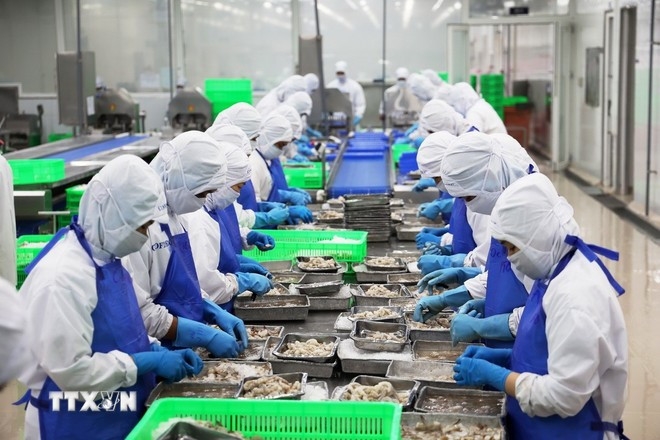
An export shrimp processing line in Ho Chi Minh City |
For the year as a whole, shrimp remained a pillar of growth, generating 4.65 billion USD in export revenue, nearly 20% higher than in 2024 and accounting for about 41% of the sector’s total export value.
Tra fish exports remained relatively stable, earning 2.19 billion USD, up 8.1% year-on-year. Exports of other fish species showed a sharp reversal, with strong growth early in the year and declines by year-end, reaching 2.16 billion USD in total. Tuna faced the steepest headwinds in 2025, with exports weakening through the year and totaling 913 million USD. Meanwhile, exports of molluscs, though modest at around 15 million USD, maintained a steady growth rate of nearly 20%.
Le Hang, VASEP Deputy General Secretary, attributed the sector’s momentum partly to global market instability, which has fueled stockpiling behavior amid concerns over rising food prices. This trend has driven both consumers and businesses in many countries to boost imports, including aquatic products.
Free trade agreements (FTAs) that have entered stable implementation have also continued to serve as a critical lever, enabling Vietnamese aquatic exports to gain breakthroughs in key markets under the Comprehensive and Progressive Agreement for Trans-Pacific Partnership (CPTPP), the E.U. - Vietnam FTA, and the Regional Comprehensive Economic Partnership (RCEP), helping offset difficulties in certain major markets.
Vietnamese enterprises have demonstrated proactiveness and flexibility in responding to market volatility. By identifying risks associated with unfavorable tariff timelines, anti-dumping duties, and the U.S. Marine Mammal Protection Act (MMPA), businesses adjusted export plans, market focus, and delivery schedules to minimize adverse impacts.
As the U.S. market faced heightened uncertainty from tariffs and technical barriers, Vietnam’s aquatic exports underwent a clear shift in market structure. The CPTPP bloc remained a major growth driver, supported by tariff advantages and the stability of markets such as Japan, Canada, and Australia. In 2025, exports to CPTPP markets reached 3.07 billion USD, up 22% year-on-year.
China, including Hong Kong, recorded the strongest growth among Vietnam’s key markets, with export turnover rising 29% to 2.45 billion USD. Meanwhile, exports to the E.U. totaled nearly 1.2 billion USD, up 12.5% from 2024, as demand gradually recovered.
Although exports to the U.S. plunged by as much as 45% in December due to tariffs and regulatory barriers, cumulative growth earlier in the year helped keep full-year exports to this market slightly higher, up 3% compared to the previous year.
VASEP Chairman Do Ngoc Tai emphasized that surpassing the 11 billion USD mark for the first time is clear evidence of the resilience, adaptability, and determination of Vietnam’s aquatic sector. However, he cautioned that 2026 is likely to remain volatile, with ongoing uncertainty in global trade, competition, and regulatory pressures, underscoring the need for sustained structural and market diversification efforts.
Source: VNA