The establishment of the center, along with a clear delineation of its mandate, is seen as laying an important foundation for public service infrastructure to support chip design, pilot production and commercialization.
Under the decision, the center operates under the Authority of ICT Industry and Communications (AITI) and is tasked with assisting the AITI Director in overseeing Vietnam’s semiconductor industry and supporting pilot chip production activities to drive sectoral growth. The center is designed to address one of the key challenges facing chip design units in Vietnam, which is the lack of comprehensive support throughout the entire pilot production process.
    |
 |
|
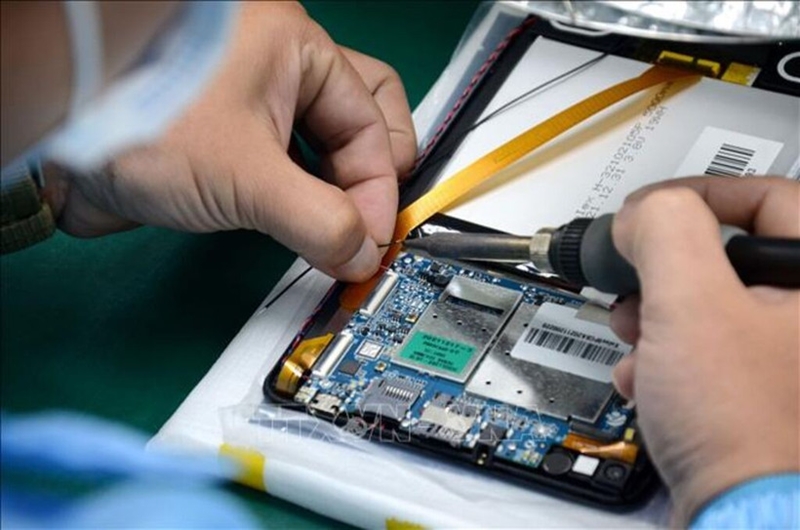
Vietnamese technology enterprises have already begun to make tangible progress in the semiconductor industry. |
Specifically, the center will provide essential infrastructure and public services to support semiconductor design and prototyping as part of Vietnam’s broader industrial strategy. Its services include support for pilot chip production; licensing access to electronic design automation (EDA) software; sharing intellectual property (IP) design libraries; technical design verification; training and testing; and other services related to semiconductor development in line with regulations.
Beyond technical support, the center is expected to play a role in fostering a dynamic semiconductor ecosystem and promoting international cooperation, thereby nurturing innovation in the field. This aligns with the Government’s broader efforts to strengthen technological capabilities and deepen Vietnam’s integration into global supply chains.
Human resources are identified as a critical pillar in Vietnam’s semiconductor development strategy, particularly as the country seeks to move beyond traditional segments such as assembly, packaging and testing into more advanced stages of the value chain. Vietnam currently has more than 7,000 skilled integrated circuit design engineers working across areas including packaging, testing, semiconductor materials and equipment. In 2025 alone, nearly 1,000 additional semiconductor design engineers were added, mainly through upskilling engineers from related fields.
However, challenges remain in scaling up training programs, expanding laboratory capacity and increasing the number of qualified lecturers and experts. Against this backdrop, workforce development has been identified as one of the center’s core missions.
The center will organize intensive, practice-oriented training courses and assist universities in chip design activities, with a view to developing a highly skilled engineering workforce for this essential industry. The center will also support start-ups and the commercialization of semiconductor products by connecting them with investment funds and national funding programs, while providing testing and performance evaluation services for chips after pilot production.
Vietnamese technology enterprises have already begun to make tangible progress in the semiconductor sector. In late December, the FPT Group delivered its first batch of power management chips to a leading Japanese electronics company via Restar, one of Japan’s top electronic component distributors. This marked the first time a Vietnamese enterprise successfully introduced commercial chips into the Japanese market, known for its stringent quality and reliability requirements.
The shipment represents a milestone for Vietnam’s chip design exports and demonstrates the potential of domestically developed intellectual property to reach wider markets across the Asia-Pacific region.
It also underscores Vietnam’s image as an emerging destination on the global semiconductor map and opening new opportunities for deeper participation by local enterprises in high-tech global value chains.
Source: VNA