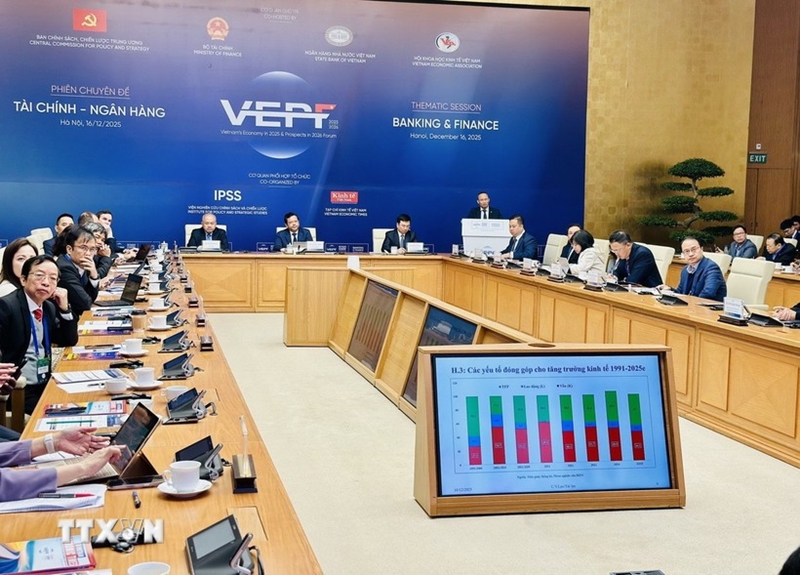
At the thematic session on finance and banking, delegates focused on solutions for financial resources and economic growth targets in the 2026-2030 period. The effective mobilization of financial resources was identified as a key prerequisite for Vietnam to realize its target of double-digit economic growth during this phase.
    |
 |
|
The thematic session on finance and banking of the Vietnam Economy in 2025 and Prospects in 2026 Forum |
In his opening remarks, Pham Thanh Ha, Deputy Governor of the State Bank of Vietnam, emphasized that the Party and the State have set a target of achieving at least 8% economic growth in 2025 and moving towards double-digit growth in the 2026–2030 period. According to the Deputy Governor, this will provide a crucial foundation for Vietnam to join the group of upper-middle-income countries by 2030 and progress towards becoming a high-income country by 2045.
He pointed out that one of the decisive challenges for achieving high growth is ensuring sufficiently large capital resources for the economy, while using them efficiently to promote a growth model driven by science and innovation.
From the perspective of budgetary management, Deputy Minister of Finance Do Thanh Trung affirmed that while mobilizing sufficient capital is a major task, allocating it to the right priorities and ensuring effective use to generate high added value must be given top priority.
At the discussion session, Dr Can Van Luc, Chief Economist of BIDV and a member of the National Financial and Monetary Policy Advisory Council, presented a paper on breakthrough solutions to mobilize financial resources for high growth in the 2026–2030 period. He noted that the development model in the coming phase needs to shift from one that is heavily dependent on capital and labor to one driven more by science, technology, innovation, and productivity.
Participants agreed that the capital market needs to be developed as the primary channel for mobilizing medium- and long-term resources for the economy, easing pressure on the banking credit system. Strengthening coordination between fiscal and monetary policies is crucial to maintaining macroeconomic stability, controlling inflation and supporting high growth amid rising risks. In addition, significant improvements in the investment and business environment, together with institutional reform and the development of a stable legal framework, were identified as solutions to attract and retain long-term, high-quality financial resources.
At the same-day session on the circular economy, Pham Dai Duong, Deputy Head of the Party Central Committee's Commission for Policies and Strategies, stressed that to realize strategic development goals, Vietnam needs a strong push to innovate its growth model. He said the new model must be sustainable, comprehensive and inclusive, focusing not only on speed but also on quality, efficiency and competitiveness. Its core lies in transformative shifts, including digital transformation to build a digital economy and digital society, and green transformation to ensure harmonious development with nature, adapt to climate change, and fulfil international commitments, particularly the goal of achieving net-zero emissions by 2050.
He affirmed that digital and green transitions are objective requirements of development. These two processes are closely interconnected and mutually reinforcing, forming a “dual transition” that will serve as a global growth driver for decades to come. He also highlighted that the circular economy, as a key driver of green transformation in the digital era and closely linked with science, technology, innovation and digital transformation, has been identified as a strategic pillar of the new growth model.
From a state management perspective, Deputy Minister of Agriculture and Environment Le Cong Thanh said Vietnam has established a relatively comprehensive orientation framework and legal corridor for the development of the green and circular economy. The merger of the Ministry of Agriculture and Rural Development with the Ministry of Natural Resources and Environment reflects a shift towards integrated management thinking based on ecological space, closely linking resources and climate, and creating an important foundation for promoting sustainable green economic development.
However, he noted that Vietnam’s green transition still faces numerous challenges, as many enterprises, cooperatives, and farmers continue to rely on traditional practices and face constraints in capital, technology, and governance capacity. Meanwhile, emerging markets such as carbon and biodiversity credit markets have yet to operate in a synchronized manner.
From an international perspective, Francesca Nardini, Deputy Resident Representative of the United Nations Development Program (UNDP) in Vietnam, said international forecasts indicate that the circular economy could help Vietnam reduce 30–34% of urban waste and cut 40–70% of greenhouse gas emissions during the 2030–2060 period, while creating jobs and reducing dependence on imported raw materials. She added that UNDP recommends implementing the circular economy through pilot models to quantify risks and benefits before scaling up.
Experts at the Forum agreed that green transformation and the circular economy represent the only viable path for Vietnam to achieve high growth in tandem with sustainable development in the digital era.
Source: VNA