To address these challenges, the General Department of Logistics and Technical Services under the Ministry of National Defense and the Military Industry-Telecoms Group (Viettel) worked with Viet Nam Electricity (EVN) to survey conditions and develop power supply plans for 201 proposed BTS locations in areas without access to the national power grid.
The sites are managed by the Northern Power Corporation (EVNNPC), Central Power Corporation (EVNCPC) and Southern Power Corporation (EVNSPC), and are spread across 16 provinces and cities. Most are located in mountainous, remote and border areas with rugged terrain, far from residential areas and existing power infrastructure. Some are even deep inside protected forests or in isolated locations, making surveys, transportation of materials and construction particularly challenging.
    |
 |
|
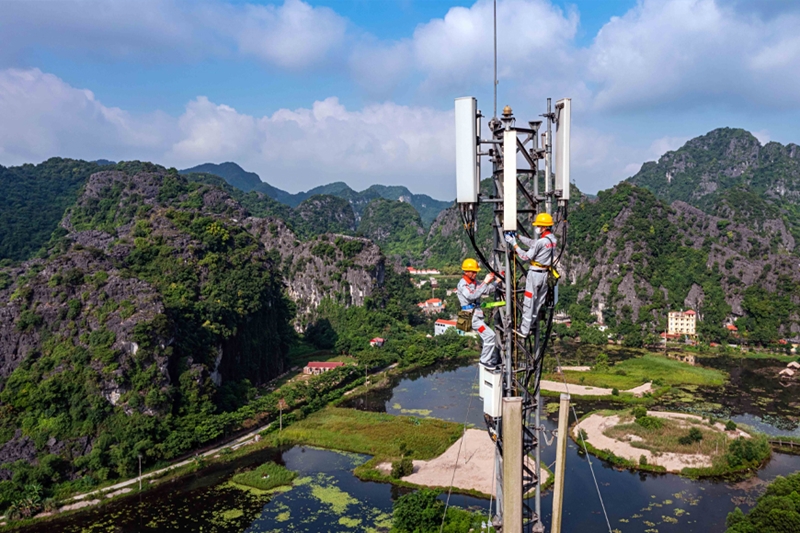
Viettel's campaign to eliminate mobile coverage gaps will bring connectivity to remote and disadvantaged areas across the country. (Photo provided by Viettel) |
Based on assessments of distances to power sources, existing grid conditions, terrain and investment capacity, the parties developed tailored power supply solutions for each site. Importantly, the plans were integrated with broader efforts to expand electricity networks in rural, mountainous and island areas, helping meet immediate needs while supporting long-term infrastructure development and more efficient resource allocation.
Following the surveys, the 201 locations were classified according to grid conditions, investment plans and power supply options. For sites near existing power lines, electricity providers identified connection points and guided Viettel in developing the lines needed to supply the stations. At locations covered by local government-funded electricity projects, power companies coordinated on construction progress and connection plans. For remote sites with difficult access or awaiting investment projects, EVN and Viettel worked together to identify on-site power solutions to ensure timely mobile coverage expansion.
As a result, all 201 BTS stations in remote, mountainous and border areas were provided with power supplies.
Beyond the number of stations installed and locations connected to electricity, the program's greatest impact lies in improving people's lives. Access to electricity and mobile connectivity enables residents in remote areas to obtain information, access market updates, use online public services, receive remote healthcare and pursue new economic opportunities. In border and island areas, improved electricity and telecommunications infrastructure also contribute to strengthening national defense and security, enhancing local management and ensuring reliable communications.
Translated by Quynh Oanh