The campaign lasts more than 220 days, from March 23 to October 31.
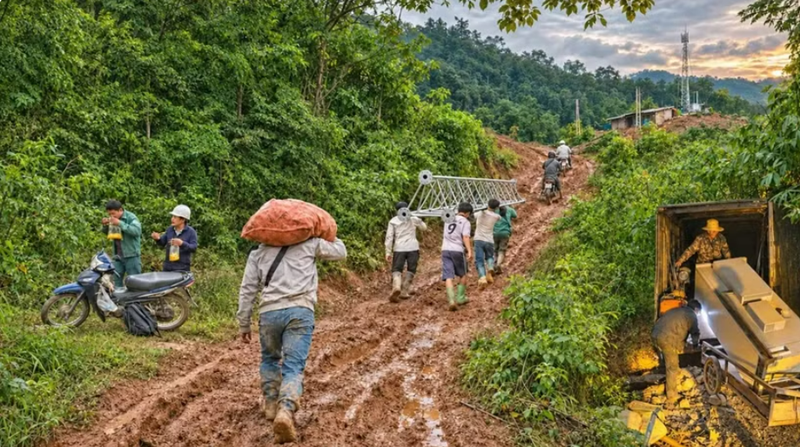
Vu Khanh Duy, Deputy General Director of Viettel Networks Corporation (VTNet), said that all 1,337 base transceiver stations (BTS) are located in mountainous areas with rugged terrain and harsh weather, posing significant challenges to construction and installation.
    |
 |
|
Workers strive to overcome challenges to expand mobile network coverage to local communities. (AI-generated design using actual photos provided by Viettel) |
Viettel has shifted from routine operations to a campaign-based approach, with unified direction from headquarters to local units.
VTNet coordinated infrastructure readiness, installation, integration and activation, while Viettel Telecom Corporation (VTT) directed its 23 provincial and municipal branches to work with contractors to complete construction and put stations into operation.
Viettel Construction Corporation (VCC) and local branches handled equipment transportation, construction, installation, power supply and transmission lines, coordinating with technical teams to activate stations immediately after installation.
Nearly 500 personnel have been mobilized for leadership, management and problem-solving support. At peak periods, 170 construction teams comprising around 1,700 workers operated simultaneously across 23 provinces and cities.
Support from Ministry of National Defense leaders, military agencies, ministries, Viet Nam Electricity and local authorities have helped resolve obstacles and accelerate implementation, Duy said.
By October 31, Viettel had activated all 1,337 BTS stations, eliminating 1,856 mobile signal-dead zones, including 788 villages and hamlets and 1,068 residential clusters with at least 50 residents each. The task was completed two months ahead of the December 31 deadline, bringing telecommunications services to around 130,000 people.
The achievement stemmed from early preparation, simultaneous implementation, flexible solutions, decisive management, experienced personnel at difficult sites and coordinated efforts involving Viettel, authorities and local residents.
In C5 hamlet of Muong Nha commune, Dien Bien province, where more than 25 H'mong ethnic minority households live on mountainsides, residents had long faced limited electricity access and difficult transport conditions. Engineers travelled half a day by car from the commune center before walking more than two kilometers through forest to reach the installation site.
Thao A Di, the hamlet head, said mobile coverage has made life easier, allowing residents to access information and contact healthcare facilities. His family has offered land for the station free of charge.
In Khau Lang hamlet of Kien Thiet commune, Tuyen Quang province, the new station, operational since October 29, has improved connectivity for 31 households with 125 residents across more than 1,000 hectares. Children can now access online learning materials while residents use online public services and entertainment content.
Duy said each additional BTS station provides more than mobile connectivity, serving as essential infrastructure for online education, healthcare, digital public services and emergency communications, including search and rescue during natural disasters.
Source: VNA