Tuan acknowledged and highly valued JBIC’s sustained contributions to Viet Nam’s socio-economic development over the years.
    |
 |
|
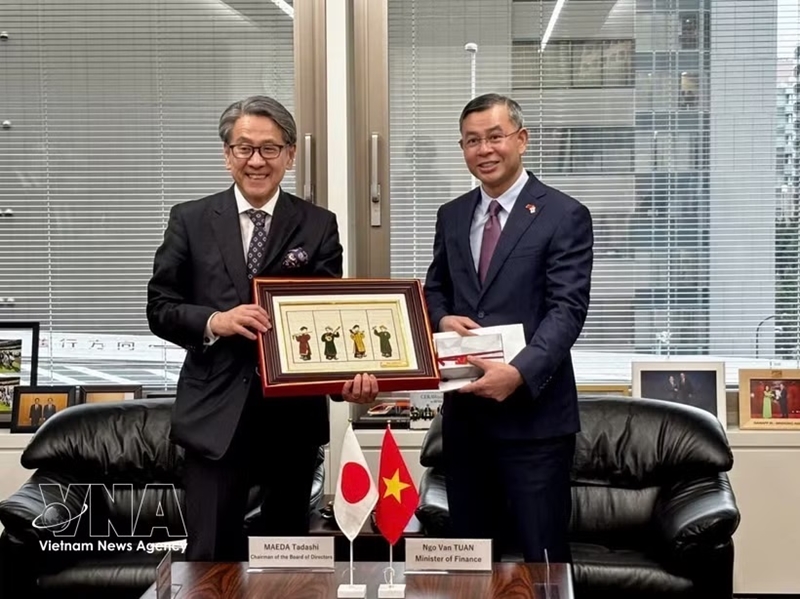
Vietnamese Minister of Finance Ngo Van Tuan (right) presents a souvenir to Chairman of the Board of Directors of the Japan Bank for International Cooperation Maeda Tadashi in Tokyo on November 10. |
The minister praised the role of the Japanese Government and JBIC in promoting the Asia Zero Emission Community (AZEC) and the Partnership for Energy and Resource Resilience in Asia (POWERR Asia).
Amid volatility in global supply chains, these initiatives offer practical ways to strengthen the economy’s adaptability and resilience. The minister called on JBIC to continue close coordination with Vietnamese agencies and Japanese partners to develop flexible financial mechanisms suited to legal regulations and practical conditions, thereby facilitating breakthrough infrastructure and energy projects with far-reaching impacts in Viet Nam, he said.
In the coming period, Tuan said Viet Nam is entering a pivotal stage of development and striving for high growth in 2026-2030. This will create substantial demand for long-term capital to develop an integrated and modern infrastructure system.
Accordingly, the Vietnamese Government has identified the development of the domestic capital market as closely linked to expanding access to funding from international financial markets. The Ministry of Finance highly valued JBIC’s standing as a leading international financial institution and expressed its wish for the bank to continue supporting Viet Nam, sharing international best practices and helping develop a modern and transparent financial market, said Tuan.
In particular, Tuan called on JBIC to continue providing advice and sharing in-depth expertise on raising funds in global capital markets, helping Viet Nam diversify funding channels, optimise costs and improve risk management.
He also suggested JBIC act as a bridge by providing insights into Japanese investors' trends and supporting Viet Nam in developing highly competitive investment attraction policies.
Tuan expected JBIC to help promote investment flows from Japan into Viet Nam, with priority given to large-scale projects in green energy, smart infrastructure, semiconductors and high-tech electronics, as well as projects with spillover effects that enable Vietnamese businesses to participate more deeply in global supply and value chains. He also expressed his hope that JBIC would support mergers and acquisitions (M&A) between businesses from the two countries.
For his part, Maeda expressed his sincere appreciation for the attention and support extended by Viet Nam’s Ministry of Finance.
He reaffirmed the bank’s commitment to continuing to work with the Vietnamese Government and the ministry, sharing experience, providing flexible financial solutions and encouraging Japanese businesses to expand their investment and operations in Viet Nam, thereby making practical contributions to the prosperity of both countries.
Earlier, from November 5 to 10, the Ministry of Finance organised a non-deal roadshow (NDR) in Japan on the sidelines of the visit of General Secretary of the Communist Party of Viet Nam Central Committee and President To Lam’s visit to the country. The program aimed to explore the possibility of issuing Vietnamese Government bonds in the Japanese market, following a similar investor engagement program in the U.S. in October 2026.
The delegation held a series of discussions and meetings with major Japanese financial institutions, banks, asset management companies and insurers. It also paid a courtesy visit and held a working session with the credit rating agency Rating and Investment Information, Inc. (R&I).
The meetings focused on the Vietnamese Government’s international fundraising plans, particularly the possibility of issuing Japanese yen bonds, known as Samurai bonds. Japanese investors expressed interest in the proposed issuance volume, maturity, timing and yield.
The NDR program is strengthening dialogue with international investors and supporting research into fundraising options suited to market conditions. It is expected to help promote Viet Nam-Japan financial cooperation, diversify funding sources and broaden Viet Nam’s international investor base.
Source: VNA