Speaking at the event, Nguyen Cong Vinh, Vice Chairman of the Ho Chi Minh City People’s Committee, said Viet Nam pursues its goal of becoming a developed, high-income country by 2045. To that end, the country is shifting its foreign investment attraction strategy from attracting large amounts of capital to prioritizing investment quality, technology transfer and stronger links with domestic businesses.
The UK has strengths complementary to Viet Nam's in financial services, capital markets, professional consulting services, education and clean energy. The two countries’ Comprehensive Strategic Partnership, established in 2025, and the U.K.–Viet Nam Free Trade Agreement provide a foundation for expanding cooperation.
    |
 |
|
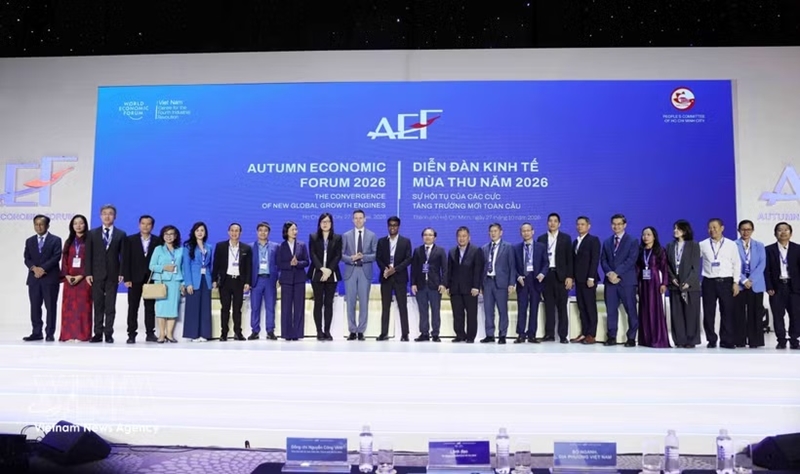
Participants pose for a group photo at a session of the Autumn Economic Forum 2026. |
Bilateral trade reached approximately 9.4 billion USD in 2025, up 11.3% year on year, he noted.
For Ho Chi Minh City, its merger with Binh Duong and Ba Ria - Vung Tau has created new development opportunities by connecting financial and service centers, industrial and high-tech hubs with seaports and logistics networks. The city aims to develop into a regional and international hub for finance, science-technology, and innovation.
It is seeking greater British investment in high-value-added sectors, including financial services, technology, research and development, and green industries, while encouraging partnerships with Vietnamese businesses in supply chains, technology transfer and management improvement, Vinh said.
Ho Chi Minh City also hopes to work with British financial institutions, credit rating agencies and businesses to develop capital markets and the International Financial Center, the official went on, adding that British expertise in market standards, risk management and international fundraising could help connect Viet Nam with global capital flows.
Other priorities include renewable energy, direct power purchase agreements, energy efficiency, eco-industrial parks, workforce training and urban planning.
The city will continue improving its investment climate, providing favorable procedural conditions and protecting investors’ legitimate rights and interests, Vinh affirmed.
British Ambassador to Viet Nam Iain Frew said the elevation of bilateral relations to a Comprehensive Strategic Partnership in 2025 has opened up a new chapter after more than five decades of diplomatic ties.
The U.K. wants to help Viet Nam integrate more deeply into the global economy, join high-tech supply chains and attract international capital, he added.
Denzel Eades, Chairman of BritCham Viet Nam, said the 2045 goal requires Viet Nam to develop a diversified and sustainable economy capable of generating greater value added. British businesses could contribute through their strengths in finance, professional services, education, pharmaceuticals and supply chains.
He also highlighted opportunities arising from Viet Nam’s developing capital market, especially the development of the Viet Nam International Financial Center.
Kim Byoungho, Chairman of the Ho Chi Minh City Development Joint Stock Commercial Bank (HDBank), said many Vietnamese businesses have strong growth potential and global ambitions, but still face difficulties in accessing international capital.
He stressed the need to improve businesses' corporate governance, transparency and communication with international investors, and to create a support ecosystem helping them better prepare for accessing global capital markets.
Stronger financial links between London and Ho Chi Minh City could expand fundraising opportunities and promote two-way investment, drawing on London’s capital market experience while developing a model suited to Viet Nam, Kim noted.
Mariam J. Sherman, World Bank Country Director for Viet Nam, Cambodia and Laos, said the growth model that has brought Viet Nam to its current position will not be sufficient for it to achieve high-income status.
During the Doi Moi (Renewal) process, Viet Nam’s GDP per capita has increased about sixfold to more than 5,000 USD, while extreme poverty has been largely eliminated. However, the country faces three major challenges: its working-age population has peaked, productivity growth remains low, and links between foreign direct investment (FDI) enterprises and domestic businesses are limited.
Sherman called for more high-quality jobs, stronger connections between markets, people and regions, efforts to turn climate risks into growth opportunities, and stronger institutional capacity.
She said Viet Nam is approaching a second major transformation: moving businesses up value chains, creating better jobs and shifting the State’s role from managing activities towards enabling development. The next phase of growth will create opportunities to move from assembly to engineering and services, replace imported energy with clean electricity, and mobilize more funding through capital markets.
Sherman also encouraged British investors to work more closely with Vietnamese suppliers and help domestic businesses meet governance, environmental and labor standards. Investment in local capabilities and policy dialogue will strengthen links between FDI and domestic firms, enabling Viet Nam to engage more deeply in global value chains.
Source: VNA