The forum, themed “Shaping the Future Green Economy & New Value Chains,” was jointly organized by the Ministry of Industry and Trade, the E.U. Delegation to Viet Nam, the E.U.-ASEAN Business Council (E.U.-ABC) and the European Chamber of Commerce in Viet Nam (EuroCham).
    |
 |
|
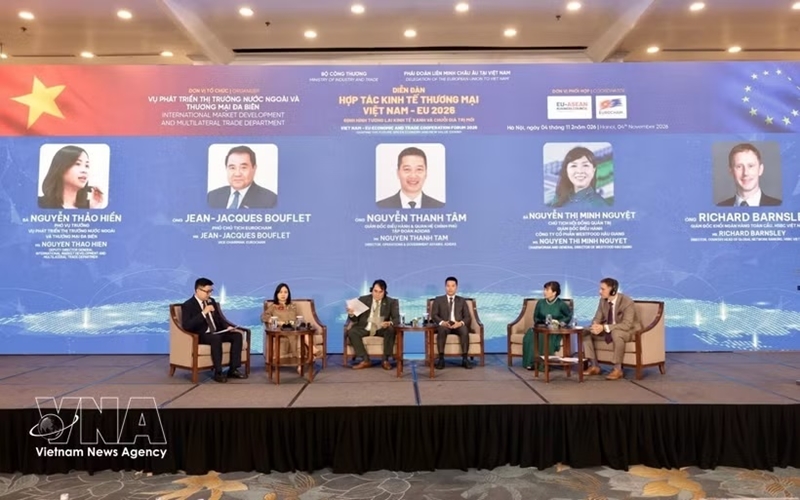
Speakers at a discussion on prospects for cooperation in developing new value chains in the context of a changing global landscape |
In his remarks Deputy Minister of Industry and Trade Luong Hoang Thai said the ninth edition of the forum serves as an effective channel for regular exchanges between government agencies and business communities on policies, market development, trade connectivity and investment.
Viet Nam is pursuing major strategic economic goals, including maintaining macroeconomic stability, achieving average annual GDP growth of at least 10% during 2026-2030 and becoming one of the world's 30 largest economies by 2030, he noted.
The year 2026 marks a new chapter in Viet Nam-E.U. relations following their elevation of bilateral ties to a Comprehensive Strategic Partnership. Together with the Viet Nam-E.U. Free Trade Agreement (EVFTA), the upgraded ties provide a solid foundation for more substantive and effective trade and investment cooperation.
More than six years after the EVFTA took effect, bilateral trade has maintained positive growth. Two-way trade surpassed 65 billion USD in the first nine months of 2026, up nearly 20% year on year.
The E.U. is Viet Nam's fourth-largest trading partner, third-largest export market and sixth-largest import market, while Viet Nam is the E.U.'s largest trading partner in ASEAN and its ninth-largest goods supplier.
Thai said Viet Nam hopes the E.U. will remain a key export market and become a strategic partner in trade upgrading, industrial linkages, economic autonomy and the adoption of higher sustainability standards.
He added that Viet Nam seeks to increase exports of technology-intensive, deeply processed and high-value-added products while importing advanced machinery, equipment, materials, green technologies and circular energy solutions from Europe.
Given the E.U.'s technological strengths, management expertise and financial resources, Viet Nam called on European partners to expand technical assistance, technology transfer and investment in green, digital and energy transitions and circular economy projects. It also expects the E.U. to translate commitments under the Just Energy Transition Partnership (JETP) into concrete financial and technological support.
E.U. Ambassador to Viet Nam Julien Guerrier reaffirmed that Viet Nam is a strategic partner of the bloc, saying the upgraded relationship has generated fresh political momentum.
He stressed that the full and effective implementation of the EVFTA is essential to unlocking cooperation potential, particularly through fair market access and a stable, transparent and predictable business environment.
The E.U. supports Viet Nam's efforts to improve law enforcement, shift from pre-inspection controls towards risk-based management, and ensure more consistent implementation of regulations across localities, he said. Such reforms would strengthen investor confidence, reduce costs and attract high-quality European investment.
Guerrier highlighted cooperation opportunities in renewable energy, circular economy, sustainable manufacturing, aerospace, seaports, airports, logistics, semiconductors, digital transformation, strategic minerals, healthcare, biotechnology and high-tech agriculture.
Noel Clehane, Vice Chairman of the E.U.-ABC, said Viet Nam is well positioned to attract a greater share of E.U. investment, manufacturing, technology and business partnerships in ASEAN, but should focus on high-quality, long-term investment that generates greater added value.
European investment could bring advanced technologies, expertise, workforce development and stronger links with Vietnamese enterprises, helping the country integrate more deeply into regional and global value chains, he said.
Participants also highlighted cooperation in the energy sector. Trinh Quoc Vu, Deputy Director of the Electricity Authority of Viet Nam under the Ministry of Industry and Trade, said Viet Nam's net-zero target by 2050 and ambitious economic growth goals are placing greater demands on energy security.
He called on European businesses to participate more actively in implementing the revised Power Development Plan VIII through investment in power generation and grid infrastructure, technology provision, technical solutions and international financing.
Viet Nam also hopes to work with European partners to develop renewable energy supply chains, particularly for offshore wind power, to meet domestic demand and serve export markets, he added.
Source: VNA