The remarks were made by leaders of the E.U.-ASEAN Business Council (E.U.-ABC) and the European Chamber of Commerce in Vietnam (EuroCham) at the Viet Nam-E.U. Economic and Trade Cooperation Forum held in Ha Noi on November 4, as well as in interviews with Vietnam News Agency reporters on the sidelines of the event.
According to Vice Chairman of E.U.-ABC Noel Clehane, Viet Nam has established a considerable manufacturing and export base, giving it an advantage in attracting investment from European corporations. However, amid the restructuring of global supply chains, the key objective is not merely to attract more investment, but also to enhance the quality of investment and the value it generates.
    |
 |
|
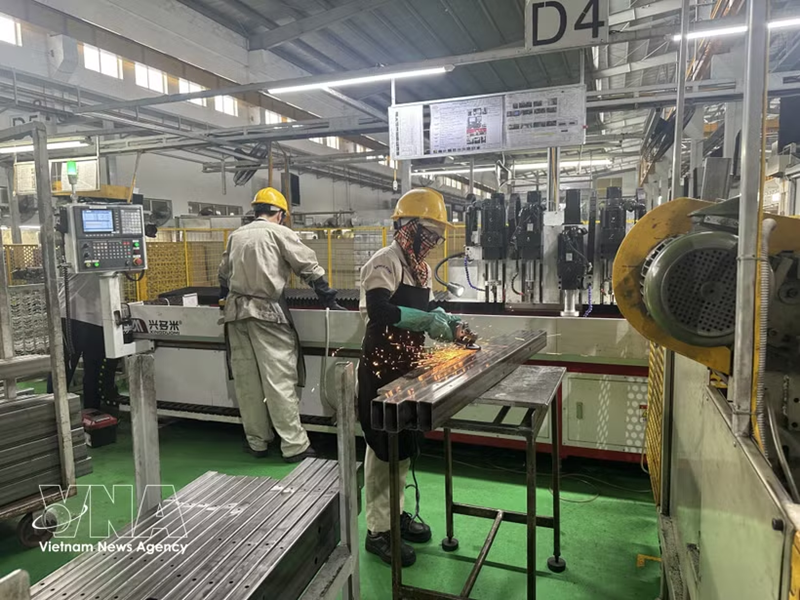
At a workshop of Viet Nam Precision Industrial No.1 Co., Ltd. |
European investment, he noted, could bring not only capital but also advanced technologies, management expertise, human resource development and stronger links with domestic businesses, enabling Viet Nam to engage more deeply in regional and global value chains.
Clehane highlighted renewable energy as one of the most promising areas for cooperation, noting Europe's strengths in wind and solar power technologies, battery storage and electricity grid systems for green energy distribution. He said Viet Nam could benefit from European companies' technologies and experience in these areas.
Other potential fields include high-tech manufacturing, the aviation industry, biotechnology, medical equipment and pharmaceuticals, he added.
Commenting on the elevation of Viet Nam-E.U. ties to a Comprehensive Strategic Partnership, Clehane offered a practical perspective from the business community. He said the upgrade sends a positive signal of both sides' political commitment to promoting trade and investment. Stronger dialogue between policymakers, regulatory cooperation, and harmonized standards could create more favorable conditions for businesses.
He also highlighted the E.U.'s Global Gateway initiative, which could support infrastructure projects such as roads, bridges and airports, thereby helping attract further investment to Viet Nam.
Meanwhile, Vice Chairman of EuroCham Torben Minko said European investors remained highly confident in Viet Nam's short- and long-term prospects.
Citing EuroCham's latest Business Confidence Index (BCI) survey, Minko said 90% of participating businesses are willing to recommend Viet Nam as a place to do business or invest in, while 23% have a long-term investment horizon of more than 20 years.
However, positive sentiment does not mean that existing obstacles have been removed. On average, businesses face eight challenges in their operations, while some enterprises significantly affected by regulatory changes encounter as many as 27 administrative barriers, according to the survey.
Minko outlined three priorities for Viet Nam to attract more European investment: streamlining and digitalizing administrative procedures; developing skilled workers, especially for renewable energy and high-tech industries; and improving access to green energy.
Regarding exports, he noted that European consumers increasingly favor high-quality, environmentally friendly products that meet sustainability standards. Vietnamese businesses should therefore strengthen compliance with environmental, social and governance (ESG) standards and keep abreast of E.U. regulations.
He also highlighted direct cooperation with European companies as a way to strengthen the capabilities of Vietnamese suppliers through production assessments, technical advice, technology transfer and joint research and development.
Small businesses also need technical and financial support to meet traceability requirements, improve production processes and enhance energy efficiency, he said.
Source: VNA